 Property
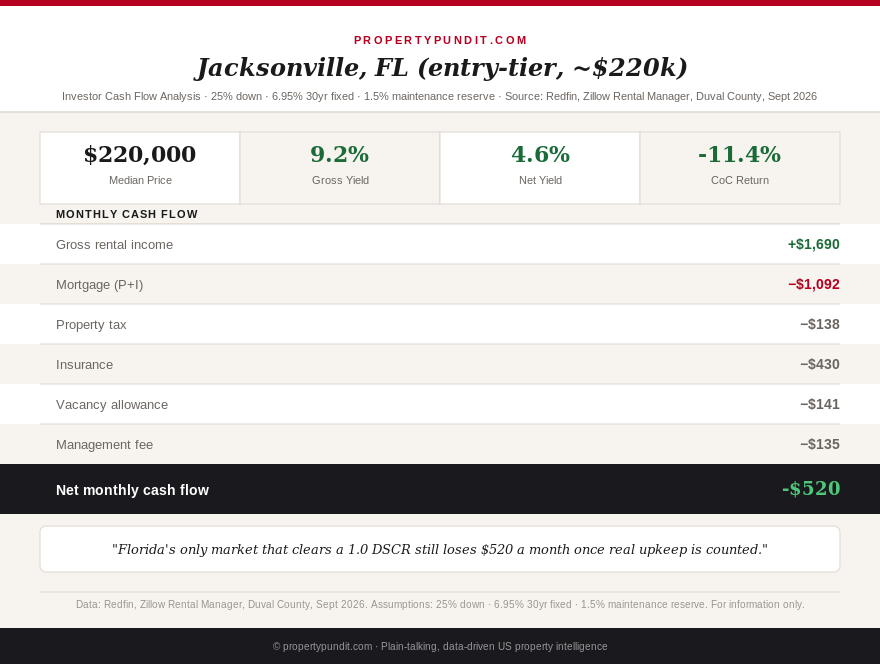
Jacksonville's entry-level housing stock, roughly $220,000 and under, is the only price point in Florida that still clears a 1.0 debt service coverage ratio for a single-family rental at today's 6.95% mortgage rate. That is the good news. The bad news is that DSCR only measures whether rent covers the mortgage, property tax, and insurance. Add the management fee, vacancy allowance, and maintenance reserve that any real landlord actually pays, and that same property runs about $520 a month negative.
This is a third look at Florida for PropertyPundit, following a first pass in May 2026 and a second in July. Two things changed since July: the mortgage rate climbed from 6.49% to 6.95%, and this site adopted a stricter underwriting standard that includes a 1.5%-of-price annual maintenance reserve, a line the July pass left out entirely. Isolating the two effects: the rate increase alone costs this deal about $50 a month. The missing maintenance line accounts for the other $275. The reserve, not the Fed, is doing most of the damage to the number Florida investors have been quoting each other.
Statewide, Florida's median sale price sits at $383,403, up a modest 0.9% year over year, with 6 months of supply and homes taking a median 73 days to sell, both signs of a market that has cooled from its pandemic-era pace without collapsing. Underneath that calm headline, every major metro tells a different, harder story once you actually run the numbers on owning a rental there.
Get this in your inbox every Friday.
One email. The number that matters and what it means for you.
Jacksonville: the only deal that comes close
Jacksonville's citywide median is $308,890, up 2.8% year over year, with homes selling in a median 57 days, eight days faster than a year ago. At that median price, 25% down, and 6.95%, the numbers don’t work: DSCR comes in at 0.78 and the property loses $1,128 a month after mgmt, vacancy, and maintenance.
The entry-level tier is a different story, and the only bright spot in this entire analysis. At $220,000, the same 25% down and 6.95% rate produce a mortgage payment of $1,092, property tax of $138 (Duval County's 0.75% effective rate), and insurance of $430 a month. Against a market rent of $1,690, that’s a DSCR of 1.02, just above the 1.0 line most DSCR lenders require. Once you subtract an 8% management fee, one month of vacancy spread across the year, and a 1.5% maintenance reserve, net cash flow lands at -$520 a month. Before the maintenance reserve, it was a much more forgivable -$245. The lesson generalizes well beyond Florida: a property can clear a lender's DSCR minimum and still lose money every month, because DSCR was never designed to measure real cash flow.
Tampa's 10% jump deserves a second look
Tampa's median sale price is $478,683, up a striking 10.0% year over year, the fastest appreciation of any major Florida metro in this analysis and one worth treating with some caution. Redfin's own reporting on comparable Sun Belt metros this year has repeatedly shown outsized headline appreciation numbers driven by a jump in luxury closings rather than broad-based gains across the price spectrum, and a 10% swing in three months of data is large enough to raise that same question here. Whatever the true median trend turns out to be, the investment math at today's advertised price is unambiguous: DSCR of 0.68 and a loss of $1,992 a month, the worst dollar loss of any market except Miami.
Orlando and the state average land in the same place
Orlando's median actually fell 1.2% year over year to $414,726, the only market here posting a year-over-year decline, yet its investment math looks almost identical to Tampa's: DSCR 0.68, cash flow -$1,727 a month. A falling price alone doesn’t fix a deal when insurance and property tax eat most of the rent before the mortgage payment even applies. The statewide average, $383,403, sits in the same range: DSCR 0.65 and a loss of $1,862 a month, confirming that Florida's overall investor math hasn’t meaningfully improved since the second-pass warning issued in July.
Miami: the insurance bill alone exceeds most mortgages
Miami is the extreme case. At a $649,570 median, Miami-Dade's 1.94% effective property tax rate, the highest in the state, adds $1,050 a month on top of a $1,344-a-month insurance bill, itself the product of coastal wind and flood exposure that no statewide reform has fully solved. Combined, tax and insurance alone cost more than the entire mortgage payment on Jacksonville's median home. The result is a DSCR of 0.52 and a monthly loss of $4,004, by far the worst number in the state and a reminder that Miami's rental math is driven almost entirely by carrying costs, not by the mortgage rate of the week.
Insurance got cheaper. It wasn’t the problem.
Florida's home insurance market genuinely improved this year. Citizens Property Insurance, the state-run insurer of last resort, cut rates by a statewide average of 8.7% at spring 2026 renewals, with Miami-Dade policyholders seeing roughly 14% reductions and 17 new private insurers entering the market after 2023-2025 tort and litigation reforms. That is real relief for existing owners and a genuine reason insurance premiums in this analysis are lower than they would have been two years ago.
It hasn’t been enough to fix the investment math, because insurance was never the only obstacle. A 0.46-percentage-point rate increase since July and a maintenance reserve line that should have been there all along did more damage to Florida cash flow this year than the insurance reform did good. Readers shopping Florida condos specifically should also budget separately for the Structural Integrity Reserve Study mandate that took full effect January 1, 2026: buildings three stories or taller and at least 30 years old can no longer waive reserve funding for structural components, and several Miami-area buildings have issued special assessments well over $100,000 per unit. None of the single-family numbers above include that risk, because it’s specific to condo and co-op ownership, but it belongs in the math for anyone considering a Florida condo as a rental.
What this means for you
If you already own Florida rental property, this isn’t a signal to panic-sell; homes purchased years ago at lower prices and rates aren’t subject to today's financing math. If you are shopping for a new Florida rental purchase, Jacksonville's entry-level tier is the only price point in the state worth underwriting seriously, and even there, budget for a real loss in the first years rather than the break-even or modest-profit number a lender's DSCR calculation implies. Anywhere else in the state, at today's rate, the numbers say wait for either a meaningfully lower price or a meaningfully lower rate before this math works as a cash-flowing rental rather than an appreciation bet.