 Property
You've watched Connecticut show up on every "hottest housing market" list this year, Hartford ranked the number one growth market in the country by Realtor.com, and it's tempting to assume that means an easy investor win. Run the actual numbers and the picture is a lot less generous: not one of Connecticut's three biggest cities clears positive cash flow once you price in the state's genuinely punishing property tax system, and the city that looks cheapest on paper is quietly the worst deal on the list.
Connecticut's statewide median home price hit $473,297 in July 2026, up 5.2% year over year (Redfin, July 2026), with a separate tracker putting it closer to $483,000 (Zillow, 2026). Active inventory sat at 10,207 homes, down 2.4% year over year, tight by national standards. Connecticut's property tax runs on a mill-rate system applied to 70% of a home's fair market value, and the state carries one of the three highest effective property tax rates in the country (Tax Foundation, 2026). That mill rate varies enormously by city, from Hartford's punishing 74.29 mills down to New Haven's comparatively modest 43.88, and that single number does more to decide whether a Connecticut rental works than the purchase price does.
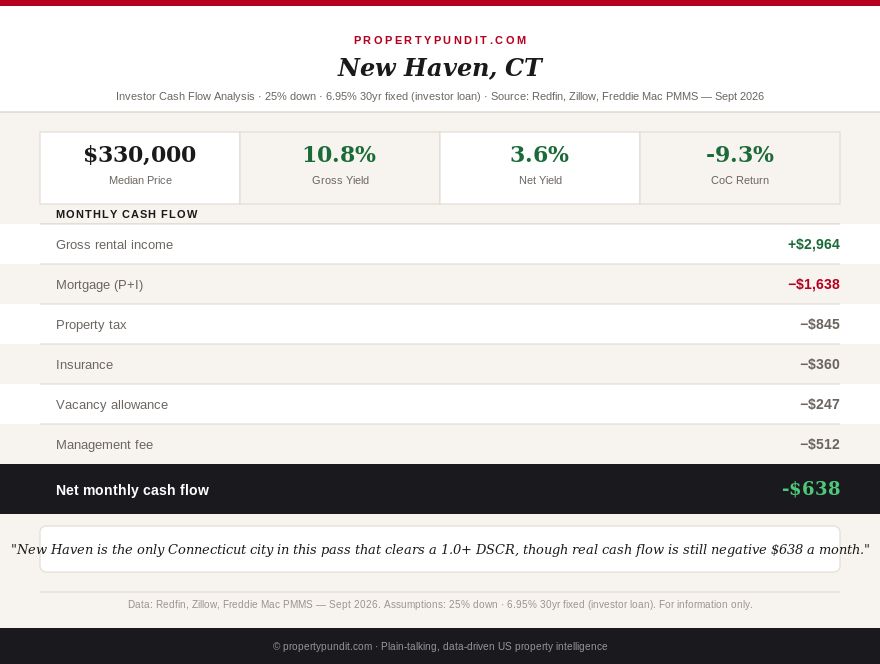
New Haven: the closest thing to a working deal
New Haven's price itself is a case where two sources disagree and it's worth naming both: Redfin's most recent city-level read put the median sale price at $340,000 (November 2025, down 4.2% year over year), while Zillow's fresher figure shows $323,843 (June 2026, up 4.3% year over year), a nearly opposite trend line from the same market. This analysis uses a $330,000 midpoint given the conflicting signals. On that price, with 25% down and a 6.95% investor loan, the mortgage runs about $1,638 a month. New Haven's 43.88 mill rate, the lowest of the three cities, works out to an effective 3.07% property tax rate, adding about $845 a month; moderate coastal insurance (New Haven sits on Long Island Sound, though less exposed than Bridgeport) adds roughly $360. Add an 8% management fee, a one-month vacancy allowance, and a 1%-of-price maintenance reserve, and total monthly costs land at $3,602. Against a 3-bedroom rent of about $2,964 (RentCafe, September 2026), New Haven clears a 1.04 DSCR, a genuine pass, but the actual cash flow still comes out to negative $638 a month.
So what for you: New Haven is the one market here where the gap between a lender's DSCR pass and your actual bank account is small enough that a modestly better insurance quote or a slightly higher rent could plausibly close it, which makes it the most realistic starting point of the three if you're determined to invest in Connecticut.
Hartford: the cheapest price and the worst deal
Hartford is where the math gets genuinely deceptive. Zillow's home value index for Hartford averages just $203,792, up 1.9% year over year, a figure that includes the city's large stock of lower-value multifamily and distressed properties. But Redfin's sale-price data, which tracks what homes actually close for, put Hartford's median at $324,000 in March 2026, up a striking 17.2% year over year. An investor pricing a Hartford purchase off the lower Zillow number would be underbudgeting by roughly $120,000 against what a competitive offer actually requires.
Worse, Hartford carries Connecticut's highest mill rate at 74.29, which works out to an effective property tax rate of 5.20% of value, the steepest of any city modeled here. On the realistic $324,000 purchase price, the mortgage runs about $1,608 a month, property tax adds roughly $1,404 a month on its own, more than the mortgage payment itself, and inland insurance adds about $313. With management, vacancy, and a maintenance reserve layered on, total monthly costs hit $3,987 against a 3-bedroom rent near $2,400 (Zillow, September 2026), a monthly loss of about $1,587, with a DSCR of just 0.72. So what for you: don't let a low Zillow average talk you into treating Hartford as the state's discount play; the real acquisition cost and the state's worst mill rate combine to make it the least investable of the three cities, not the best.
Get this in your inbox every Friday.
One email. The number that matters and what it means for you.
Bridgeport: coastal insurance stacks on top of the mill rate
Bridgeport's $368,133 median price (Zillow, up 5.1% year over year) sits between the other two, but it carries its own combination of problems. Its mill rate of 53.99 works out to an effective 3.78% property tax rate, adding about $1,159 a month, and because Bridgeport sits directly on Long Island Sound, its wind and flood exposure pushes coastal insurance to roughly $407 a month, about 30% above the inland baseline. The mortgage on a 25%-down, 6.95% loan runs about $1,827 a month. Altogether, monthly costs reach $4,108 against a typical single-family rent of $2,500, a loss of about $1,608 a month, the worst of the three cities, with a DSCR of 0.74. So what for you: Bridgeport's price tag looks like a discount next to Boston or New York, but it stacks a high mill rate on top of a real coastal insurance bill, and neither cost shows up in a quick online search the way the purchase price does.
The one thing Connecticut gets right
Give Connecticut credit for one structural feature that a lot of other states don't share: its mill rate applies equally to owner-occupied and rental property, with no separate assessment class or homestead exemption that shifts extra cost specifically onto landlords, the pattern this site has now confirmed in eight other states, from Alabama's doubled investor assessment ratio to Arkansas's owner-only homestead credit. Connecticut and Colorado are the clearest confirmed exceptions to that pattern found so far. The catch is that Connecticut's tax burden is simply high for everyone, owner-occupants included, so the parity doesn't translate into a genuine investor edge the way it might in a lower-tax state with the same even-handed structure. So what for you: don't assume "no landlord penalty" means "cheap taxes." In Connecticut it means everyone, including the owner living next door to your rental, is paying close to what you are.
What this means for your next move
The math here points toward a specific conclusion: Connecticut isn't a market where the purchase price tells you much of anything on its own. Frankly, if you're set on Connecticut specifically, New Haven's lower mill rate and moderate insurance make it the market to underwrite first, not because it clears a clean profit, but because its negative $638 a month is the smallest gap to close of the three. Most investors who run this exact comparison end up passing on Hartford entirely once they see that its advertised low price doesn't survive contact with either the real sale price or the mill rate, and treat Bridgeport's coastal appeal as an appreciation play rather than an income one.
For the underlying mechanics of how lenders actually qualify an investor loan, see our DSCR loan investor guide, and for how Connecticut's yield compares to other counties nationally, the single-family rental yield county map is a useful cross-check. If you're weighing Connecticut against another Northeast state, our recent New York spotlight found not a single New York market clearing a 1.0 DSCR, and the Rhode Island spotlight found a similar coastal-insurance squeeze on Warwick's numbers. Connecticut's story is consistent with both: this remains a tough region for cash flow no matter which city you pick.