 Property
You've probably had upstate New York on a list somewhere. The prices look like the Midwest, the rents look reasonable, and every third listing feed puts Rochester or Syracuse in a "most affordable market" roundup. Then you actually run the numbers against a lender's underwriting sheet and the whole thing collapses in the property tax line. That's not a Rochester problem. It's a New York problem, and it shows up in four different cities four different ways.
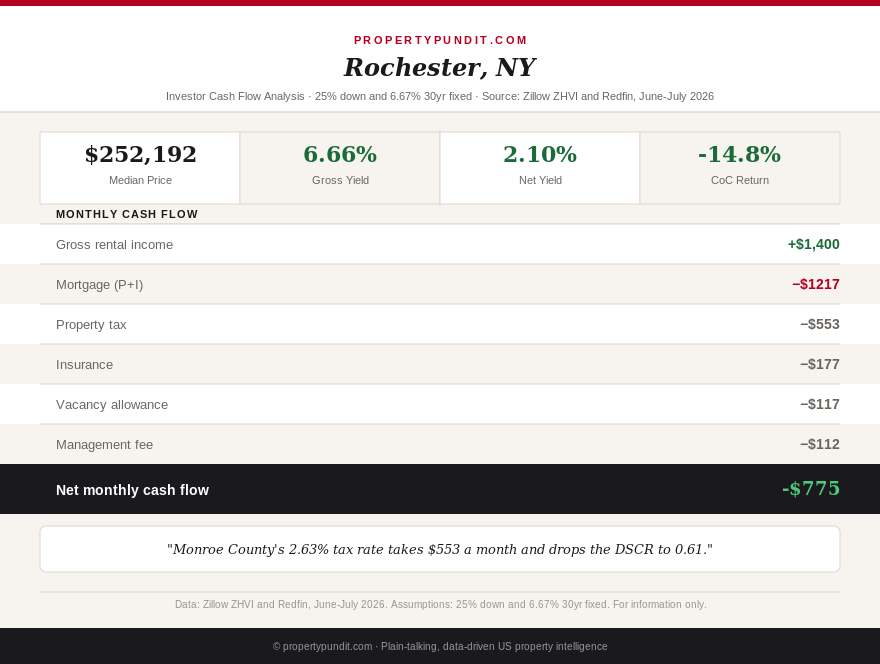
Here's the headline finding from this pass: Rochester homes get about 7 offers each and sell in roughly 9 days (Redfin, July 2026), which makes it one of the most competitive markets in a country where sellers currently outnumber buyers by 51%. And at Zillow's home value index of $252,192 (June 30, 2026), a 25% down purchase there underwrites to a debt service coverage ratio of 0.61. Not a near miss. The worst of the four New York markets we underwrote.
The reason is one number: Monroe County's effective property tax rate of 2.63%. On a $252,192 home that's $553 a month before you have paid a dollar of principal, interest, or insurance.
Get this in your inbox every Friday.
One email. The number that matters and what it means for you.
The statewide record that tells you nothing useful
New York's median sales price hit a record $475,000 in June 2026, up 8% from $440,000 a year earlier, on 9,286 closed sales (New York State Association of Realtors, released July 21, 2026). Inventory rose 4.4% to 32,508 homes, the sixteenth consecutive month of year-over-year inventory growth.
Zillow's home value index for New York State sits closer to $499,000 for the same period. The two figures disagree by about 5%, and the reason is methodology rather than error: NYSAR reports the median of homes that actually closed through the MLS, while Zillow's index estimates a value for every home in the state whether it sold or not. In a market where downstate transactions carry a much higher price than upstate ones, the closed-sale median moves with the geographic mix of who happened to sell that month. We covered the same divergence when the state first set a record in New York's record price alongside rising inventory.
Either way, the statewide number is a downstate number wearing a statewide label, and it's useless for underwriting an upstate rental. If you're shopping New York on cash flow, ignore the $475,000 headline entirely and price the county you're actually buying in.
What a 2.63% effective rate does to a deal
New York's statewide effective property tax rate is about 1.55% (Tax Foundation), already among the highest in the country. The upstate counties investors are drawn to run well above it. Monroe County, which contains Rochester, sits at roughly 2.63%. Onondaga County, which contains Syracuse, is around 2.59%. Erie County, which contains Buffalo, is comparatively mild at 1.76%.
Put the same $250,000 property in Monroe and Erie counties and the monthly tax line differs by $181, or $2,175 a year. That single line item is larger than the entire annual property tax bill on a comparable house in Indiana or Missouri, two markets we mapped in the single-family yield map by county.
There is also no relief mechanism available to you. New York's STAR exemption reduces school tax for owner-occupants only, so a non-homestead rental parcel pays the full levy. If you're comparing a New York county against a Sun Belt county on advertised price alone, you're understating your New York carrying cost by roughly $500 a month, and a deal that looks like it pencils won't.
Four New York markets, fully underwritten
Every row below assumes a 25% down conventional investor purchase at 6.67% over 30 years (Freddie Mac PMMS, August 13, 2026), landlord insurance at $2,125 a year (the higher end of the $1,651 to $2,125 New York range reported by landlord insurance carriers in 2026), one month of vacancy allowance, and 8% management. Prices are Zillow home value index as of June 30, 2026 except Binghamton, which uses our cached price band. Rents are market three-bedroom single-family asking rents.
| Market | Price | Tax rate | PITI | Rent | Effective rent | DSCR | Monthly cash flow |
|---|---|---|---|---|---|---|---|
| Binghamton (Broome) | $155,000 | 2.50% | $1,248 | $1,300 | $1,096 | 0.88 | -$151 |
| Buffalo (Erie) | $246,321 | 1.76% | $1,727 | $1,600 | $1,349 | 0.78 | -$377 |
| Syracuse (Onondaga) | $225,918 | 2.59% | $1,755 | $1,600 | $1,349 | 0.77 | -$405 |
| Rochester (Monroe) | $252,192 | 2.63% | $1,947 | $1,400 | $1,181 | 0.61 | -$766 |
Not one market clears a 1.0 DSCR, let alone the 1.20 most lenders want. Add a 1% of value annual maintenance reserve and every number gets worse by $130 to $210 a month. Binghamton at 0.88 is the closest thing New York has to a functioning cash flow market, and it's a small, thin market where a single vacancy can wipe out a year of margin.
Rochester is the outlier in a way that surprised us. It has the highest price of the four, the lowest rent of the four, and the highest tax rate of the four. Its gross yield is 6.66% against Binghamton's 10.06%. The 7-offer competition that makes it look hot is owner-occupant competition, not investor competition, and if you bid into it you're paying an owner-occupant price for a property that produces a landlord's return.
For a DSCR loan on Rochester rents to work at 1.0, you'd need to buy at about $143,000, which is 43% below the index value. That's a distressed-acquisition strategy, not a market-rate one, and you should treat any Rochester listing near the median as an appreciation bet rather than a cash flow purchase. Our DSCR loan guide walks through where lenders actually draw the line. If you're underwriting New York on a spreadsheet that shows positive cash flow, check your property tax assumption first, because it's almost always the line that's wrong.
The rent cap map is not what most sources say it is
This one is worth correcting carefully, because we got it wrong ourselves in our first New York pass in June and a lot of investor-facing coverage still repeats the same error.
New York's Good Cause Eviction law took effect in April 2024. It applies automatically in New York City. Everywhere else in the state, a municipality has to vote to opt in. Where it applies, an annual rent increase above the lower of 10% or 5% plus local CPI is presumptively unreasonable and a tenant can challenge it, and a landlord needs a defined good cause to decline a lease renewal.
The commonly cited figure of "70-plus municipalities" is wrong. As of early 2026 roughly 18 to 19 municipalities had opted in: New York City, Albany, Rochester, Ithaca, Kingston, Poughkeepsie, Beacon, Newburgh, Nyack, Hudson, New Paltz, Fishkill, Catskill, Croton-on-Hudson and Binghamton among them. Several went further than the state floor. Albany set the landlord portfolio exemption at a single unit, meaning even a one-property owner is covered.
Buffalo has not opted in. Syracuse voted the measure down on February 23, 2026, when its Common Council deadlocked 4-4. So the two upstate markets with the strongest rent-to-price ratios in our table are the two where your rent increases are not capped, while Rochester and Binghamton, the best-performing and worst-performing rows respectively, both are.
At current inflation of 3.4% (BLS, July 2026 CPI released August 12), the Good Cause ceiling works out to 8.4%, which is well above what upstate rents are actually growing. The cap is not binding today. It becomes binding at exactly the moment a market runs hot, which is the moment you'd want to reprice. If you're buying in Rochester or Binghamton, underwrite your five-year rent growth at the cap rather than at market, and check whether your target municipality has amended the state floor downward.
The 6.41% most out-of-state buyers forget
New York taxes non-residents on New York-source income, and rental income from a New York property is New York-source income. An out-of-state owner in the $80,650 to $215,400 bracket owes 6.41% state income tax on net rental income, filed on a non-resident return, on top of whatever their home state charges.
On a property that's already cash flow negative this looks harmless, since there's no taxable profit to tax. It stops being harmless the day you sell. New York applies the same non-resident treatment to gain on the sale of New York real property, and the state requires an estimated payment at closing. If your entire New York thesis is appreciation, as the table above suggests it has to be, then the state takes a bite out of the only return you were counting on.
Price that into your exit before you price it into your entry, because a 6.41% haircut on gain is the difference between a good five-year hold and a mediocre one.
What the numbers point toward
Frankly, if you're an out-of-state investor with cash to deploy this quarter, New York is not where it goes. Four markets, four failed DSCR tests, the highest non-homestead property tax burden of any state we've underwritten this year, a rent cap in two of the four cities, and a non-resident income tax on both the income and the exit. Most investors who run these numbers end up buying the same cash flow profile in Ohio, Indiana or Missouri at half the tax rate.
If you already own in New York, the call is different. Erie County at 1.76% is the one place in the state where the tax line is defensible, Buffalo has not opted into Good Cause, and its 3.7% year-over-year value growth is real. Concentrating there and rotating out of Monroe County is a rational portfolio move, and the current buyer's market gives you time to be selective on the buy side even while Rochester's 9-day sale pace gives you speed on the sell side.
And if Rochester specifically is the market you know, buy it the way its own numbers demand: below $143,000, off-market or distressed, with a renovation plan. At $252,000 with 7 competing offers, you're bidding against people who get to live in the house. They can pay more than you can, and on this math, they should.