 Property
You've been running Colorado numbers off a spreadsheet built back in July, back when a rough 0.5%-of-price estimate stood in for a real insurance quote. That estimate put Denver's investor loss at about $1,286 a month, painful but survivable. Pull an actual Colorado homeowners quote today and that estimate is wrong by roughly $2,500 a year, because Colorado's insurers have spent 2026 catching up on a peril most out-of-state investors never price in at all: hail.
This is a second pass on Colorado, built on the same first-pass underwrite we published in July, now updated for today's 6.95% rate, a real hail-adjusted insurance figure, and the 1.5%-of-price annual maintenance reserve this site now applies to every state. Denver and Colorado Springs both get materially worse. Pueblo, the one market that passed DSCR the first time around, actually gets a little better on paper, for a reason worth understanding before you write it off with the rest of the state.
Colorado's hail alley problem insurers finally priced in
Colorado's own Division of Insurance analysis found that hail, not wildfire, is the single largest driver of the state's homeowners premiums, accounting for roughly 26% to 54% of the bill depending on the county, and closer to half of what a typical Front Range homeowner pays (Colorado Public Radio, February 2026). The Denver-to-Colorado-Springs corridor sits squarely inside what the insurance industry calls Hail Alley, and it has earned the name: a single May 2024 Denver-area storm caused more than $2 billion in damage in a few hours.
Source figures diverge here, and it's worth naming both rather than picking one silently. MoneyGeek's 2026 estimate for a standard policy on a roughly $450,000 home runs $3,200 to $3,800 a year. A separate 2026 tracker cited widely in Colorado insurance coverage puts the statewide average premium at $6,630, the fourth highest in the country. The gap likely comes down to coverage assumptions: dwelling limits, deductible choice, and replacement-cost versus actual-cash-value policies vary enough between trackers to explain a swing this size. Given that hail specifically concentrates its cost along the Front Range, where both Denver and Colorado Springs sit, this underwrite uses the higher, more conservative $6,630 figure for both cities rather than the lower statewide blend, and Front Range investors should budget nearer that number until they have an actual quote in hand.
If you're underwriting a Colorado rental off an insurance guess instead of a bound quote, that's the single line most likely to be wrong, and wrong in the expensive direction.
Get this in your inbox every Friday.
One email. The number that matters and what it means for you.
Denver: the state's most expensive market gets more expensive
Denver's city median sale price reached $619,090 in August 2026, up 4.9% year over year (Redfin). The Denver Metro Association of Realtors, covering the broader 11-county metro, reports a lower $594,495 median close price, essentially flat year over year; the gap reflects Redfin's narrower city boundary against a metro figure that includes cheaper suburban counties.
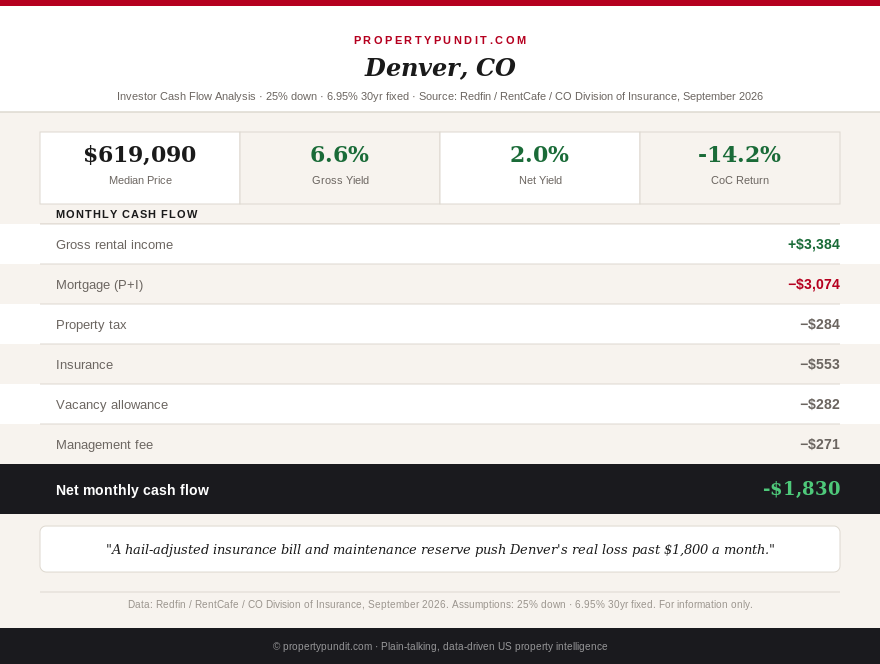
At 25% down and 6.95%, a $464,318 loan carries roughly $3,074 a month in principal and interest. Add Denver's 0.55% property tax rate ($284 a month) and the hail-adjusted $553 monthly insurance figure, and PITIA runs about $3,911. RentCafe's August 2026 data puts a three-bedroom house rent at $3,384 a month, giving Denver a 0.87 DSCR, a clear fail against the 1.0 minimum lenders require.
Run that rent through an 8% vacancy allowance and 8% property management fee, then subtract the $774 monthly maintenance reserve, and Denver's real cash flow lands at roughly negative $1,830 a month, worse than the negative $1,286 this site reported in July. None of that gap comes from a worse rental market. It comes entirely from pricing insurance and upkeep the way an owner actually has to pay for them. If you're underwriting Denver off last year's numbers, or anyone else's spreadsheet that assumes a flat insurance percentage, you're underestimating the real monthly cost by more than $500.
Colorado Springs: military demand doesn't offset the same insurance bill
Colorado Springs carries a genuine demand floor that Denver doesn't: Fort Carson, NORAD, and Peterson Space Force Base anchor roughly 30,000 military and defense jobs in the metro, a stabilizing force this site has flagged in prior Colorado Springs coverage. Zillow puts the city's average home value at $450,850 as of May 2026, down 2.0% year over year; Houzeo's competing figure shows a $499,900 median, up slightly. The two trackers use different methodologies (average value versus median sale price), which explains most of the roughly $49,000 gap.
At 25% down on the Zillow figure, a $338,138 loan runs about $2,238 a month in principal and interest. Property tax at 0.48% adds $180, and the same $553 hail-adjusted insurance estimate applies, since El Paso County sits inside the same Front Range hail belt (the state's own fortified-roof rebate program there, worth up to $388 a year in savings, is itself evidence of how seriously local regulators treat the risk). PITIA totals about $2,971 against a three-bedroom rent of roughly $2,300 (a range of $2,200 to $2,632 shows up across rental trackers), a 0.77 DSCR.
After vacancy, management, and the $564 maintenance reserve, Colorado Springs runs a real monthly loss of about $1,595, more than double the negative $685 this site reported in July. A strong, real demand story doesn't cancel out an insurance bill; the two are separate variables, and Colorado Springs is proof that even a market with a durable federal-employment anchor still has to clear its actual carrying costs.
Pueblo: the one market that still clears DSCR, and why
Pueblo is the exception, and the reason is worth sitting with. Redfin's most recent Pueblo median sits at $265,000, down 5.7% year over year, a genuinely cheap entry point relative to the rest of the state. The first-pass rent figure this site used in July, $1,385 a month, turns out to have understated the real single-family rate; current three-bedroom house rent data puts Pueblo closer to $2,000 a month, a jump that looks dramatic until you recognize it as the same blended-rent error this site has now caught in several other states, where a citywide or apartment-weighted average undersells what an actual single-family rental commands.
At 25% down, a $198,750 loan runs about $1,316 a month in principal and interest. Pueblo's property tax, at the same statewide 0.51% rate, adds $113 a month. Pueblo sits further south, away from the worst of the Front Range hail corridor that runs through Denver and Colorado Springs, so this underwrite uses a more conservative $3,500 annual insurance estimate, or $292 a month, roughly $260 a month below the Front Range figure. PITIA totals $1,721 against $2,000 in rent, a 1.16 DSCR, comfortably above the 1.0 minimum and an improvement on the barely-passing 1.01 DSCR from the first pass.
Real cash flow tells a different story once vacancy, management, and Pueblo's $331 maintenance reserve are subtracted: roughly negative $365 a month, still a loss, just a much smaller one than Denver's or Colorado Springs'. A DSCR pass is not the same thing as a cash-flowing property, a gap this site has now confirmed in enough states to treat as a standing rule rather than a one-off. Pueblo clears the lender's bar. It does not clear an investor's actual bank account, though it comes closer than anywhere else in the state.
The real Colorado advantage: no non-homestead penalty
Colorado's genuine investor edge has nothing to do with monthly cash flow. The state assesses property by use type, not by occupancy, which means a single-family rental is taxed at the same 6.7% residential assessment ratio as an owner-occupied home. That distinguishes Colorado from a growing list of states this site has covered, including Michigan, Alabama, and South Carolina, where investors pay a separate, meaningfully higher non-homestead rate simply for renting the place out instead of living in it.
Colorado's flat 4.4% income tax applies identically to rental income and offers no real estate-specific exemption, so it doesn't add a second advantage on top of the property tax parity. Combined with one of the lowest effective property tax rates in the country, Colorado's real pitch to an investor isn't monthly income; it's a state that won't penalize you at tax time for being a landlord instead of an owner-occupant, layered on top of the appreciation an expensive, supply-constrained market like Denver has delivered for years.
What this means for you
The math points toward treating Colorado as an appreciation and low-tax-friction play, not a cash flow play, and Pueblo as the only market on this list worth underwriting for near-term income at all. If you're set on Denver or Colorado Springs, budget the real hail-adjusted insurance figure from day one rather than a flat percentage estimate, and go in expecting to carry $1,500 or more a month against appreciation you're betting will show up later. If monthly cash flow is the actual goal and Colorado is non-negotiable, Pueblo's $265,000 median and roughly $365 monthly shortfall is the closest thing the state offers to a workable number, and it's still a number you need reserves to carry.
For a broader comparison of what a Colorado dollar buys against a lower-tax, lower-insurance state, our Denver vs. Colorado Springs breakdown and the first-pass Colorado spotlight both cover ground this update builds on. If DSCR financing itself is the part you're still learning, our DSCR loan investor guide walks through how lenders actually qualify a deal like these, and our county-by-county yield map is a faster way to screen for markets where the math starts in your favor instead of against it.