 Property
If you have been waiting for the Fed to start cutting rates before you refinance, Wednesday delivered the opposite: a rate hike, the first since 2023. If you spent the days before the vote nervously refreshing your rate tracker as it climbed toward 7%, here is the part that should actually change how you read this week: your mortgage quote barely moved because of the hike itself. It had already priced in almost all of it before anyone at the Fed said a word.
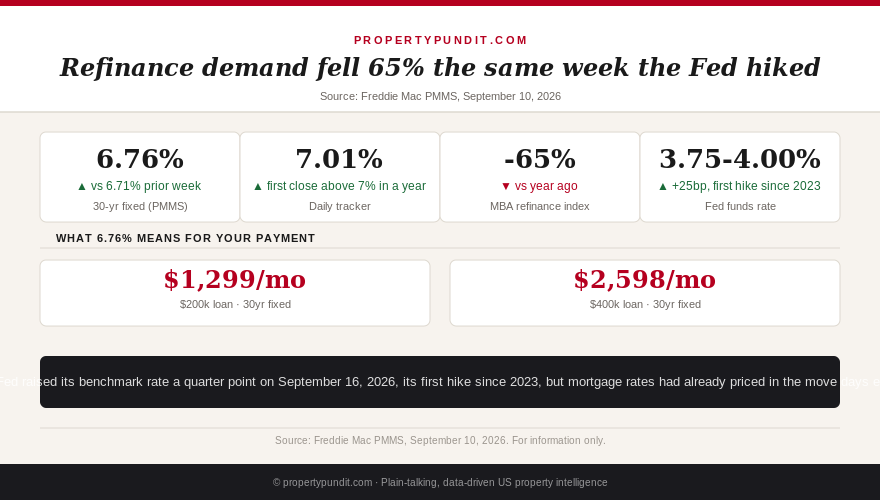
Freddie Mac's benchmark 30-year rate stood at 6.76% in last week's official survey (Freddie Mac PMMS, September 10, 2026), and daily trackers pushed as high as 7.01% this week (Optimal Blue, September 17, 2026), the first close above 7% in about a year. Both of those numbers moved before the Fed's Wednesday vote, not after it. The Federal Open Market Committee voted 12-0 to raise its target range a quarter point to 3.75%-4.00%, its first increase since 2023 (Federal Reserve, September 16, 2026), and rate trackers the next morning were essentially flat against where they closed the night before.
That disconnect is the real story this week, more than the hike itself. Mortgage rates track the 10-year Treasury yield, not the federal funds rate the Fed just moved, and bond markets had already built in roughly a 93% chance of exactly this move days in advance (CME FedWatch, September 2026). Meanwhile, refinance applications fell 65% below their year-ago level (Mortgage Bankers Association, week ending September 11, 2026), and that drop happened before the hike too, because the math on refinancing at today's rates simply does not work for most people who locked in the past two years.
Get this in your inbox every Friday.
One email. The number that matters and what it means for you.
Why a Fed hike did not move your mortgage quote
The confusion is understandable. It feels like the Fed setting rates higher should mean your mortgage rate goes higher too, and on a long enough timeline, Fed policy does feed through to the cost of borrowing. But the federal funds rate governs overnight bank lending, not 30-year mortgages. Mortgage rates are priced off the 10-year Treasury yield, which moves on inflation data, deficit concerns, and expectations, all of which get baked in well before any Fed meeting actually happens. A hot producer price report on September 10 and a still-sticky CPI reading on September 11 (Bureau of Labor Statistics, September 2026) pushed yields higher a full week before Wednesday's vote, which is exactly why rate trackers were already near 7% before the Fed did anything. We covered this mechanism in more detail the day before the vote, and this week is the confirmation of it in real time: the rate move already happened before the Fed voted.
For you, the lesson is straightforward. Stop watching the Fed's meeting calendar expecting your rate quote to move on the day of the vote. Watch the 10-year Treasury and the daily trackers instead, because those are what actually decide what a lender quotes you tomorrow morning.
Three different 30-year rates, one confusing week
Three separate benchmarks are floating around this week, and they disagree on purpose, not by error. Freddie Mac's PMMS, the industry's official weekly survey, last read 6.76% on September 10. The Mortgage Bankers Association's own weekly survey, based on actual applications rather than a lender rate-sheet sample, put the 30-year rate at 6.97% for the week ending September 11, up from 6.85% the week before. Daily trackers such as Optimal Blue showed 7.01% on September 17, the freshest read of the three. None of these numbers is wrong; they are measuring slightly different things on slightly different days, and PMMS in particular lags the market by several days because it is a survey, not a live feed. Adjustable-rate applications rose to an 8.5% share of the market, the highest since June (Mortgage Bankers Association, September 2026), as more borrowers try to dodge the fixed-rate spike rather than fight it, a trend we tracked in detail two weeks ago. Your own quote will also vary by lender and by credit profile, which is worth knowing before you assume the number in a headline is the number you will actually get; see our breakdown of how credit score actually affects your mortgage rate.
If a lender quotes you something between 6.7% and 7.1% this week, both numbers are real. It just depends on which survey and which day; use the freshest daily number to judge your actual quote, not the slower weekly average everyone else is citing.
Forecasts for where rates go from here are also split, which is worth knowing before you anchor on any single prediction. Fannie Mae's latest outlook expects the 30-year rate to ease to roughly 6.3% by the end of 2026 and 6.2% in 2027, while the Mortgage Bankers Association's own forecast has rates holding closer to 6.5% through 2027 (Fannie Mae; Mortgage Bankers Association, September 2026). Both forecasts assume rates drift down from here, not up, but neither one gets you back to the 3% to 4% range that defined 2020 and 2021, which is the real reason so many homeowners are simply staying put on their existing loan rather than watching for a refinance window that may never arrive.
Why refinance demand collapsed 65%
The Mortgage Bankers Association's composite application index fell 4.1% for the week ending September 11, driven almost entirely by the refinance side, which dropped 9% from the prior week and 65% below the same week a year ago. That is not a typo, and it is not really about this week's rate move at all. Most homeowners who could genuinely benefit from refinancing already did it during the sub-4% window of 2020 and 2021, and most of the people who bought more recently locked their original rate somewhere between 6.5% and 7.3%, which is already close enough to today's rate that a refinance would barely move their payment. The pool of people for whom refinancing still makes sense has simply gotten very small, and it keeps shrinking every month rates stay in this range.
If your existing rate starts with anything below a 6, refinancing this week almost certainly costs you money instead of saving it, once you count closing costs against the marginal difference; see our full breakdown of what closing costs actually include before you assume a refinance is free to try.
The real break-even math, worked out
Say you bought in 2024 with a $350,000 balance at 7.25%, a common rate for that vintage. Your principal and interest payment is about $2,388 a month. Refinancing into today's 6.76% rate drops that to roughly $2,273, a saving of $115 a month, or about $1,380 a year. Closing costs on a refinance typically run 2% to 4% of the loan amount, so somewhere between $7,000 and $14,000 on a balance this size. Divide the cost by the monthly saving and the break-even point lands between 61 and 122 months, meaning five to ten years before the refinance actually pays for itself. Most people do not stay in the same loan, or even the same house, that long without moving, selling, or refinancing again for some other reason.
Run those numbers against your own balance and rate, and for most people who locked in the past two years, the math points toward waiting for at least another half a point of relief before a refinance pays for itself. If you locked before 2022 at a rate under 4%, the math is not close at all; there is essentially no scenario at today's rates where refinancing helps you.
The math looks different for someone who locked closer to the top of the range. Take a $450,000 balance at 7.0%, roughly what a buyer with strong credit might have gotten in late 2024. The current payment runs about $2,993 a month. At 6.76%, that drops to $2,922, a saving of $71 a month, which is smaller in dollar terms than the earlier example because the starting rate was already closer to today's. On a $650,000 balance at the same 7.0% starting point, the saving grows to roughly $103 a month, since the dollar impact of any rate gap scales with the size of the loan. The rule of thumb holds either way: the bigger your balance and the wider the gap between your current rate and today's rate, the faster a refinance pays for itself, and anything under a quarter-point gap almost never clears the break-even bar no matter how large the loan.
What this means for you
The headline this week is a Fed hike, but the number that should actually change your behavior is the 65% collapse in refinance demand, because it confirms that the market has already sorted itself into two groups: people with old, low rates who have no reason to touch their mortgage, and recent buyers whose math on refinancing does not clear yet. If you are shopping for a new purchase loan, use the daily tracker, not last week's PMMS reading, to judge what you will actually be quoted, and decide on locking versus floating based on the 10-year Treasury's direction rather than the Fed's meeting calendar. If you already own and were hoping this week's vote would be your signal to refinance, it was not; the signal you actually need is a meaningfully lower daily rate than your current one, sustained for more than a week, not a single Fed announcement.