 Property
You've had the same tab open for weeks now: the mortgage calculator, the rate tracker, the spreadsheet where you keep running the same numbers with a slightly different rate every time you check. You already know your fixed rate. What you're actually trying to figure out is whether locking in a payment for 30 years still makes sense when the number on the screen keeps climbing toward 7%, or whether the adjustable-rate option everyone told you to avoid in 2022 is worth a second look now that the math has changed.
This week's data gives you an actual answer to lean on. The Mortgage Bankers Association's weekly survey, for the week ending August 28, 2026, found adjustable-rate mortgage applications climbed to 8.0% of total volume, the highest share in five weeks, even as the average 30-year fixed contract rate rose to 6.79%, its highest level in a month. Borrowers aren't taking on ARM risk by accident. They're doing the same math you are, and a meaningful number of them are concluding the gap is wide enough to be worth it.
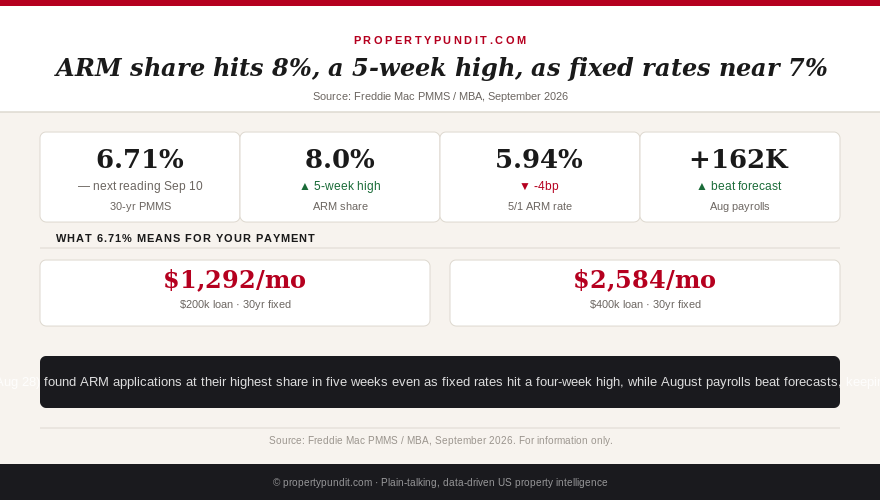
The number: ARM applications at an 8.0% share, a five-week high
MBA's weekly survey for the week ending August 28, 2026 (released September 2) put the Market Composite Index up 0.8% week over week, with the seasonally adjusted Purchase Index rising 2% even as rates held near 6.8%. The detail that stands out is the ARM share specifically: 8.0% of applications, up from a run of readings closer to 7% through most of the summer, the highest ARM share in five weeks. At the same time, the average 5/1 ARM contract rate actually fell to 5.94% from 5.98%, widening the gap against a 30-year fixed rate that rose to 6.79% the same week (MBA, week ending August 28, 2026). Freddie Mac's official PMMS, a separate weekly benchmark, put the 30-year fixed at 6.71% as of September 3, 2026, with the next reading due September 10. Daily rate trackers ran further ahead still: Mortgage News Daily's own index hit 6.89% on September 8, its highest reading in four weeks. So what this means for you: whichever benchmark you're watching, the direction is the same, fixed rates are drifting up while ARM rates are easing, and that combination is exactly what's pulling more borrowers toward the adjustable option.
Why now: a strong jobs report just took a September rate cut off the table
The timing isn't a coincidence. August's jobs report, released September 4, showed payrolls rose 162,000, well above what forecasters expected, with unemployment holding steady at 4.1% (Bureau of Labor Statistics, September 2026). A separate reading, the ISM services index, came in at 55.4 for August, also ahead of expectations. Neither number supports the case for the Federal Reserve to cut rates at its September 15-16 meeting, and prediction markets have moved accordingly: implied odds of a hold sit near 73%, with the remaining probability split between a hike and a cut, and a cut specifically priced at roughly 1%. If you were hoping a Fed move might drag your fixed-rate quote back down before you lock, this week's data argues against waiting. So what this means for you: a rate-anxious pause rarely pays off when the data behind it points toward "more of the same," and this week's combination of a hot jobs report and a rising fixed rate is exactly that signal.
Get this in your inbox every Friday.
One email. The number that matters and what it means for you.
The worked math: what a 5/1 ARM actually saves on a $400,000 loan
Run the numbers precisely rather than trusting the gut feeling that "ARMs are cheaper." On a $400,000 loan at the current 6.71% 30-year fixed rate (Freddie Mac PMMS, September 3, 2026), the principal-and-interest payment is $2,584 a month. The same loan at 5.94%, the average 5/1 ARM rate from MBA's most recent survey, runs $2,383 a month. That's a $201-a-month difference, or $12,060 saved over the ARM's five-year fixed period, money that goes straight into your pocket rather than the lender's, assuming nothing else changes. On a smaller $300,000 loan the same gap runs about $151 a month; on a $200,000 loan it's closer to $101. The percentage gap is consistent, it's the dollar amount that scales with loan size. So what this means for you: the larger the loan, the more a fixed-versus-ARM decision is actually worth running the numbers on rather than defaulting to whichever option your loan officer mentions first.
The break-even math: what happens after year five
Here's the part most ARM pitches skip. Most 5/1 ARMs carry a 2-percentage-point initial adjustment cap, meaning the rate can jump by up to 2 points the first time it resets, five years in. On that same $400,000 loan, after five years of payments at 5.94%, the remaining balance runs approximately $371,940. If the rate adjusted the full 2 points to 7.94%, the new payment on that balance, amortized over the remaining 25 years, would be about $2,856 a month, some $272 more than the original 30-year fixed payment of $2,584 would have been. At that worst-case rate, it would take roughly 44 months, just under four years, of paying that extra $272 a month to erase the $12,060 banked during the first five years. Add it up and the ARM borrower is still net ahead in cumulative dollars through roughly year 8 to 9 of the loan, even in the adjustment's worst case, and meaningfully ahead if the rate resets to anything less severe than the full cap. So what this means for you: the math points toward an ARM being the stronger choice if you expect to sell, refinance, or pay off the loan within seven to eight years, and a genuinely closer call, not an automatic loss, even if you don't.
Reading the ARM share as a signal, not just a personal choice
An 8.0% ARM share is still a small slice of total mortgage volume, most borrowers are still choosing the fixed rate, but the direction matters more than the level. ARM share has been drifting between roughly 7% and 8% for most of 2026, and this week's move to a five-week high, paired with fixed rates hitting a four-week high the same week, is the clearest signal yet that the rate gap has widened enough to change behavior at the margin. That's a different story than 2022 and 2023, when ARM share spiked because fixed rates were rising so fast that ARMs became the only affordable option for many buyers; this year's move looks more like borrowers making a calculated bet that today's fixed rate, hovering near 7%, is closer to a local peak than a new floor. Whether that bet pays off depends on where the 10-year Treasury and mortgage spreads sit five years from now, which nobody, including this site, can promise. So what this means for you: treat this week's ARM data as one more data point confirming that sophisticated borrowers see the current fixed rate as expensive relative to the alternative, not as a guarantee that rates will fall by the time your own adjustment date arrives.
Put all of it together and the case for at least running the ARM numbers on your own loan amount is stronger this week than it's been in over a month. Fixed rates are drifting toward 7% on the daily trackers even as the official PMMS holds at 6.71%, a strong jobs report has taken a near-term Fed cut off the table, and the ARM-to-fixed rate gap is wide enough that the break-even math clears seven or eight years out even in a worst-case adjustment. Frankly, if you're planning to move, sell, or refinance before year seven, most people who run this exact comparison end up choosing the ARM once they see the actual dollar figures rather than the "ARMs are risky" headline. If you're planning to stay for the long haul and rate certainty matters more to you than $201 a month, the fixed rate is still the better fit, and there's nothing wrong with saying so once you've done the math rather than skipped it. Before you lock either way, make sure you've accounted for how closing costs factor into a refinance-versus-hold decision, and if your credit profile sits anywhere near a pricing tier boundary, what your credit score actually does to your rate is worth checking before you assume either quote is final. For the mechanics of exactly how an ARM adjusts once the fixed period ends, the ARM reset payment math breaks down the cap structure in full, and last month's look at ARM share's prior dip to 7.9% shows how quickly this number can move in either direction depending on the week's rate print.