 Property
If your investing shortlist has Northwest Arkansas on it because of the Walmart-Tyson-J.B. Hunt growth story, here is the number that should give you pause before you call a lender: a full underwrite of a Bentonville single-family rental loses $1,579 a month. Not the cheapest market in the state. Not the slowest one. The one everyone is moving to.
Arkansas as a whole still markets itself on low carrying costs, an effective property tax rate around 0.6% statewide, a flat-ish graduated income tax that tops out at 3.9%, and a homestead credit that just grew. All of that is true for an owner-occupant. Run the same three markets, Bentonville, Fort Smith, and Little Rock, through a real investor underwrite at today's rate, and none of them clears a 1.0 debt service coverage ratio. The reasons differ by city, and the differences matter more than the average.
This is Arkansas's third pass through our state rotation, following underwrites in May and July 2026. The numbers below look worse than either of those earlier passes for a specific reason: this pass adds a maintenance reserve, the 1% to 1.5% of a property's value that a long-hold rental needs budgeted every year for repairs and replacements, a line the May and July passes priced without. The headline finding is the kind of thing a growth-chasing investor pitch tends to skip: the fastest-growing city in the state is also the worst rental deal of the three we tested, because population growth has been funding appreciation, not rent.
Get this in your inbox every Friday.
One email. The number that matters and what it means for you.
Arkansas's median price depends on which number you use
Redfin's statewide data puts Arkansas's median sale price at $278,012 as of May 2026, up 3.0% year over year. Zillow's smoothed statewide home value index, which blends the entire housing stock rather than just that month's closings, runs lower at $225,822, up 3.5% year over year. The gap exists because Redfin reflects what actually changed hands last month, skewed toward whatever mix of homes happened to sell, while Zillow spreads across every home in the state whether it sold or not. Little Rock shows the same pattern at the city level: Redfin's November 2025 reading put the median sale price at $281,000, while a separate Movoto pull from February 2026 showed $269,880, a gap that mostly reflects a market that has cooled slightly between those two snapshots rather than any real disagreement about direction.
For you, the practical takeaway is to treat any single Arkansas price headline as a range, not a point estimate, and to always check the date and the data source before you underwrite a specific address against a statewide or citywide average. The underwrite below uses the more recent $269,880 Movoto figure for Little Rock, since it is the freshest of the two readings.
Bentonville's boom doesn't fund the rent roll
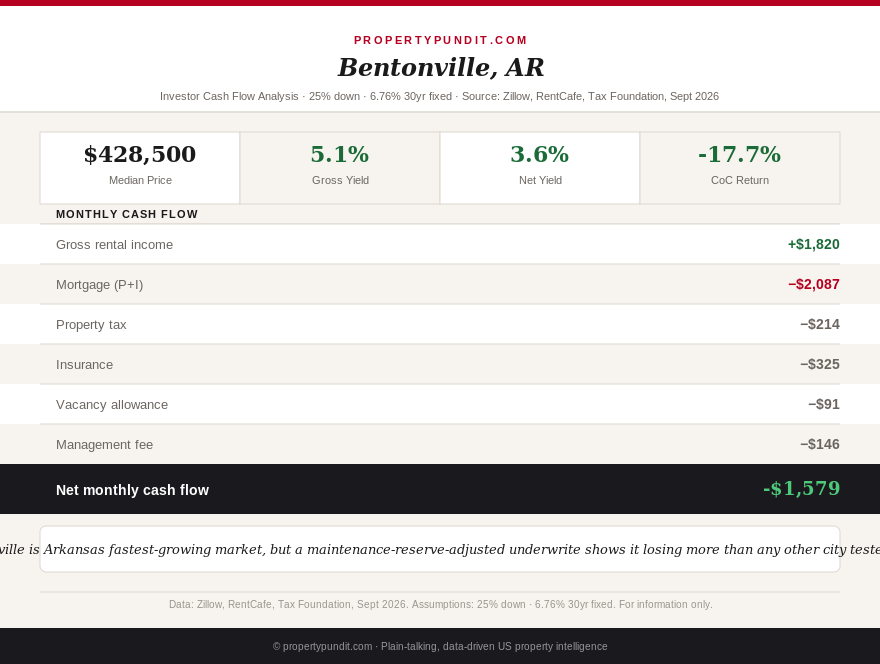
Northwest Arkansas just crossed 605,000 residents and is adding roughly 250 new people a week, anchored by Walmart, Tyson Foods, and J.B. Hunt, three Fortune 500 headquarters in one metro (Axios Northwest Arkansas, 2026; Milken Institute, 2026). Bentonville's median home value has climbed to $428,500 against a median household income of $112,792. At 25% down and Freddie Mac's 6.76% rate (Freddie Mac PMMS, September 10, 2026), the loan on that median home carries a $2,087 principal and interest payment. Add Arkansas's roughly 0.6% effective property tax rate ($214 a month) and an estimated $325 a month in landlord insurance, and the PITI payment reaches $2,626. Average three-bedroom rent in Bentonville runs about $1,820 a month (Zillow Rental Manager, 2026), which puts the debt service coverage ratio at 0.69, the weakest of the three markets tested here. Add an 8% management fee ($146), a 5% vacancy allowance ($91), and a 1.5% annual maintenance reserve ($536 a month on a property this size), and the full monthly cost stack reaches $3,399 against $1,820 in rent, a loss of $1,579.
The lesson here is not that Bentonville is a bad place to own property long-term. It is that the growth story driving prices higher, corporate relocation, population inflow, national "best metro" rankings, is an appreciation thesis, not a cash-flow thesis, and the two are not the same bet. If cap rate and monthly income are what you are underwriting for, the region generating the most headlines is not the region with the numbers to back it.
Fort Smith is cheaper. It is not really better.
Fort Smith is Arkansas's most affordable major market, with a median sale price of $219,000 over the three months ending June 2026, down 1.5% year over year (Redfin, 2026). On paper that looks like the obvious entry point for a budget-conscious investor. Run the numbers: 25% down and a 6.76% rate produce a $1,067 principal and interest payment, plus $110 in property tax and an estimated $300 in landlord insurance, for a $1,477 PITI. Average three-bedroom rent in Fort Smith runs only about $1,056 a month (RentCafe, 2026), producing a 0.71 DSCR. After an 8% management fee ($84), a 5% vacancy allowance ($53), and a $274 monthly maintenance reserve, the full cost stack reaches $1,888 against $1,056 in rent, an $832 monthly loss. As a share of the purchase price, that loss is actually the largest of the three markets tested, a bigger percentage hit than either Bentonville or Little Rock, because Fort Smith's rent has fallen even further behind its price than the rest of the state.
The takeaway for you is the same one this site keeps finding in state after state: the cheapest sticker price in a market is not the same thing as the best deal. Fort Smith's low entry cost doesn't buy you a better DSCR; it just buys you a smaller loan against a rent roll that has fallen behind by even more.
Little Rock, the market nobody is pitching, comes closest
Using Little Rock's own $269,880 median (Movoto, February 2026), the same 25% down and 6.76% rate produce a $1,315 principal and interest payment, $135 in property tax, and an estimated $300 in insurance, for a $1,750 PITI. Average three-bedroom rent around $1,550 a month (Rentometer and Zumper, 2026) produces a 0.89 DSCR, the best of the three markets here. After an 8% management fee ($124), a 5% vacancy allowance ($78), and a $337 monthly maintenance reserve, the full cost stack reaches $2,289 against $1,550 in rent, a $739 monthly loss, the smallest dollar shortfall of the group. It's still a loss, and it still fails to clear a 1.0 DSCR, but it fails by less than either the growth market or the discount market.
If you're set on Arkansas and cash flow is the primary goal, the boring, average-priced market beats both the exciting growth story and the discount-price story on the numbers that actually matter to a lender and to your bank account.
The tax break that skips every rental in the state
Arkansas raised its homestead property tax credit to $600 for 2026 tax bills, and the state legislature's Act 174 pushes it further to $675 for assessment years beginning January 1, 2026 (Arkansas Department of Finance and Administration, 2026). Amendment 79 separately caps how fast a homestead's assessed value can grow to 5% a year. Both benefits apply only to an owner-occupied primary residence. A rental property in the same neighborhood is assessed at the full 20% of fair market value with no growth cap and gets none of the credit, which means an investor's tax bill in a fast-appreciating submarket like Bentonville can climb noticeably faster year over year than a neighboring owner's, even though both are taxed at the same nominal rate. Pulaski County's own records make the gap concrete: a non-homestead (rental) property in Little Rock carries an effective rate closer to 0.90% to 1.0%, nearly double the 0.6% statewide average this article uses for the comparative underwrite above, meaning the real Little Rock numbers are likely somewhat worse than the estimate modeled here.
This is now the sixth state where this site has found the identical structural pattern, following North Dakota, South Dakota, Maui County, Montana, and Alabama, and it fits a nationwide picture: homestead exemptions in 46 states plus DC structurally exclude rental property (Tax Foundation; Harvard Joint Center for Housing Studies, 2026). Our Utah spotlight found a similar owner-versus-investor split baked directly into the assessed value itself, though Arkansas's version works through the credit and the growth cap rather than a separate assessment ratio. Either way, if you are underwriting an Arkansas rental off an advertised "average" tax bill, check whether that average includes the homestead credit before you use it, because your own bill as a landlord will not.
What this means for you
Across all three markets tested, at today's rates and prices, the math points toward passing on Arkansas as a pure cash-flow play, at least until either rents catch up meaningfully or rates come down a full point or more. If you already own here, or you're underwriting Arkansas as a long-hold appreciation bet rather than a monthly-income bet, the state's genuine advantages, low property tax, no state-level landlord penalty on the rate itself, and a still-growing population base in the northwest corner, remain real. Most people who run these numbers end up concluding that Little Rock, not the boomtown and not the discount city, is the one worth a second look if Arkansas stays on the list at all. For the underwriting mechanics behind these DSCR and yield figures, see our DSCR loan investor guide and the county-level SFR yield map; our July underwrite of this same state shows how much worse the picture looks now that a maintenance reserve is priced in.