 Property
Utah shows up on nearly every "best states for landlords" list for one reason: a property tax rate that looks like a rounding error next to Texas or Illinois. Salt Lake County advertises 0.55%. Weber County advertises 0.60%. Run those numbers on an actual rental property, not a primary residence, and the real bill is close to double. Utah taxes an owner-occupied home on only 55% of its market value, a 45% exemption written into state law. A rental property gets none of it. The county rates everyone quotes are the homeowner number after that exemption is already applied, and no investor spreadsheet we've seen catches the difference before running the numbers.
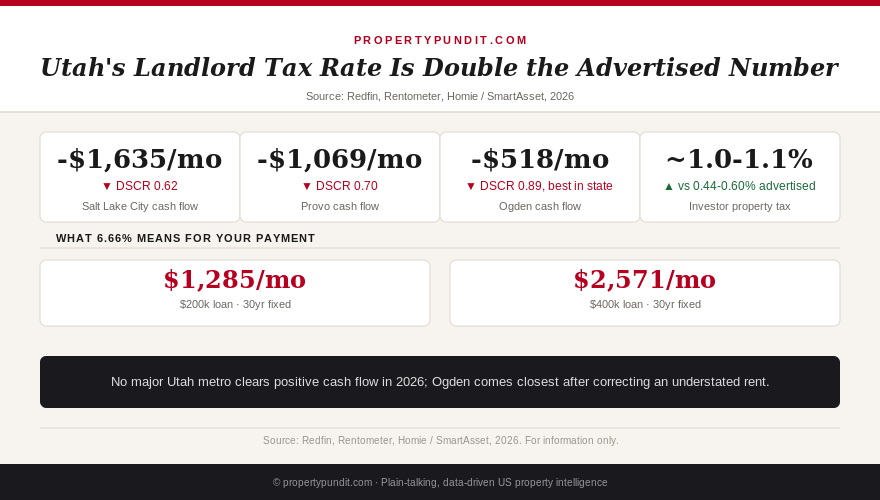
This is a second-pass update to our July 2026 Utah spotlight. Statewide, the median home price is $534,273 (Redfin, June 2026), up 2.4% year over year, with 20.5% of homes selling above list and 20.7% seeing price drops, both down slightly from a year earlier. That's a market cooling at the margins but still appreciating. What changed since our first pass isn't the state's headline numbers. It's what happens when you underwrite Salt Lake City, Provo, and Ogden using the correct investor tax rate and, in Ogden's case, a rent figure that was quietly wrong the first time.
The 45% exemption that only homeowners get
Utah law assesses a primary residence at 55% of its fair market value before the county tax rate is applied, and assesses everything else, second homes, vacation rentals, and long-term rental property, at the full 100%. The nominal mill rate doesn't change between the two. What changes is the base it's applied to, and that alone roughly doubles the effective rate for an investor. Salt Lake County's widely quoted 0.55% effective rate is a primary-residence figure; on a rental, the same county tax works out to roughly 1.0% of market value. Utah County, home to Provo, quotes 0.44% for owner-occupants and closer to 0.80% for investors. Weber County, home to Ogden, quotes 0.60% for owner-occupants and roughly 1.09% for investors.
This isn't unique to Utah. Idaho runs an almost identical structure, where a 0.50% homeowner rate becomes 1.0% to 1.1% once the exemption disappears. What makes Utah worth flagging specifically is how often it appears on national "low property tax" rankings built entirely from homeowner data, with no note that the number doesn't apply to the exact audience reading an investor guide.
So what for you: if you're underwriting a Utah rental off a property tax rate you found on a homeowner-facing site or calculator, you're underestimating your carrying cost by roughly half the tax line, and that error alone can flip a deal that looked breakeven into a real monthly loss.
Salt Lake City: the state's priciest market is also its worst investor math
Salt Lake City's median sale price reached $609,000 over the three months ending June 2026, up 3.5% year over year (Redfin), while Zillow's smoothed home value index puts the broader market at $579,572, up 2.1% year over year. Homes sell in about 29 days on two competing offers on average, a still-competitive owner-occupant market. For an investor, a 3-bedroom rental in Salt Lake County rents for roughly $2,200 a month as of late August 2026 (Rentometer).
| Item | Monthly |
|---|---|
| Purchase price | $609,000 |
| Down payment (25%) / loan | $152,250 / $456,750 |
| P&I (6.66%, 30yr) | $2,935 |
| Property tax (1.00% investor rate, Salt Lake County) | $508 |
| Insurance (statewide estimate, 2026) | $115 |
| PITI total | $3,558 |
| Gross rent (3BR SFR, Aug 2026) | $2,200 |
| DSCR (gross rent / PITI) | 0.62: FAILS |
| Vacancy (5%) / management (8%) | -$110 / -$176 |
| Effective rent after vacancy/mgmt | $1,923 |
| Monthly cash flow | -$1,635 |
Salt Lake City's tech-sector wage base, anchored by the Silicon Slopes corridor's roughly 67,000 tech jobs and $30 billion in annual economic impact, is real and keeps rents rising. But that same corridor has also compressed affordability for owner-occupants and, in our first-pass underwrite in July, produced a -$1,468 monthly loss. This pass's -$1,635 is worse, driven by a further 4% price increase and the corrected investor tax rate. Silicon Slopes hiring has also grown more volatile in 2026, with displaced tech workers competing for the same buyer pool that supports SLC's home values, a concentration risk worth watching if you're underwriting a multi-year hold here specifically.
So what for you: Salt Lake City's rent growth story is genuine, but at today's prices, tax rate, and rates, it doesn't come close to covering the mortgage, and a bet on this market is a bet on appreciation and rent growth catching up over several years, not on it cash-flowing from day one.
Get this in your inbox every Friday.
One email. The number that matters and what it means for you.
Provo's BYU-driven rent doesn't close the gap either
Provo's median sale price sits at $485,000 over the three months ending May 2026, down about 1% year over year (Redfin), the only one of the three markets showing a price decline rather than a gain. Provo's rental demand is unusually durable thanks to Brigham Young University, and average rent across all unit types is up 6.45% year over year to $1,953 a month as of July 2026 (Zumper), though newer-built 3-bedroom complexes specifically can command as much as $2,669 (RentCafe), a spread worth checking against a specific property before you underwrite off either number alone.
Using the more conservative $1,953 figure, a Provo rental at 25% down runs a P&I of roughly $2,338, plus an investor-adjusted Utah County tax of about $323 a month (0.80% effective) and an estimated $115 in insurance, for a PITI near $2,776. Effective rent after vacancy and management comes to about $1,707, leaving a monthly loss of roughly $1,069 and a DSCR of 0.70. That's an improvement on our first pass's -$1,382, thanks mostly to the price pulling back slightly and rent catching up, but it's still a loss every month, and it would take the higher new-construction rent figure alone to meaningfully close that gap.
So what for you: Provo's rental demand is about as reliable as a college town gets, but reliable demand at these prices still isn't the same as reliable profit, and the gap between the median-price loss and the best-case new-construction rent is the range you should actually underwrite, not either number in isolation.
Ogden's understated rent flattered nobody, until we fixed it
Here's the genuine reversal in this pass. Ogden's median sale price is $386,839 (Redfin, June 2026), up 2.9% year over year, the cheapest of Utah's three major markets by a wide margin. Our first-pass analysis in July used an estimated 3-bedroom rent of $1,550 a month for Ogden. Rentometer's 2026 data puts actual 3-bedroom rents in Ogden closer to $2,075 a month, unchanged year over year through at least June 2026, a 34% gap between what we modeled and what the market actually supports.
Correcting that single number changes the outcome substantially. At 25% down, Ogden's loan of roughly $290,000 carries a P&I near $1,865, plus an investor-adjusted Weber County tax of about $352 a month (1.09% effective, the highest investor rate of the three markets) and an estimated $115 in insurance, for a PITI of about $2,332. Against the corrected $2,075 rent, effective rent after vacancy and management comes to roughly $1,814, for a monthly loss of about $518 and a DSCR of 0.89, the closest any Utah market gets to the 1.0 lender minimum. That's roughly half the -$891 loss our first pass reported, entirely because the rent number was wrong the first time, not because anything about Ogden's fundamentals changed.
So what for you: Ogden remains the closest thing to a value play in Utah, and the corrected numbers make the case stronger than our first pass did, but "closest to breakeven" and "actually breakeven" are still two different things, and a 0.89 DSCR won't clear most lenders' underwriting minimums without a larger down payment.
What Utah's genuine advantages still buy you
None of this means Utah lacks real structural advantages for a landlord. The state cut its flat income tax rate to 4.45% in 2026, the sixth consecutive annual cut, and that rate applies equally to rental income, a genuine and durable benefit over graduated-rate states like California or New York. Utah also bans local rent control outright: state law preempts any city or county from capping rent increases, so a Utah landlord never has to underwrite the kind of ordinance risk that shows up in parts of the Northeast or West Coast. Continued in-migration along the Wasatch Front corridor, driven by both job growth and households relocating with capital from higher-cost states, supports the long-run case for rent and price appreciation across all three markets.
The math points toward treating Utah as an appreciation and income-tax-efficiency play rather than a monthly cash-flow play in 2026. If you're underwriting any Utah property, run the investor-adjusted tax rate, not the homeowner rate your county assessor's website shows first, and verify the actual 3-bedroom rent with a current Rentometer or Zumper pull rather than an older estimate, the way Ogden's number here was quietly wrong until this pass caught it. For a broader framework on separating a market's true carrying costs from its advertised ones, or for the mechanics of qualifying for this kind of purchase in the first place, our down payment guide and DSCR loan investor guide cover the financing side in more depth.