 Property
If you've been refreshing a rate tracker every morning waiting for your refinance to finally pencil out, this week made that wait longer, not shorter. Mortgage News Daily's daily average put the 30-year fixed at 7.07% on Thursday and 7.12% on Friday, the first time it's crossed 7% since May 2025. You're not imagining the jump, and you're not the only one watching it happen hours before the Federal Reserve casts a vote that's already 93% priced in.
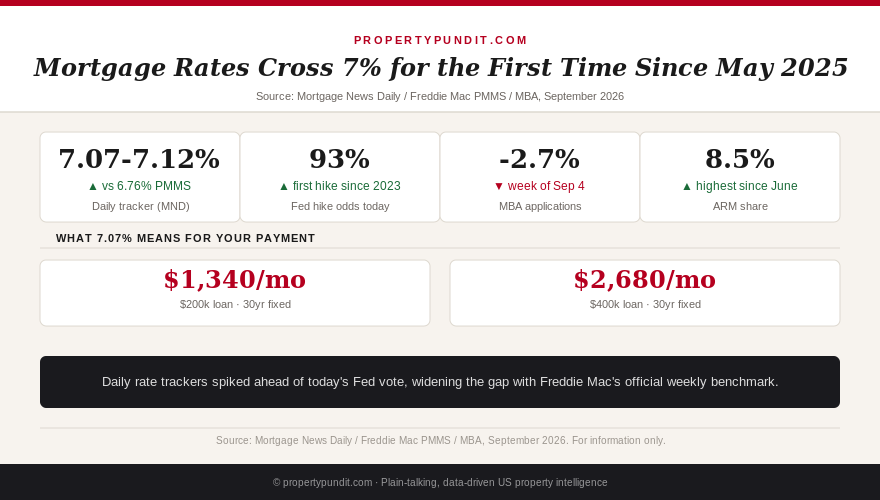
Here's the number that actually matters for your decision: on a $386,190 loan (10% down on the national median home), the gap between today's daily tracker and Freddie Mac's official 6.76% rate is about $80 a month. That's real money, but it's a fraction of what a genuine refinance would cost someone who's sitting on a rate from a few years ago. If you locked in the 3s or low 4s, this week's number doesn't change your math. It confirms it.
The bigger story is what happens at 2pm ET today, when the Fed's policy statement lands, followed by a press conference at 2:30. Futures markets are pricing a 93% chance of a quarter-point hike to a 3.75%-4.00% target range, which would be the Fed's first increase since 2023. If you've been assuming rate cuts were coming, that assumption needs updating.
Get this in your inbox every Friday.
One email. The number that matters and what it means for you.
Why the daily tracker and the official rate don't match
Freddie Mac's Primary Mortgage Market Survey, the number most headlines quote, is a weekly average of lender rate sheets published every Thursday. It's the industry's official benchmark, but it's also structurally a step behind. Mortgage News Daily's tracker updates every business day and reacts to bond market moves in real time, which is exactly what happened after Thursday's producer price report came in hot and pushed the 10-year Treasury up 12 basis points in a single session. We covered the full mechanism, why your mortgage rate tracks the 10-year Treasury rather than the Fed's own rate, in yesterday's explainer, and this week's spread between the two numbers, roughly 30 to 35 basis points, is unusually wide even by that standard.
If a lender quotes you something close to 7% this week and you're wondering why it doesn't match the 6.76% you read on the news, this is why. Ask which figure they're quoting and compare it against Thursday's fresh PMMS release before you assume you're getting a bad deal. The two numbers will likely converge somewhat once Thursday's official reading catches up to where daily trackers already sit, but don't expect them to match exactly; a 10 to 15 basis point gap is normal even in calm weeks, and this has been anything but a calm week.
What today's Fed decision actually does to your rate
A 25-basis-point hike to 3.75%-4.00% would be the Fed's first increase since 2023, reversing a cutting cycle that ran through 2024 and 2025. But mortgage rates don't move in lockstep with the federal funds rate, they move with investor expectations about where the funds rate is headed. Because a hike today is already priced in at 93% odds, most of the damage to your rate quote already happened over the past two weeks, not this afternoon. The number that would actually move markets further is a surprise: a bigger-than-expected hike, or a dot plot signaling more hikes are coming in 2027.
For anyone locking a rate this week, that means the practical question isn't "will the Fed hike," it's "did the Fed hike more than expected, or say something more hawkish than expected." Watch the 2:30pm press conference, not just the 2pm statement, for that signal. The Fed's updated Summary of Economic Projections, released alongside today's statement, will also show where each committee member expects the funds rate to land through 2027; a dot plot showing several more hikes penciled in would be a bigger deal for your rate than today's move itself.
Applications are already pulling back
The Mortgage Bankers Association's weekly survey, covering the week ending September 4, showed the Market Composite Index down 2.7% on a seasonally adjusted basis, with purchase applications down a modest 0.2% and refinance applications down 6% week over week and a steep 25% below the same week last year. The MBA's own rate reading hit 6.85%, the highest since June 2025. One number moved the other direction: ARM applications climbed to an 8.5% share, the highest since June, as more borrowers try to dodge the fixed-rate spike with a lower introductory rate. We ran the full ARM-versus-fixed math, including the break-even point after a rate reset, in this month's ARM data drop.
If you're a repeat buyer sitting on a sub-4% mortgage, this data confirms what you probably already suspect: refinancing right now doesn't clear the bar, and won't until rates move meaningfully lower than where they sit today.
It's worth putting this week's applications data in context. The MBA's survey has now shown purchase demand essentially flat or falling for most of the past six months, even as home prices cooled and inventory built to a decade-plus high. That combination, more homes to choose from and softer demand, is exactly what's been pulling list prices down for ten straight months. Rates crossing 7% this week adds one more reason for a hesitant buyer to wait, but it doesn't change the underlying negotiating position: sellers are still cutting prices at the highest rate of 2026, and that edge for buyers isn't going away just because the Fed voted today.
The worked math on locking versus waiting
Take a $350,000 loan balance at a 3.8% rate, roughly where a lot of 2020-2021 refinances landed. Refinancing that balance at this week's 7.07% tracker rate would push the payment from about $1,631 to about $2,345 a month, a jump of $714. No rational homeowner refinances into that gap voluntarily. This is precisely why refinance volume is down 25% year over year: the math simply doesn't work for most people who already have a good rate, and it won't until the spread closes by several points, not a fraction of one.
For a new purchase, the calculation is different but still specific. On that same $386,190 loan, moving from Freddie Mac's 6.76% to the current 7.07% tracker adds about $80 a month, or roughly $28,800 over the life of a 30-year loan if the rate never drops. That's a real cost, but it's a locking decision, not a should-I-buy-at-all decision. If you're inside 30 days of closing, most loan officers will tell you the same thing: lock now and consider a float-down option only if the fee is small relative to the odds of a meaningful drop before closing, which we broke down in our closing costs guide.
What this means for your next move
The math points toward locking if you're already under contract and closing soon: the Fed's move is priced in, and waiting for a surprise rate drop is a bet against 93% odds. If you're still shopping and your credit needs work before you apply, that's the move that actually helps you this week, not rate-watching; see how your credit score actually affects your quote for what moves the needle fastest. And if you're a homeowner hoping to refinance, this week's data confirms the honest answer: it isn't close yet, and chasing it now would cost you more than staying put.