 Property
If you're the kind of investor who reads "0.46% property tax rate" and starts mentally penciling in a Phoenix rental, stop before you call a lender. Arizona genuinely has some of the lowest property tax rates in the West, and it doesn't carve out a punitive higher rate for landlords the way several other states now do. That reputation is accurate. What it leaves out is what happens once you add up every other line on the page: the mortgage, the insurance, the management fee, the vacancy allowance, and a maintenance reserve that a lot of investor pitches quietly skip.
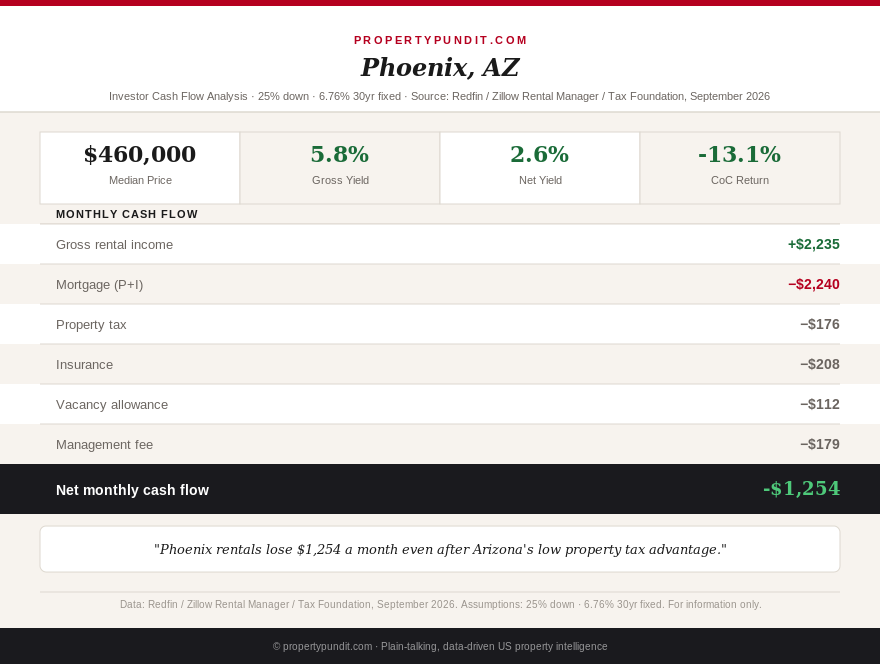
A full underwrite of Phoenix at today's prices and rates shows a single-family rental losing $1,254 a month. Tucson, often pitched as the "affordable" alternative, loses $904. Neither clears a 1.0 debt service coverage ratio, and neither comes remotely close to breaking even. Low carrying costs are a real advantage over the life of a hold, but they were never going to fix a purchase price that has outrun local rents.
This is Arizona's third pass through our state rotation, following underwrites in May and July. The numbers moved for a specific reason worth understanding before you write off the state entirely, or before you assume the earlier, smaller losses were the real picture.
Get this in your inbox every Friday.
One email. The number that matters and what it means for you.
Phoenix's price depends on who you ask
Redfin's city-level data puts Phoenix's August 2026 median single-family sale price at $460,000, down 2.5% year over year as 735 homes closed, a 9.6% drop in sales volume from a year earlier. A separate, broader Greater Phoenix metro figure for the same month puts the median at $445,000, up 1.14% year over year. The two numbers disagree because they're measuring different footprints: the city-proper figure captures Phoenix's own boundaries, while the metro figure blends in the wider valley, including some lower-priced suburbs that pull the median down even as prices there are rising.
Either number tells the same underlying story for an investor: inventory has grown enough, 23,406 active listings and 4.28 months of supply in Greater Phoenix, that the market has shifted from seller-leaning to balanced. Whichever median you use, the cash-flow math below barely changes, which is exactly the point.
The real monthly math
Using the $460,000 city figure, 25% down, and Freddie Mac's current 6.76% rate, a 30-year loan on the remaining $345,000 carries a principal and interest payment of $2,240. Add Maricopa County's 0.46% effective property tax rate ($176 a month) and roughly $208 a month in insurance, and the full PITI payment lands at $2,624. Zillow Rental Manager puts the market rent for a comparable three-bedroom single-family rental at $2,235, which means the mortgage payment alone already exceeds the rent before a single other cost is counted. That's a 0.85 DSCR: the property doesn't even cover its own mortgage payment out of rental income, let alone turn a profit.
Run the same model against the $445,000 Greater Phoenix figure and the DSCR improves slightly to 0.88, with the monthly shortfall narrowing to $1,157 before operating costs. Better, but still nowhere close to a deal that works.
The line the first two passes left out
Here's where this pass diverges from Arizona's May and July underwrites, which priced management and vacancy but never included a maintenance reserve line at all. Standard practice for a long-hold single-family rental is to budget 1% to 1.5% of the property's value annually for repairs, replacements, and the kind of wear that doesn't show up until year six or seven. On a $460,000 Phoenix property, a 1.5% reserve works out to $575 a month. Add that to an 8% management fee ($179) and a 5% vacancy allowance ($112), and the full monthly cost stack reaches $3,490 against $2,235 in rent, a loss of $1,254.
This isn't unique to Arizona. Washington's Spokane market and Wisconsin's Milwaukee market both saw their reported cash flow worsen substantially once this site started pricing a maintenance reserve into every underwrite, and Arizona is simply the latest state to get the same correction. If you've been running your own numbers on a spreadsheet that stops at PITI plus management, add this line before you make an offer.
Why the flat income tax matters too
Arizona taxes rental income at a flat 2.5% state rate, unchanged since the 2023 repeal of Proposition 208's high-earner surcharge. That's a genuinely low rate as state income taxes go, but it's not zero, and it's worth comparing against the states this site has already found to be the real no-tax outliers: Texas, Nevada, and Wyoming, none of which charge a dime of state income tax on rental profit. A landlord clearing even a modest annual profit in Arizona hands over 2.5% of it that a Texas or Nevada landlord in an identical financial position never sees. It's a smaller drag than the cash-flow shortfall above, but it stacks on top of it rather than offsetting it.
This matters most for the investor pitch that leans on Arizona's tax environment as the headline reason to buy. A 0.46% property tax rate sounds like it belongs in the same conversation as Wyoming or Nevada, both of which also skip income tax entirely. It doesn't. Arizona's property tax advantage is real on its own terms, but it isn't paired with the income-tax-free structure that makes those other states a genuinely different proposition for a landlord filing a Schedule E every spring. Treat the 0.46% figure as one input, not the whole case.
Tucson doesn't fix the problem
Tucson's median sale price sits at $325,000, down a modest 0.67% year over year, which on paper looks like the more approachable entry point. Run the same underwrite: 25% down, 6.76% rate, and a $243,750 loan produces a $1,583 principal and interest payment. Pima County's property tax rate, 0.78% effective and more than 60% above Maricopa County's, adds $211 a month, and insurance runs about $170. That's a $1,964 PITI payment against $1,685 in market rent for a comparable single-family home, a 0.86 DSCR that's barely different from Phoenix's 0.85. After the same management, vacancy, and maintenance lines, Tucson loses $904 a month.
The lesson here matters beyond Arizona: a lower purchase price doesn't automatically mean a better deal if the local property tax rate eats most of the savings. Tucson's price is 29% lower than Phoenix's, but its tax rate is 70% higher, and the two mostly cancel out. Insurance runs slightly cheaper in Tucson too, about $170 a month against Phoenix's $208, but that gap is nowhere near large enough to swing the comparison on its own.
Neither city's inventory situation looks likely to fix this soon, either. Phoenix's 4.28 months of supply and Tucson's roughly 73-day average time on market both point to a market with real buyer choice, which tends to put downward pressure on prices rather than the kind of rent growth that would close a $900-plus monthly gap.
What this means for you
If you're evaluating Arizona as a cash-flow investment at today's prices and rates, the math points toward passing, not buying. Neither Phoenix nor Tucson clears breakeven, and the gap in both cities is large enough that a modest rent increase or a small price correction won't close it on its own. Investors who already own here, or who are underwriting Arizona as a long-term appreciation and tax-efficiency play rather than a monthly-income play, can reasonably stick with the state's genuine advantages: a low, uniform property tax rate and no separate landlord penalty. But if positive monthly cash flow is the goal, this pass confirms that Arizona in September 2026 isn't the state to chase it in. For the mechanics behind these numbers, including how DSCR is calculated and what lenders actually check, see our DSCR loan investor guide and the county-level SFR yield map; for a similar low-tax-marketing trap in another state, our Utah spotlight found the same pattern with a doubled investor rate hiding behind an advertised homeowner discount, and our July underwrite of this same state shows how much the picture has shifted since the maintenance reserve was added.