 Property
You already own two rental properties in Texas, and the appeal of a state with zero income tax and zero capital gains tax is obvious on its face. Wyoming checks both boxes, and it shows up on nearly every "best states for investors" list for exactly that reason. The last time this site ran the numbers here, Casper looked like the closer thing to a workable deal, the smallest monthly loss of Wyoming's three ordinary markets, while Cheyenne posted the widest. Rerun both cities today at current prices, current insurance, and today's 6.76% rate, and that gap between them barely exists anymore.
Cheyenne's median price actually fell since the last check. Casper's rose by nearly 8%. On paper those read like opposite stories. In practice, they produced almost the same investor math.
Cheyenne's price fell. Its investor loss shrank with it.
Redfin puts Cheyenne's median sale price at $379,793 over the three months ending June 2026, up 5.5% year over year on that longer window but down from the $424,500 figure this site used two months ago, a reminder of how thin and month-to-month Laramie County's sample can run. At 25% down and today's 6.76% rate (Freddie Mac PMMS, September 10, 2026), the $284,845 loan carries an $1,849 monthly principal-and-interest payment. Wyoming assesses residential property at just 9.5% of fair market value before the mill levy applies, producing an effective rate of roughly 0.53% statewide, about $168 a month here. Insurance runs an estimated $223 to $267 a month for coverage sized to this home's value (insure.com, 2026); this analysis uses the $245 midpoint. PITI comes to $2,262.
Against $1,500 in citywide rent, unchanged from the last check and still anchored by F.E. Warren Air Force Base's steady base of renters, DSCR comes to 0.66, up slightly from 0.65. After a combined 13% for management and vacancy, cash flow runs roughly negative $957 a month, an improvement of $44 from the negative $1,001 this site reported before. So what for you: the price pullback did more work than the rate increase undid, which is the one piece of good news in this update, but a $44 improvement on a $957 monthly loss is still a loss you'd be funding out of your own pocket every month.
Get this in your inbox every Friday.
One email. The number that matters and what it means for you.
Casper was Wyoming's best deal. It just got $182 a month worse.
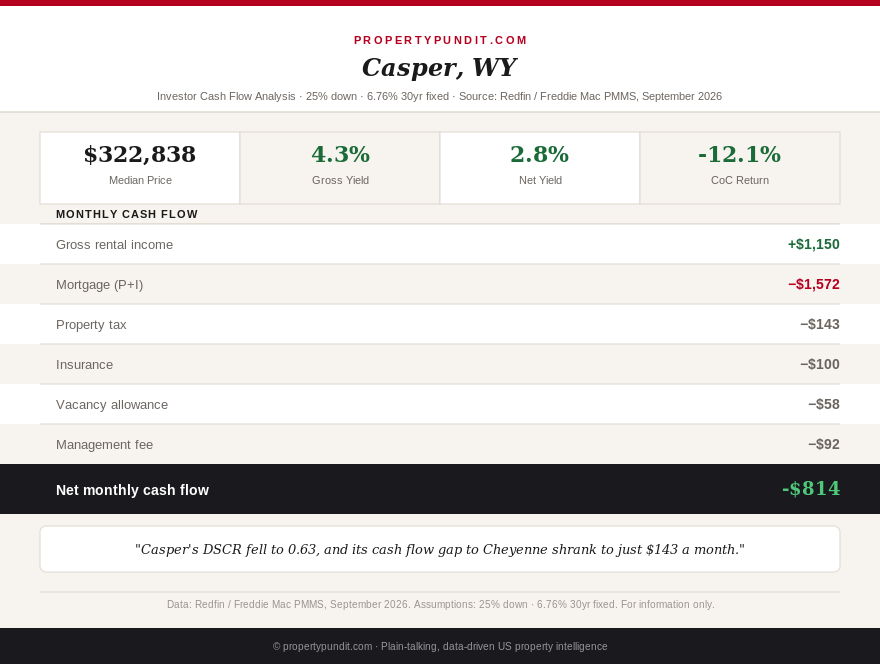
Casper told the opposite price story. Redfin puts its median sale price at $322,838 over the three months ending July 2026, up 7.6% year over year, among the fastest-appreciating markets in the state and a place Redfin now rates "very competitive," with homes going pending in around 30 days. At 25% down and 6.76%, the $242,128 loan carries a $1,572 monthly principal-and-interest payment. Property tax at the same 0.53% effective rate adds about $143 a month. Insurance in Casper runs closer to $96 to $104 a month for comparable coverage (MoneyGeek, The Zebra, 2026); this analysis uses $100. PITI comes to $1,815.
Against $1,150 in rent, DSCR falls to 0.63, down from 0.70 the last time this site checked, moving further from, not closer to, the 1.0 threshold most DSCR lenders require. Cash flow runs roughly negative $814 a month, worse by $182 than the negative $632 reported before, almost entirely a function of the higher price and a modestly higher insurance estimate. The energy-sector job base that anchors Casper's rental demand hasn't changed at all. So what for you: Casper's reputation as Wyoming's "smallest loss" market was earned two months ago at a lower price. At today's numbers that reputation no longer holds up, and if you're underwriting off the old figure, you're underestimating your real monthly cost by close to $200.
The gap between Wyoming's two biggest markets just fell from $369 to $143
Put the two updates side by side and the real story isn't either city on its own, it's how close they've become. Two months ago, Cheyenne's loss ran $369 a month worse than Casper's, a wide enough gap that "just buy in Casper instead" was a reasonable rule of thumb. Today that gap is $143, less than half what it was, because Cheyenne's price correction and Casper's price run happened at the same time, from opposite directions, and mostly canceled each other out at the portfolio level. So what for you: if you were choosing between these two cities based on which one loses less money, the honest answer today is that it barely matters which one you pick, since neither clears DSCR and the dollar difference between them has nearly disappeared.
Laramie and Jackson Hole: the same problems, unchanged this pass
This update didn't re-verify Laramie or Jackson Hole in the same depth. Laramie's own DSCR problem, 0.73 in the last check on a citywide rent that likely understates what University of Wyoming students actually pay by the bedroom, is carried forward unverified this pass and worth a fresh look next time Wyoming comes up in rotation. Jackson Hole remains what it was: a market where the typical home value cleared $1.9 million in the last check, driven by ultra-high-net-worth second-home and short-term-rental demand that distorts any statewide median and makes standard DSCR underwriting close to meaningless there. So what for you: if a "Wyoming home prices" headline number ever looks unusually high, check whether Teton County is doing the pulling before you assume the whole state got more expensive.
Zero income tax is real. It still hasn't fixed the price-to-rent math.
Wyoming charges no state income tax and no state capital gains tax, a genuine, durable structural advantage over almost every other state this site has covered. It shows up as real savings on any rental income you collect and on the exit, when you eventually sell. It has never been the reason these three ordinary markets fail DSCR, and it still isn't. The same pattern has now shown up in Texas, South Dakota, Tennessee, and Utah: a favorable tax structure is a genuine perk, not a fix for a purchase price that has outrun what local rent can carry. So what for you: don't let Wyoming's tax pitch talk you into skipping the DSCR math on the actual property, because the tax bill was never what was breaking these deals.
Wyoming lawmakers are drafting the same investor tax gap already confirmed in Idaho and Utah
There's a new wrinkle worth watching, though it isn't law yet. Wyoming's legislative interim committee advanced a bill this month that would cut the residential assessment ratio, the share of a home's value that actually gets taxed, from 9.5% to 8.3%, but only for owner-occupied primary residences (Wyoming Tribune Eagle / County 17, September 2026). Investment property, including everything modeled in this article, would stay at the current 9.5% ratio. The bill carries an $87.1 million appropriation to backfill the revenue loss for schools and local governments, and it's still moving through Wyoming's interim process ahead of the 2027 general session, not enacted, not yet in effect on any property tax bill you'd actually pay.
If it eventually passes, an owner-occupied home's effective rate would drop to roughly 0.46%, while an investor holding an identical property next door keeps paying 0.53%, a gap of about 14% on the tax line alone. That's the same primary-residence-exemption mechanism this site has now found in Idaho and in Utah's Salt Lake City market, and Wyoming would make it three states running the identical play. So what for you: this isn't priced into the numbers above because it isn't law, but if you're underwriting a multi-year hold in Wyoming, model the version where your property tax gap against an owner-occupant widens further, not stays flat.
Put it together and neither Cheyenne nor Casper clears DSCR at 25% down and 6.76%, and the gap between them has narrowed enough that picking one over the other on cash flow grounds isn't a real strategy anymore. The math points toward passing on both as ordinary rental buys, the same conclusion this site reached on the first pass, just with a smaller margin separating them now. If Wyoming's tax structure is genuinely what's pulling you in, frankly, the more defensible play is a short owner-occupant hold to capture the lower assessment ratio if that bill eventually becomes law, not a straight DSCR rental purchase at today's prices. For the underwriting framework behind every number in this article, the DSCR loan investor guide and the county-level SFR yield map are the two best starting points, and if you're weighing Wyoming against another zero-income-tax state, South Dakota's spotlight ran into the identical tax-doesn't-fix-cash-flow conclusion. Compare both cities against the numbers this site published in July to see exactly how much two months moved the math in your own model.