 Property
Two properties into your Texas portfolio, you already know the drill: a "cheap Midwest market" pitch means nothing until you run the actual PITIA against actual rent. Fourteen months ago, this site ran that math on Wisconsin's three largest markets and found Milwaukee the only one that cleared a lender's DSCR line, limping in at a modest $125-a-month loss once management and vacancy were subtracted. That article, like most of this site's early spotlights, never modeled a maintenance reserve. Rerun the same three cities today with that line item added back in, at 25% down and 6.71%, and the picture is worse than the headline number suggested the first time.
Milwaukee still passes DSCR. It just loses three and a half times as much money doing it. Madison's rent has grown, and its price has grown faster. Green Bay is the one genuine surprise: a fresh, city-specific tax figure came in lower than the county-wide estimate this site used before, the first time a Wisconsin number has moved in the investor's favor rather than against them.
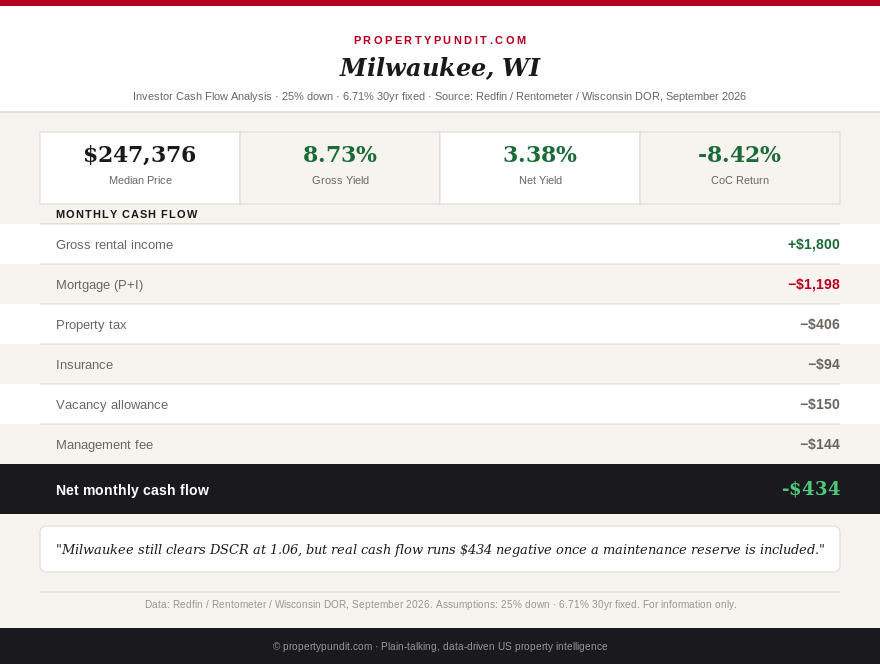
Milwaukee: the DSCR pass just got a lot more expensive
Milwaukee's median home sale price has climbed to roughly $247,376 (Redfin, July 2026), up from the $236,000 this site used in mid-2026. Rent moved too, and in the direction that matters: a genuine 3-bedroom single-family rental now runs closer to $1,800 a month (Rentometer, August 2026), well above the $1,650 figure used previously and further still above RentCafe's citywide apartment average of $1,639, the number a quick search would surface first. At 25% down and today's 6.71% (Freddie Mac PMMS, September 3, 2026), the $185,532 loan carries an $1,198 monthly principal-and-interest payment. Milwaukee's in-city effective property tax rate now checks in around 1.97%, higher than the 1.82% figure this site used the first time, adding roughly $406 a month, plus an estimated $94 in insurance (scaled from Wisconsin's statewide $1,367-a-year average, ValuePenguin 2026). PITIA comes to $1,698.
Against $1,800 in rent, that's a DSCR of 1.06, still clearing the 1.0 minimum most DSCR lenders require. The number that changes everything is the one this site left out the first time: a 1.5%-of-price annual maintenance reserve, roughly $309 a month on a property this age and price tier. Subtract that, plus an 8% management fee and a 5% vacancy allowance, and effective cash flow lands at roughly negative $435 a month, not the negative $125 this site reported before. So what this means for you: a DSCR pass tells a lender you qualify. It does not tell you whether the deal cash-flows, and Milwaukee is the cleanest illustration on this site of exactly how much daylight sits between those two tests.
Madison: the best rents in the state, and an even bigger gap
Madison remains the state's counterintuitive case. A 3-bedroom single-family rental here now commands roughly $2,600 a month (RentCafe-range market data, 2026), up from $2,515, still the strongest rent figure of any Wisconsin market by a wide margin. But Madison's median home price has run up further too, to approximately $445,000 (Redfin, three months ending June 2026), driven by University of Wisconsin and state government employment demand pressing against a supply base that isn't expanding to match.
At 25% down and 6.71%, the $333,750 loan carries a $2,156 monthly principal-and-interest payment. The city of Madison's own 2026 budget documents put its effective property tax rate at 1.84%, itself the lowest the city has set in 40 years but still notably higher than the 1.69% county-wide estimate this site used previously, adding about $682 a month, plus an estimated $169 in insurance. PITIA comes to $3,007. Against $2,600 in rent, DSCR comes in at 0.86, below the 1.0 threshold, and once the same maintenance reserve, management fee, and vacancy allowance are subtracted, cash flow runs roughly negative $1,291 a month, close to double the negative $676 figure this site reported the first time. So what this means for you: Madison proves again that strong rent alone doesn't make a deal work, and this pass shows the gap between Madison's rent and its price has only widened, not narrowed, even as both numbers grew.
Get this in your inbox every Friday.
One email. The number that matters and what it means for you.
Green Bay: the one number that moved in the investor's favor
Green Bay's median home price sits around $265,000 (Redfin, July 2026), up sharply on a year-over-year basis but actually a touch below the $273,000 figure this site cited before, reflecting normal month-to-month movement in a smaller market. A comparable single-family rental now earns an estimated $1,550 a month, close to the $1,400 used previously. At 25% down and 6.71%, the $198,750 loan carries a $1,284 monthly principal-and-interest payment.
Here's the twist: Brown County's own 2026 budget cited the lowest county property tax rate on record, and a fresh, city-specific check puts Green Bay's effective rate closer to 1.50%, well below the 1.75% figure this site used the first time. That correction adds roughly $331 a month rather than the $398 previously assumed. Insurance runs an estimated $101. PITIA comes to $1,716. Against $1,550 in rent, DSCR lands at 0.90, meaningfully improved from the 0.78 reported before. Cash flow still runs negative, roughly $693 a month once the maintenance reserve is added, worse in dollar terms than the negative $573 figure from before, but the DSCR improvement is real and it's the first Wisconsin number in two passes to move the right direction. So what this means for you: even a genuine tax correction in your favor doesn't automatically fix a deal's cash flow if a cost line was missing entirely from the first analysis, which is exactly what happened here.
The missing maintenance line, not rent or insurance, drove most of this pass's damage
Every other input in this update moved in a mixed or modest direction: rents rose across all three cities, Milwaukee and Madison's tax rates moved up while Green Bay's moved down, and insurance stayed close to Wisconsin's low, non-coastal, non-wildfire baseline. What moved every single city's cash flow lower, without exception, was the addition of a maintenance reserve this site's first Wisconsin pass never modeled at all. That's the same root cause behind Washington's second-pass reversal published earlier this month, where Spokane's cash flow swung from positive $24 to negative $565 largely because of the identical missing line. So what this means for you: before you trust any published DSCR-passes-but-thin-margin number, whether it's ours or a lender's own marketing page, ask specifically whether a maintenance reserve was included. If the answer is no, assume the real number runs several hundred dollars worse than what's on the page.
The income tax bill is unchanged, and it still isn't the reason Wisconsin fails
Wisconsin's graduated income tax still runs 3.50% to 7.65% for 2026 (Tax Foundation, 2026), with bracket thresholds adjusted modestly for inflation but no rate change since the first pass. That's a genuine, ongoing cost for an out-of-state investor, but it was never the reason these three markets struggle, and it still isn't. Compare it against Washington's complete exemption on real estate capital gains, a durable structural advantage Wisconsin doesn't offer, and Wisconsin's tax position looks average for the Midwest rather than an outlier in either direction.
The real constraint, in Milwaukee, Madison, and Green Bay alike, is the same one showing up nationally in 2026: purchase prices have moved further from what rent alone can carry at a 6.71% rate, and a maintenance reserve this site should have modeled from day one only makes that gap more visible. So what this means for you: don't rule Wisconsin out on tax grounds and don't assume it works on "affordable Midwest" reputation either. Underwrite the specific property against its specific rent, including a real maintenance line, before assuming a state-level headline tells you anything about one deal.
Put the three markets together and Milwaukee remains the only one worth a serious look, and only with the loss it now actually shows. Madison's superior rent still can't outrun its superior price, and the gap widened, not narrowed, on this pass. Green Bay's tax correction is genuinely good news, but it wasn't enough to offset the missing maintenance line by itself. The math points toward passing on all three as they stand, unless you can find a specific Milwaukee property priced meaningfully under that $247,376 median or a rent meaningfully above $1,800; frankly, if you're underwriting a Wisconsin deal off last year's numbers, you're underestimating the real monthly cost by a few hundred dollars, and most investors who rerun this exact math end up walking away from Madison and Green Bay entirely. For a framework on how to underwrite any of these three deals properly before making an offer, the DSCR loan investor guide and the county-level SFR yield map are the two best starting points, and if a Milwaukee deal looks close on paper, run the numbers again against the state's first-pass figures to see exactly how much a real maintenance reserve moves your own bottom line.