 Property
Here's the number that mattered most in our first look at Washington back in July: +$24 a month. That was the monthly cash flow on Spokane's cheapest rental tier, the single positive number in a state where Seattle and Tacoma both lost money at the median. It was thin, but it was real, and it made Spokane's entry-level stock the one place in Washington an investor could point to and say the numbers work. Run that same property through a second pass with an actual landlord insurance quote instead of a guess, and a maintenance reserve that should have been there from the start, and the number is -$565.
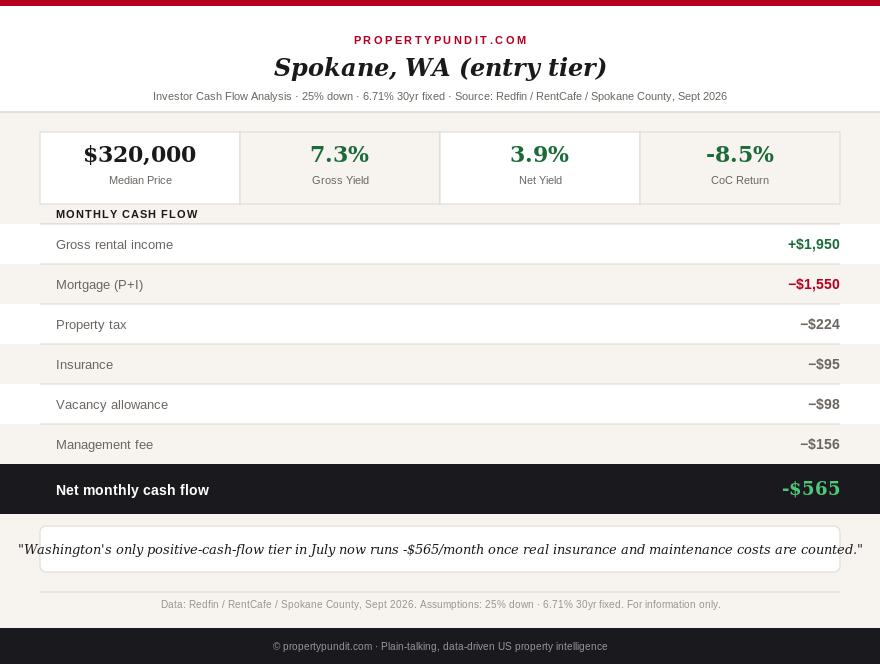
This is a second-pass update to our July 4, 2026 Washington spotlight, and the state's two real advantages, zero income tax and a capital gains exemption on real estate, haven't moved. What's changed is the accounting underneath the one market that used to work, and a new statewide rent cap that's now fully in effect.
The only positive number in Washington just went negative
Spokane's entry tier has appreciated since July, from a representative $250,000 to roughly $320,000 for a starter-home-grade property in areas like North Spokane and Mead (multiple 2026 local market sources). At that price, 25% down, and today's 6.71% rate (Freddie Mac PMMS, September 3, 2026), the loan payment alone runs about $1,550 a month. Add Spokane County's 0.84% effective property tax rate ($224/month) and a landlord insurance premium sourced at roughly $95 a month, and PITIA comes to about $1,869. Against a representative $1,950 monthly rent for a 3-bedroom rental in this tier, that's a DSCR of 1.04, still comfortably above the 1.0 floor most DSCR lenders check.
| Item | Monthly |
|---|---|
| Purchase price | $320,000 |
| Down payment (25%) | $80,000 |
| Loan amount | $240,000 |
| P&I (6.71%, 30yr) | $1,550 |
| Property tax (0.84%, Spokane County) | $224 |
| Insurance (sourced landlord quote) | $95 |
| PITIA total | $1,869 |
| Gross rent (3BR SFR) | $1,950 |
| DSCR (gross rent / PITIA) | 1.04: PASSES |
| Vacancy allowance (5%) + management (8%) | -$246 |
| Maintenance reserve (1.5%/yr) | -$400 |
| Monthly cash flow | -$565 |
The DSCR pass is real. The cash-flow number is what a lender never checks: a 5% vacancy allowance, an 8% property management fee, and a 1.5%-of-value annual maintenance reserve, a line our July first pass left out entirely. That omission, combined with the July-to-September price and rate moves, accounts for nearly the entire swing from +$24 to -$565.
So what for you: if your underwriting stops at "does it clear DSCR," Spokane's entry tier still says yes. If it includes a full operating budget, the same property costs you $565 a month to hold, and that's the number that should decide whether you write the check.
Get this in your inbox every Friday.
One email. The number that matters and what it means for you.
Seattle and Tacoma: worse than the first pass, not better
Seattle's median has moved to $899,000 (Redfin, three months through July 2026), above the $865,000 Zillow ZHVI figure our July pass used; the gap reflects Redfin's transaction-based median running above Zillow's broader home-value index, and we're using Redfin here since it reflects what buyers are actually paying. At 25% down and 6.71%, the loan payment alone is about $4,354 a month. Add King County's 0.83% property tax ($622/month) and a Seattle-tier insurance estimate of $142 a month, and PITIA comes to roughly $5,118. Against a representative $3,695 monthly rent for a 3-bedroom single-family rental, that's a DSCR of 0.72, and full cash flow after vacancy, management, and maintenance runs about -$3,013 a month, nearly double the -$1,644 our July pass showed, mostly because that first pass never counted a maintenance reserve at all.
Tacoma tells a similar story at a smaller scale. At a $497,000 median, 25% down, Pierce County's 0.91% tax rate, and a $2,882 monthly rent, DSCR comes out to 0.99, essentially breakeven on paper and actually better than July's 0.86 thanks to real rent growth. But the same missing maintenance reserve pulls full cash flow to about -$1,013 a month, worse than July's -$804. Rent is genuinely rising in both cities. It isn't rising fast enough to outrun price, rate, and a properly counted maintenance budget.
So what for you: Seattle and Tacoma were never going to be cash-flow plays even in July, and a more honest accounting this pass makes that gap wider, not narrower. Anyone underwriting either city needs to be buying for appreciation and tax efficiency, not monthly income.
A new statewide rent cap just landed on top of all of this
Washington's House Bill 1217 took effect in 2025 and is now fully live for 2026 lease renewals: rent increases on existing tenancies are capped at 7% plus inflation or 10%, whichever is lower, which works out to 9.683% for most 2026 renewals. Landlords can't raise rent at all during a tenant's first 12 months, must give 90 days' notice before any increase, and can't charge more than a 5% premium for a month-to-month lease over a fixed term on the same unit. Violations carry real teeth: tenants can recover up to three times the overage, and the state Attorney General can seek penalties up to $7,500 per violation. New construction under 12 years old and owner-occupied buildings of four units or fewer are exempt.
A 9.683% ceiling isn't a binding constraint for a Spokane or Tacoma landlord this year, since none of the rents modeled above are anywhere near that kind of annual jump. But it removes the option that has historically bailed out a thin-margin rental in a hot market: a sharp one-time rent catch-up. If a Washington rental is underwater on cash flow today, the law caps how fast rent growth alone can close that gap going forward.
So what for you: HB 1217 doesn't change today's negative numbers, but it puts a ceiling on how quickly you can grow your way out of them, which matters if your investment thesis depends on rent catching up to your costs over the next few years.
What this means for a Washington investor in 2026
Washington's real advantage hasn't changed and it's a genuine one: no state income tax on rental income, and real estate sales are fully exempt from the state's capital gains tax, a combination most competing no-income-tax states don't fully match. Those are durable, structural benefits that show up on your tax return and at exit, not in a monthly cash-flow line. They're also exactly why Seattle, Tacoma, and Spokane keep attracting investor capital despite math that doesn't pencil at the median.
The math points toward treating any Washington rental in 2026 as an appreciation-and-tax-efficiency play rather than a passive income source, since even the state's best-performing tier now runs negative once a full operating budget is applied. Frankly, if a DSCR pass above 1.0 has been your green light on a Spokane deal, run it again with a real insurance quote and a maintenance line before you sign, the same correction that flipped this one from +$24 to -$565. Before you commit capital to any West Coast market, check your numbers against a DSCR lender's actual minimum, which usually sits above the bare 1.0 breakeven used here, and compare Washington's after-tax picture against county-level yield data in states that still clear positive cash flow before you decide where the next check goes. If the down payment on a $320,000-plus entry property is the sticking point, the 20%-down assumption is often wrong and worth revisiting before ruling a market out on cash alone.
Most investors who run this specific math end up treating Washington the way they'd treat a low-yield, high-quality bond: worth holding for the tax treatment and long-run appreciation, not for what it puts in your account every month.