 Property
If you passed on Morgantown, West Virginia as a rental market after our first pass at this state back in July, you were working from a number that was wrong by $694 a month. Not a rounding error, not a source-methodology quirk, an actual bad input that made a near-breakeven college-town deal look like one of the worst numbers in the state. We are going back through West Virginia today with corrected data, and the fix changes the ranking of every market in it.
Why West Virginia is back up for review
West Virginia's statewide median sale price hit $274,142 in June 2026, up 4.2% year over year, according to Redfin. Zillow's smoothed home value index shows a much lower $182,704, a divergence you should expect in a low-transaction-volume state where Redfin's closed-sale median skews toward whatever actually traded that month while Zillow values the entire housing stock, including homes that rarely sell. Name both if you're quoting a "West Virginia price" to anyone.
The state's income tax picture hasn't changed since our first look: West Virginia's third consecutive cut is still in effect, a 5% reduction across every bracket under Senate Bill 392, bringing the top marginal rate to 4.58% from 4.82%, retroactive to January 1, 2026. That is old news at this point, not a new finding, so it's not the headline here. What is new is that three of our own numbers from the first pass turned out to be stale or wrong, and fixing them tells a more useful story than the tax cut does.
If you're tracking West Virginia as a candidate market, treat the state-level tax and price trend as background context. The market-by-market cash flow numbers below are what actually decide whether a specific deal works.
Get this in your inbox every Friday.
One email. The number that matters and what it means for you.
The rent number that was actually wrong
Our July analysis of Morgantown used a rent figure of $888 a month for a three-bedroom rental, which produced a 0.63 DSCR at the time, one of the worst readings in the state. That figure came from a citywide rental average that includes West Virginia University's dense stock of small studio and one-bedroom units aimed at individual students, the same trap we flagged in Oregon's second-pass correction, where a blended apartment average understated true single-family rent by $785 a month in Portland. Morgantown is now a second confirmed case of the same pattern.
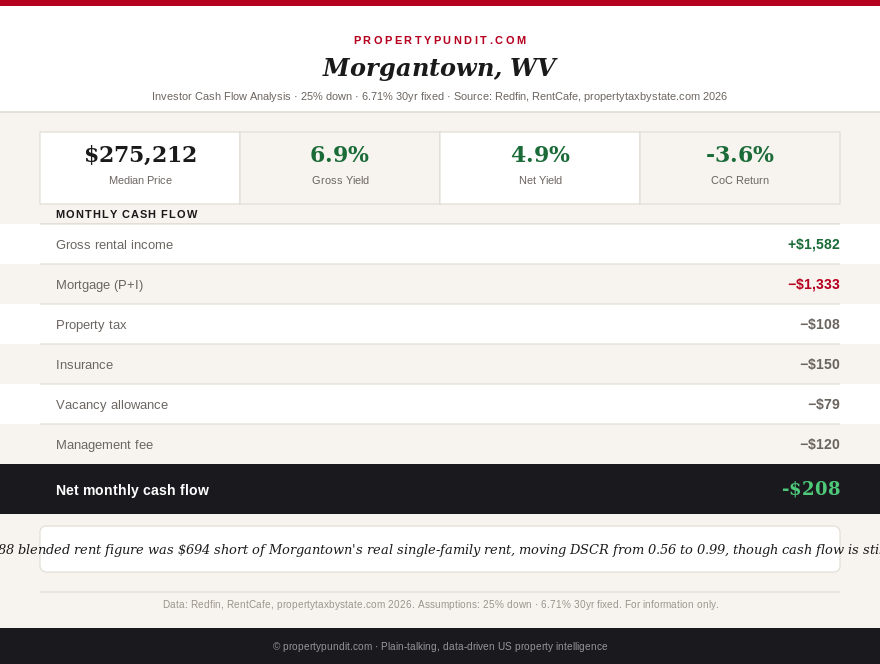
The real number: a genuine single-family house in Morgantown rents for about $1,582 a month on average, and dedicated three-bedroom apartment units run even higher, near $1,667 (RentCafe, 2026). That is a $694 gap between the figure we used before and what an actual investor renting out a full house near WVU's campus would collect. Recomputed at Morgantown's current $275,212 median price and today's 6.71% rate, 25% down, the old $888 rent produces a DSCR of 0.56. The corrected $1,582 rent produces a DSCR of 0.99, a jump of 0.43 points from one input alone, with the price and rate held constant in both calculations so the comparison isolates the rent error specifically.
WVU's Morgantown enrollment is actually projected to fall about 5% for fall 2026, to 22,409 students from 23,532, so this isn't a story about surging student demand inflating rents. It's a story about a citywide average masking what a full house, rather than a slice of a shared apartment building, genuinely commands in this market. If you had ruled out Morgantown based on our earlier number, it's worth a second look with a rent figure that actually matches the asset you would be renting out.
How the three West Virginia markets rank now
Martinsburg, in the DC and Baltimore commuter corridor of Berkeley County, is now the state's strongest market: a $277,000 median home, a 0.52% effective property tax rate, and an average house rent around $1,800 a month produce a DSCR of 1.12, comfortably above the 1.0 lender minimum, and a cash flow of about negative $39 a month once an 8% management fee and 5% vacancy allowance are applied. That is a real improvement from our first pass's 0.86 DSCR reading for the same city, driven mainly by a more accurate current rent figure for this commuter-driven submarket.
Charleston, the state capital in Kanawha County, comes in second: a $228,885 median, up a sharp 11.7% year over year, a 0.65% effective property tax rate, the highest of the three cities, and a three-bedroom rent near $1,488 a month produce a DSCR of 1.06 and cash flow of about negative $107 a month. Morgantown, with its corrected rent figure, now sits third at a 0.99 DSCR and roughly negative $208 a month in cash flow, essentially tied with Charleston rather than trailing it by a wide margin the way our first pass suggested.
The practical takeaway is that the gap between West Virginia's best and worst major market just narrowed from a 0.49 DSCR spread to a 0.13 spread once the data was corrected, which means the state is more internally consistent than it first appeared, not that any one city has pulled decisively ahead.
What is still true: nobody clears positive cash flow
Even with Morgantown's correction, no West Virginia market in this analysis produces positive monthly cash flow after real operating costs. The statewide median itself, at $274,142 and an estimated blended 0.55% property tax rate, produces a 0.93 DSCR and roughly negative $298 a month, the weakest of the four figures in this piece specifically because it reflects a mix of higher-cost and lower-cost counties rather than any single, well-chosen submarket. That is consistent with the pattern we have now confirmed in most states we have revisited this year: correcting a bad input moves the ranking inside a state without necessarily moving any market across the breakeven line.
Martinsburg's near-breakeven position at negative $39 a month is close enough that a modest rent increase, a slightly better insurance quote, or a buyer willing to put down more than 25% could plausibly close the remaining gap on a specific property, which isn't something we could have said about any West Virginia market in July.
The regulatory backdrop, briefly
West Virginia has no statewide rent control law, and no city in the state has adopted a local ordinance restricting rent increases between tenancies, according to current landlord-tenant law summaries. Security deposits are capped at one month's rent, and landlords get a full 24 hours' notice requirement before they must let a tenant know about a non-emergency entry, both fairly standard, landlord-workable terms. None of this has changed since our first pass, and it remains a genuine, if secondary, point in the state's favor relative to markets with active rent-cap legislation.
If landlord-friendly regulation is a factor in your state selection, West Virginia still checks that box even though its cash flow math doesn't yet work at current prices and rates.
What this means for your next move
The math points toward Martinsburg as West Virginia's most investable market right now, close enough to breakeven that a specific, well-underwritten property could clear it, while Charleston and a corrected Morgantown both sit in a similar, second-tier position rather than one being clearly better than the other. Frankly, if you had already written off Morgantown specifically because of a rent number you saw from an older analysis, including our own, that number was wrong, and it's worth re-underwriting with a genuine single-family rent figure before you move on. For a deeper look at how DSCR lenders actually price and structure these loans once you have a real number to work with, see our DSCR loan investor guide, and cross-check any county-level yield assumption against our SFR yield county map before you commit. Our original July analysis and the Oregon correction that first surfaced this same rent-blending error are both worth reading side by side with this piece if you want the full before-and-after picture.