 Property
Vermont's investor pitch has always leaned on one idea: Act 250, the state's 1970 land-use law, keeps new supply scarce enough that patient capital wins on appreciation even when monthly cash flow doesn't work. That thesis just got more complicated. Burlington, South Burlington, and Rutland City are all preparing applications for a new "Tier 1A" designation that would exempt development in their densest areas from Act 250 review entirely, a genuine crack in the 56-year-old constraint this market has been built around. The exemption isn't in effect yet. It only takes hold once Vermont's Land Use Review Board approves each city's specific application. But the direction is clear, and it changes what you're actually betting on if you're underwriting Vermont property today.
This is a second-pass update to our July 2026 Vermont spotlight. Statewide, the median home price is $423,674 (Redfin, June 2026), down 2.0% year over year, up meaningfully from the $385,000 statewide figure we cited in July, a reminder that a single month's read in a low-transaction state like Vermont can swing hard even when the year-over-year trend is flat to down. What actually changed since our first pass isn't just the headline number. It's the Act 250 reform, a materially updated property tax picture for Burlington and Rutland City specifically, and a new statewide rent-increase law that didn't exist in July.
The exemption Vermont's biggest cities are chasing
Act 250 requires environmental, traffic, and community-impact review for larger developments statewide, and it's the reason this market has been described as a supply-constrained, appreciation-only play since our first pass. Act 181, passed in 2024, and further legislation enacted in 2026 replaced the old one-size-fits-all review with a tiered system. Starting January 1, 2026, a municipality can apply to the Land Use Review Board for Tier 1A status covering the parts of the city suitable for dense development. Inside an approved Tier 1A zone, development is fully exempt from Act 250 review. Burlington, South Burlington, and Rutland City, Vermont's three largest cities and, not coincidentally, the three markets this and our first-pass article have covered, are all currently preparing applications.
None of the three has been approved as of this article's publication. The exemption becomes effective only once the Land Use Review Board signs off on each city's specific application, not on a fixed 2026 date, so treat this as a real but pending shift, not a completed one. If Burlington's application clears, the core scarcity argument behind this market's appreciation thesis weakens specifically in the city where it's mattered most.
So what for you: if you're holding Vermont property, or considering it, on the strength of "no new supply is coming," that assumption is no longer safe to make unconditionally in Burlington, South Burlington, or Rutland City specifically. Track the Land Use Review Board's decision on each application before you treat permanent scarcity as this market's guaranteed edge.
Burlington's tax system quietly favors landlords. Barely.
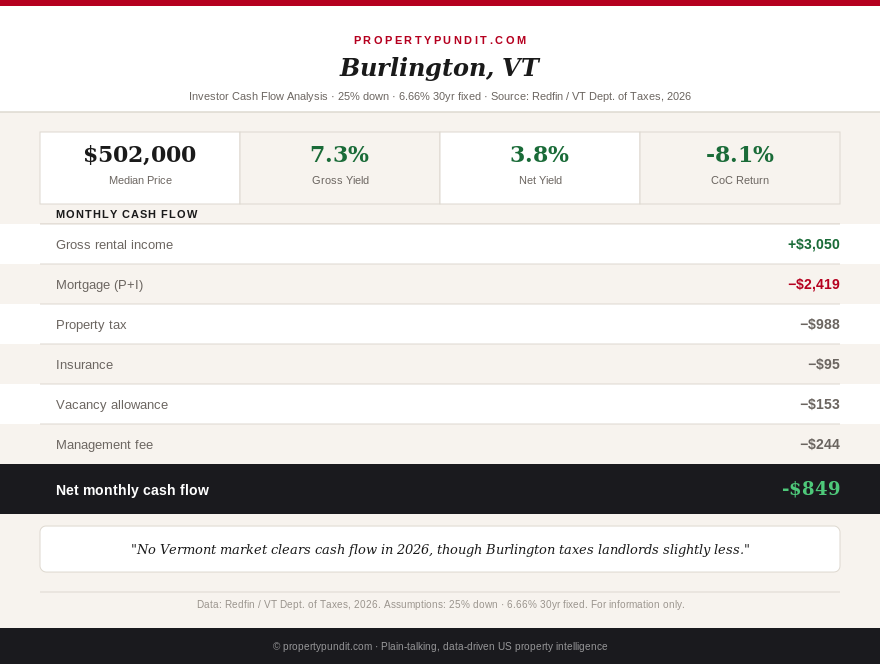
Burlington's median sale price sits at $502,000 over the three months ending June 2026, down 2.6% year over year (Redfin), with price per square foot down 5.4% over the same period, both signs of a market cooling at the edges even as the level stays high. For an investor, 3-bedroom houses in Burlington command a median rent of about $3,050 a month as of mid-2026 (Zumper), broadly unchanged from the $3,050 figure we used in July.
Vermont's education property tax runs on a dual-rate system: a homestead rate for owner-occupied primary residences and a nonhomestead rate for everything else, including long-term rentals. Each town's actual rate depends on a formula involving its own school district spending and its Common Level of Appraisal, or CLA, the ratio between a town's assessed values and true market value. Burlington's CLA sits at 81.76%, high enough (meaning its assessments are relatively current) that its FY2026 nonhomestead education rate, $1.5072 per $100, actually comes in slightly below its homestead rate of $1.5264. Add Burlington's FY2026 municipal rate of $0.8556 per $100, which applies identically regardless of homestead status, and the total effective rate is about 2.36% of assessed value for a rental versus 2.38% for an owner-occupant, a real but small inversion of the pattern this site has documented in Idaho and Utah, where investors pay roughly double the homeowner rate. In Vermont, the direction depends entirely on the town's own assessment currency, not a blanket exemption.
| Item | Monthly |
|---|---|
| Purchase price | $502,000 |
| Down payment (25%) / loan | $125,500 / $376,500 |
| P&I (6.66%, 30yr) | $2,419 |
| Property tax (2.36% nonhomestead, city + education) | $988 |
| Insurance (statewide estimate, 2026) | $95 |
| PITI total | $3,502 |
| Gross rent (3BR SFR, 2026) | $3,050 |
| DSCR (gross rent / PITI) | 0.87: FAILS |
| Vacancy (5%) / management (8%) | -$153 / -$244 |
| Effective rent after vacancy/mgmt | $2,654 |
| Monthly cash flow | -$849 |
That -$849 monthly loss is meaningfully worse than the -$539 our first pass reported in July. The gap is almost entirely a modeling correction, not a change in Burlington's fundamentals: our first-pass figure used a general 1.51% nonhomestead estimate that didn't capture Burlington's actual combined city-plus-education rate of roughly 2.36%, the same class of understatement this site has now caught in several other states' first-pass underwrites. Burlington's genuine advantages, its role as Vermont's largest job and university center and its comparatively favorable landlord tax treatment, are real. They don't cover a nearly $850 monthly gap at today's price and rate.
So what for you: Burlington's tax system is one of the very few places nationally where being a landlord instead of a homeowner is a small tax edge rather than a penalty, but "small edge" and "profitable rental" are different claims, and this market still requires betting on appreciation and rent growth, not on day-one income.
Get this in your inbox every Friday.
One email. The number that matters and what it means for you.
Rutland City: the opposite tax story, and a closer breakeven
Rutland City is the counterexample that makes Burlington's tax quirk worth taking seriously rather than dismissing as a rounding error. Rutland's median sale price runs about $265,000 over the three months ending mid-2026, down 7.6% year over year (Redfin); a single-month July reading of $317,000 shows how much a low-transaction market like Rutland can swing month to month, so treat the three-month figure as the more stable one. Three-bedroom rents in Rutland run around $2,250 a month as of July 2026, up 5.2% year over year (RentHop).
Rutland City's CLA sits at just 63.94%, meaning its assessments lag well behind current market value, the opposite situation from Burlington. That gap pushes Rutland's FY2026 nonhomestead education rate to $1.9273 per $100, well above its own homestead rate of $1.6058. Layer on Rutland's FY2026 municipal rate of $2.1536 per $100, more than double Burlington's, and the total nonhomestead rate comes to roughly 4.08% of assessed value, one of the highest combined effective rates this site has found in any state pass to date, against a homestead total of about 3.76%.
Run the underwrite anyway: at 25% down, Rutland's roughly $198,750 loan carries a P&I near $1,277. Property tax at the 4.08% nonhomestead rate adds about $901 a month, plus an estimated $95 in insurance, for a PITI near $2,273. Against $2,250 in gross rent, that's a DSCR of 0.99, the closest this site has found any Vermont market come to the 1.0 lender minimum. Effective rent after vacancy and management comes to about $1,958, for a monthly loss of roughly $316, less than half of Burlington's shortfall despite Rutland's tax rate running almost double.
So what for you: price still beats tax rate in this comparison. Rutland's punishing nonhomestead rate is real, but its much lower entry price more than offsets it, which is the same lesson this site keeps finding across cheaper secondary markets: a high tax rate on a low basis can still lose you less money each month than a low tax rate on an expensive one.
What Vermont's genuine advantages still buy you
Vermont's top income tax bracket remains 8.75% on income above $229,550, the highest in New England, and rental income is taxed at the same graduated 3.35%-8.75% rates as any other ordinary income; nothing about that changed since July. What is new: Vermont's HB 772 takes effect July 1, 2026, and limits landlords statewide to one rent increase per year, a real new constraint on the income side of this equation that didn't exist when we first covered this market. Vermont also doesn't preempt local rent control the way some states do, and Burlington's own narrow, legally-contested 2022 rent-stabilization ordinance remains in place, though it still falls short of comprehensive rent control.
The math points toward treating Vermont as a patient-capital, appreciation-and-tax-structure play rather than a cash-flow play in 2026, and toward watching the Act 250 exemption applications closely rather than assuming the state's core supply thesis is fixed. If you're underwriting a Vermont property, check your specific town's CLA before assuming a standard homestead penalty applies, the way Burlington and Rutland City diverge here, and confirm whether your target city has an active Tier 1A application before pricing in permanent scarcity. For the mechanics of financing this kind of purchase and separating genuine carrying costs from advertised ones, our DSCR loan investor guide and down payment guide cover the underwriting side, and our New Hampshire spotlight is the closest regional comparison if you're weighing a neighboring no-income-tax alternative against Vermont's tax structure. Our original July Vermont underwrite has the first-pass numbers this update corrects.