 Property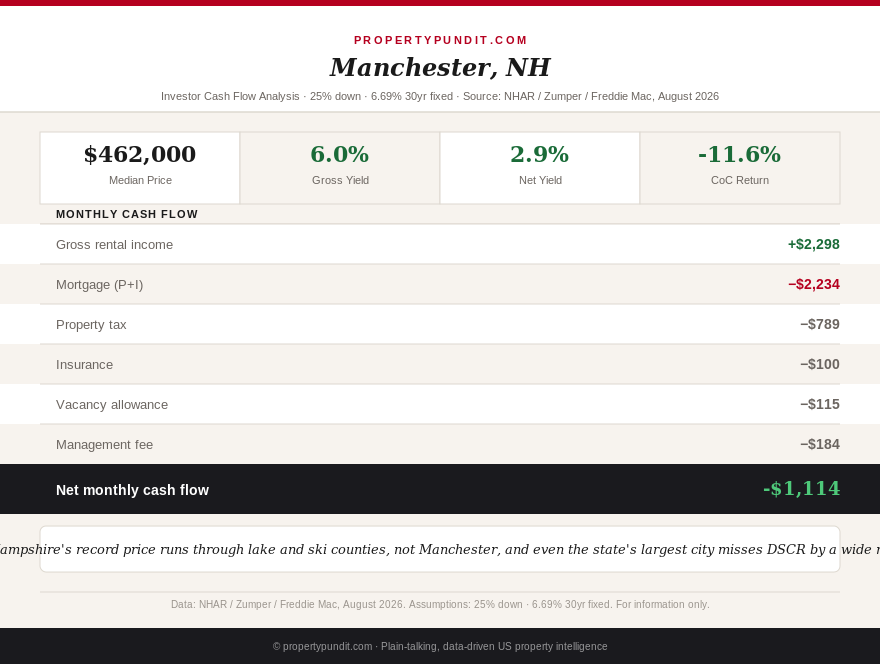
New Hampshire's statewide median sales price hit $580,000 in July, a record, according to the New Hampshire Association of Realtors. If you're an out-of-state investor who has heard the pitch about New Hampshire having no income tax and no sales tax, that record price probably sounds like confirmation you're looking in the right place. It isn't quite that simple, on either the price or the tax side.
Start with the price. That $580,000 figure is a statewide number, and New Hampshire's statewide number is being pulled upward by lake towns and ski towns, not by the cities where an investor would actually buy a rental. Belknap County, home to Lake Winnipesaukee communities like Meredith and Laconia, saw its sales volume jump 45% year over year with a median price of $615,000, up 33%. Sullivan County, home to Sunapee, saw sales volume rise 90.3%. Manchester, the state's largest city, sold for a median of $461,750 in the most recent city-level data available, more than $100,000 below the statewide figure. If you're comparing New Hampshire's "record" headline against a market you might actually invest in, you're very likely comparing the wrong number.
Then there's the tax pitch. New Hampshire genuinely has no tax on wages, and as of 2025 no tax on interest and dividends either, since that levy was fully phased out. Individuals owe no state capital gains tax. All of that is real and it's a durable advantage for someone who moves to New Hampshire and draws a paycheck there. It is a different question entirely for an investor who holds rental property through an LLC, which is how most people finance a rental with a DSCR loan in the first place.
Get this in your inbox every Friday.
One email. The number that matters and what it means for you.
New Hampshire's record price is a lake and ski story, not a city story
New Hampshire's months of supply sat at 2.7 in July, barely changed from 2.5 a year earlier. Anything under four months is considered a seller's market, so New Hampshire remains deep in seller's-market territory even as national inventory has been easing elsewhere. Statewide inventory did grow, up 15.6% year over year to 2,992 single-family homes, the highest count since 2021, but that's still a fraction of the more than 10,000 homes that were on the market back in 2015. Supply is recovering off a genuinely broken base, not approaching balance.
The affordability picture backs this up in blunt terms: the state's median household income currently runs 47% below what's needed to qualify for the median-priced New Hampshire home, and the last time median income matched the median home price was 2021. Josh Greenwald, president of the New Hampshire Association of Realtors, put it plainly in the group's own release: continued growth in housing supply is a positive sign, but the persistent shortage of starter homes keeps pushing prices up faster than incomes can follow. If you're pricing New Hampshire off the statewide headline instead of the specific city or county you'd actually buy in, you're very likely both overestimating your entry cost and underestimating how tight competition remains for anything reasonably priced.
Manchester, Nashua, and the state's cheapest county all miss DSCR
Here's the full underwriting on New Hampshire's three most relevant investor markets, all at 25% down and today's 6.69% Freddie Mac rate.
Manchester (Hillsborough County, the state's largest city): median price $462,000, monthly principal and interest $2,234, property tax $789, insurance $100, for a total PITI of $3,123. A typical three-bedroom single-family rent runs about $2,298 a month (Zumper, June 2026); after an 8% management fee and 5% vacancy allowance, effective rent lands around $2,008. That's a monthly cash flow of roughly negative $1,114, and a debt service coverage ratio of 0.74, well below the 1.0 minimum most DSCR lenders require.
Nashua (also Hillsborough County, the state's second-largest city): median price $490,000, PITI of $3,307 against effective rent near $2,133. Monthly cash flow comes in around negative $1,173, with a DSCR of 0.74, almost identical to Manchester's.
Coos County (the state's cheapest, covering Berlin and the northern tip of the state): median price just $269,900, the lowest in New Hampshire by a wide margin. That sounds like the obvious value play. It isn't. PITI runs $1,866 against HUD's fair market rent of $1,275 for a three-bedroom unit, and effective rent after costs lands near $1,114. Monthly cash flow works out to roughly negative $752, the smallest dollar loss of the three, but the DSCR is actually the worst of the group at 0.68, because rent hasn't kept pace with even Coos County's modest price. Gross yield tells the same story: Manchester and Nashua both run close to 6.0%, while Coos comes in under 5.7%. The cheapest county in the state does not have the best rent-to-price ratio; it has the worst one. If you're chasing New Hampshire's lowest sticker price on the assumption that cheap automatically means better cash flow, run the actual rent-to-price math first, because in this state it points the opposite way.
The "no income tax" pitch only tells half the story
New Hampshire's Business Profits Tax charges 7.7% on net business profits above $50,000, and the Business Enterprise Tax adds 0.6% on an enterprise value tax base above $100,000. Neither applies to an individual who simply draws a salary. Both can apply to a rental property held inside an LLC or partnership once that entity's net profit or enterprise value crosses the threshold, which is exactly the ownership structure most DSCR-loan investors use, since the loan itself is typically written to the entity rather than to a person. A single rental property rarely trips the $50,000 profit threshold on its own, but a growing portfolio held under one LLC can get there faster than an investor expects, especially once appreciation and rent growth are factored into the entity's overall value for BET purposes.
None of this erases New Hampshire's real advantages. There's still no state tax on the rental income itself below those thresholds, no state capital gains tax when you eventually sell, and no sales tax on materials if you're renovating. The point isn't that the tax pitch is false; it's that the version most investors hear is written for a household moving to New Hampshire for the paycheck, not for an LLC-structured rental portfolio, and the two situations run into meaningfully different rules. Before you lean on "no income tax" as the deciding factor in an investment decision, confirm which New Hampshire tax code you're actually operating under.
The one genuine bright spot: insurance
Every cost line in this state's underwriting works against the investor except one. New Hampshire's average homeowners insurance premium runs about $1,151 to $1,212 a year, roughly $96 to $101 a month, making it one of the cheapest states in the country to insure a home, about 67% below the national average (Insurify and LendingTree, 2026). That's the opposite of what shows up in most of the states covered in this series, where a hidden insurance number has been the line item that quietly kills an otherwise workable deal. In New Hampshire, insurance was never the problem. Property tax and purchase price are doing all the damage on their own, which means shopping around for a cheaper policy won't rescue a New Hampshire deal the way it might in a hail- or hurricane-exposed state, so don't spend your negotiating energy there.
What the state's new housing law might do from here
New Hampshire lawmakers passed a new mixed-use housing law this summer aimed at removing some local barriers to building more units, and municipalities are still working through how to apply it town by town, according to New Hampshire Bulletin reporting from late July. Separately, the federal ROAD to Housing Act, which became law in July, includes provisions easing manufactured-home construction rules that could add supply at a lower price point nationally. Neither is the kind of change that shows up in next quarter's inventory numbers. Supply-side fixes in a slow-growth, high-demand state like New Hampshire tend to play out over years, not months, so treat any near-term relief on price as unlikely and plan your entry timeline accordingly rather than waiting for a supply wave that isn't close to arriving.
So is New Hampshire investable right now?
Not for cash flow, not at today's prices and rates. Every market tested here, from the state's largest city to its cheapest county, misses DSCR by a meaningful margin, and Coos County's low price doesn't fix the underlying rent-to-price problem. The math points toward treating New Hampshire as an appreciation-and-tax-structure hold rather than an income property: a long-term bet on continued price growth in a supply-constrained state, combined with no personal income tax and no capital gains tax on exit, works best if you can keep ownership structured to stay under the Business Profits Tax and Business Enterprise Tax thresholds. Frankly, if monthly cash flow is your priority, most investors running these numbers end up looking at markets covered elsewhere in this series with a genuine DSCR loan path to positive income, using a resource like an SFR yield map by county to screen for better rent-to-price ratios before committing capital to a state where the tax story is more interesting than the cash flow. For context on how another high-priced New England market handles the same trade-off, Massachusetts's investor math tells a similar story, and so does Vermont's.