 Property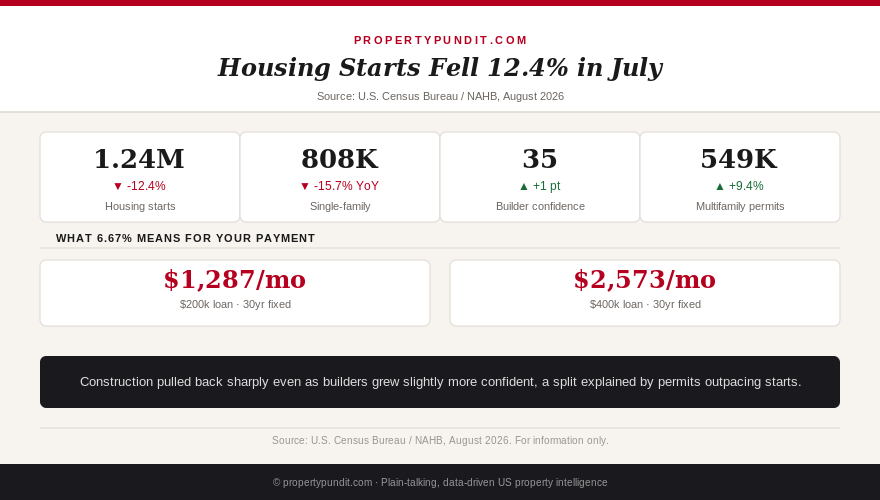
You check your rate-alert app every Wednesday morning before your 3.8% loan even crosses your mind, and this week the number that actually moved had nothing to do with rates. The Census Bureau reported that U.S. housing starts fell 12.4% in July to a seasonally adjusted annual rate of 1.24 million units, down from June's 1.415 million (U.S. Census Bureau, August 19, 2026). That is the sharpest monthly drop in this cycle, and it landed on the same day builders told a different story about how they feel.
Single-family construction, the part of this report that touches homes people like you actually buy, fell 9.9% from June and 15.7% from a year ago to 808,000 units. Multifamily starts fell even harder, down 16.8% to 431,000. Yet the NAHB/Wells Fargo Housing Market Index, builders' own confidence reading, ticked up a point to 35 in August, with current sales conditions rising two points to 39 (NAHB, August 18, 2026). Construction collapsed and builders got slightly more optimistic in the same week. That contradiction is the story worth understanding, not just the headline drop.
Here is the part that resolves the contradiction: multifamily building permits, the paperwork builders file before they break ground, climbed 9.4% in July to an annualized 549,000 pace and sat 6.4% above a year ago. Permits are forward-looking; starts are what already happened. Builders pulled back on starting new projects this month while quietly stockpiling approvals for later, which reads less like builders losing faith in the market and more like builders waiting for a better week to pour concrete.
Get this in your inbox every Friday.
One email. The number that matters and what it means for you.
Why builder confidence rose while construction fell
Housing starts and builder sentiment measure two different things: starts count what already got built, and the HMI captures what builders expect over the next six months. A builder sitting on an approved permit and rising material costs might rationally pause a groundbreaking for a month while still feeling better about future sales, especially if buyer traffic and asking prices haven't deteriorated further. NAHB's regional breakdown backs that read: the Northeast held at 44 and the Midwest at 45, both comfortably the strongest regions, while the South fell two points to 31 and the West stayed flat at 27, the two regions carrying most of the country's oversupply. This isn't a uniformly weak market; it's a divided one, and July's national starts number blends a soft South and West with a steadier Northeast and Midwest.
The other detail worth sitting with is price behavior: 35% of builders cut prices in August, down slightly from 37% in July, marking the 16th straight month that at least three in ten builders have needed a price cut to move inventory. Builders are more confident and still discounting. Both things are true at once in a market where financing costs, not demand collapse, are doing most of the damage. For you, the takeaway isn't that builders are suddenly bullish; it's that the pullback in new construction is a deliberate pause on financing terms, not a signal that builders expect the market to get materially worse from here.
What fewer new homes means for the house you already own
New construction is the release valve for housing supply. When builders start fewer homes, the existing housing stock, including the one you're sitting in at 3.8%, faces less future competition from freshly built alternatives down the street. Single-family starts running 15.7% below a year ago means the pipeline of new inventory reaching the market in 2027 is measurably thinner than it looked heading into this summer. That tends to put a floor under resale values in markets where new construction had been the main source of relief for buyers, because fewer new options means existing homes hold their relative appeal.
This cuts differently depending on where you live. In the South and West, where builders are still discounting most aggressively and regional confidence sits at 31 and 27, a slower pipeline mostly means the current glut takes longer to work through rather than a fresh crunch. In the Northeast and Midwest, where confidence already sits closer to 45, a pullback in new supply tightens an already tighter market faster. If you're tracking your own home's value as part of a move-up or refinance decision, the direction of this report favors you as a current owner more than it favors a buyer hoping new construction cools competition for existing listings.
Your refinance math hasn't moved, and this report doesn't change that
Nothing in this data changes the arithmetic on refinancing out of a 3.8% loan. Freddie Mac's 30-year fixed rate held at 6.67% the same week this report published (Freddie Mac PMMS, August 13, 2026), meaning a $200,000 loan today carries a principal-and-interest payment around $1,287 a month, and a $400,000 loan runs about $2,573. Refinancing from 3.8% into anything near 6.67% would roughly double your interest cost on the same balance; no construction report, however dramatic, closes a gap that wide. If you've been holding a rate-alert threshold and it hasn't triggered yet, this week's news isn't the thing that should trigger it.
What a soft construction report can do, if it repeats over the next several months, is add to the pile of data the Federal Reserve weighs alongside employment and inflation when it sets policy. One month of weak starts is not evidence of a Fed pivot on its own, and treating it as one would be reading far more into a single release than the data supports. The more useful habit is watching whether September and October starts confirm July's weakness or bounce back, the same way you'd want to see a mortgage application trend hold for a few weeks before reading too much into a single weekly refinance number.
What this means if you're shopping for a newly built home
If your search has included new construction because builders were offering rate buydowns and price cuts that resale sellers wouldn't match, this report is a reason to move with more urgency, not less. Fewer starts today means fewer finished, move-in-ready new homes on lots a year from now, and builders who are already discounting on 35% of sales in a soft month have less room to keep cutting once their own pipeline thins out. The same logic explains why falling buyer demand and steady mortgage rates have been moving independently of each other all summer: supply-side decisions like this one, not just demand, are shaping where prices head next, and builders are actively managing their own supply down rather than waiting for demand to force their hand.
Frankly, if you're weighing a new-construction purchase against a resale home this fall, the math points toward locking in a builder incentive now rather than assuming next spring brings a better deal. A thinner 2027 pipeline means less builder desperation, not more, once today's discounted inventory clears. Most people who run the numbers on builder incentives against resale asking prices end up finding the new-build discount is worth more than it looks, especially once closing cost credits that builders routinely offer are factored into the comparison.