 Property
You've been sitting on a Massachusetts deal, waiting to see if this November's ballot would hand you statewide rent control on top of a market that's already the hardest place in the country to evict a bad tenant. That specific threat just went away, struck down by the state's highest court over a drafting flaw. But don't mistake that for Massachusetts suddenly becoming an easy place to cash flow. Boston and Worcester both lose real money for an investor at today's rates, and the state's landlord rules were already tough long before rent control showed up on a ballot.
Here's the full underwriting on Massachusetts' three largest markets, what actually happened to the rent control question, and the one corner of the state where the math still works.
Massachusetts' $678k median hides three sources that disagree
The Warren Group, which tracks recorded deeds statewide, put Massachusetts' June 2026 single-family median at $678,000, down 1.4% year over year, with condo sales up a modest 0.8% to $572,900. The Massachusetts Association of Realtors, working from MLS listings, shows a similar direction: $715,000 in June 2026, down from $725,000 a year earlier. Redfin's broader, rolling four-week methodology tells a different story entirely: $667,628 for the period ending in May 2026, up 0.4% year over year. Two deed-and-MLS-based sources say Massachusetts prices are ticking down for the first time in this cycle. Redfin's differently-timed, differently-weighted sample says they're still, barely, rising.
Neither side is wrong; they're measuring different windows with different inputs. Before you underwrite a Massachusetts deal off a single "the market is up" or "the market is down" headline, check which of these three methodologies produced the number you're looking at, because right now they don't agree on the market's basic direction.
Get this in your inbox every Friday.
One email. The number that matters and what it means for you.
The rent control question that almost changed the math
Homes for All Massachusetts collected more than 124,000 signatures, well past the 74,574 required, to put a statewide rent control question on the November 2026 ballot. The proposal would have capped annual rent increases at the lesser of 5% or inflation, applied statewide with no municipal opt-out, and included no vacancy decontrol, meaning the cap would have followed a unit even after a tenant moved out. On June 23, 2026, the Massachusetts Supreme Judicial Court struck the question from the ballot, ruling that a clause exempting religious institutions from the cap made the measure legally defective under the state's single-subject and exemption rules. The court didn't reject rent control on the merits; it rejected this specific draft.
Tenant advocates haven't dropped the issue. They're now pursuing the same rent-stabilization policy directly through the state legislature, a path that doesn't require a ballot win but does require the State House to actually pass something. So what for you: the specific ballot threat this November is off the table, which is real, near-term relief if you were pricing that risk into a 2026 purchase. It is not evidence that Massachusetts rental regulation risk has gone away, only that this particular vehicle failed on a technicality.
Boston and Worcester: bigger loans, bigger monthly losses
Boston's median sale price ran $852,000 over the three months ending May 2026, up 1.9% year over year (Redfin), though Zillow's home value index shows $786,208, down 0.9% year over year, another reminder that a sales-price median and a value index don't always move together. At 25% down and this week's 6.66% rate, a Boston purchase means a $639,000 loan, principal and interest of $4,108/month, plus an estimated $880/month in property tax at the city's 1.24% effective non-owner-occupied rate and roughly $310/month in landlord insurance. Total PITI: $5,298. Against an estimated $4,000/month rent for a three-bedroom single-family, that's a DSCR of 0.76, well under the 1.0 floor most non-QM investor lenders require. After a 5% vacancy allowance and an 8% management fee, net monthly cash flow lands at roughly -$1,818.
Worcester, the state's fastest-appreciating major market for much of 2026, has cooled from the 12% year-over-year gains logged in the spring to a still-solid 5.5% as of June, with a median around $480,000. At 25% down and 6.66%, PITI runs $3,162/month against an estimated $2,400/month rent, DSCR 0.76, essentially identical to Boston's ratio despite a much smaller loan. Net cash flow after vacancy and management comes out to roughly -$1,074/month. So what for you: Worcester's lower price doesn't translate into a better DSCR than Boston, because its rent hasn't kept pace with its own appreciation. A cheaper entry point isn't automatically a better cash-flow bet; check the ratio, not just the sticker price.
Springfield under $175k: still the only real cash-flow play
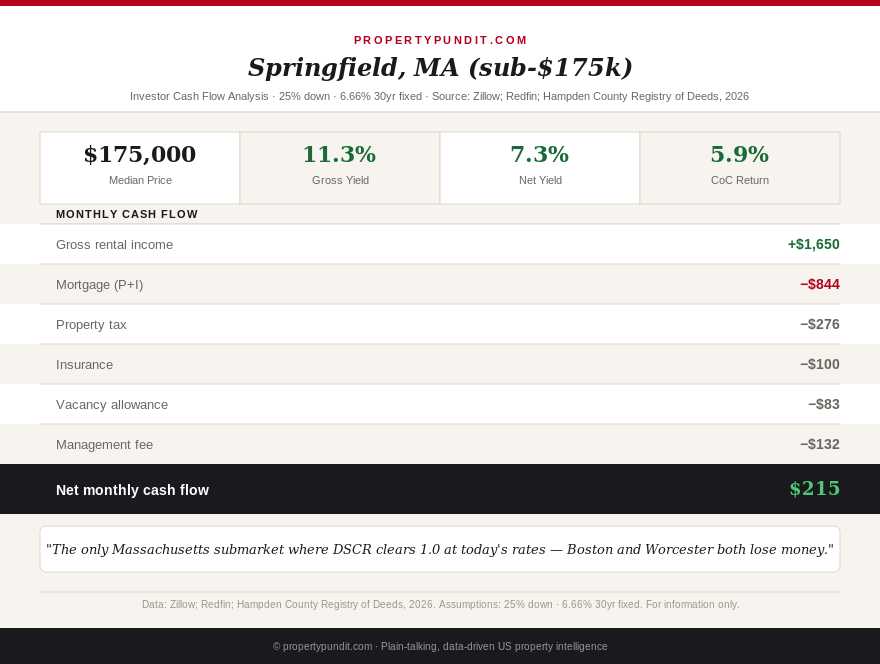
Springfield is the exception, and specifically its entry-level stock, not the whole city. At the broader Springfield median of roughly $318,000, the same 25%-down, 6.66% math produces PITI of $2,179/month against an estimated $1,950/month rent, DSCR 0.90, still short of the 1.0 floor. But Zillow's typical-home-value figure for Springfield sits meaningfully lower, $265,192, and the cheapest quartile of the market, roughly sub-$175,000 three-bedroom stock, is where the numbers actually turn positive: a $131,250 loan at 6.66% runs $844/month in principal and interest, plus $276/month in property tax at Springfield's 1.89% effective rate, the highest of any major Massachusetts city, and an estimated $100/month in insurance. Total PITI: $1,220, against $1,650/month in estimated rent, a DSCR of 1.35. After vacancy and management, net monthly cash flow comes out to roughly +$215.
That's a modest number, and it erodes further if you overpay for the property or underestimate a Springfield-specific maintenance line, but it is the only submarket among the three covered here that produces a genuine positive number rather than a smaller loss. So what for you: if Massachusetts cash flow is the goal rather than appreciation, the entry-level end of Springfield's market is the only place in this comparison worth underwriting on income alone.
Massachusetts' landlord rules: a 1-in-5 rating, and what it actually costs
Independent of the rent control ruling, Massachusetts already ranks among the most tenant-protective states in the country. Eviction proceedings typically run 4 to 6 months from filing to a sheriff's removal, well above the national norm, which means a non-paying tenant can sit in a unit for half a year before an owner regains it. Security deposits are capped at one month's rent and must be held in a separate, interest-bearing account, with strict itemized-receipt and timing rules that generate real liability for landlords who get the paperwork wrong. The state's 5% flat income tax applies to rental income with a 4% surtax layered on above roughly $1.05 million in total income, and investment properties get no Homestead Tax Credit or equivalent cushion the way an owner-occupied primary residence does.
So what for you: none of that changed this week. The rent control ruling removed one specific, additional restriction from this November's ballot; it didn't touch the eviction timeline, the deposit rules, or the tax treatment that already make Massachusetts a slower, more paperwork-heavy state to operate a rental in than most of the country.
So what should a Massachusetts investor actually do
At today's 6.66% rates, Boston and Worcester are appreciation plays, not income plays, and an investor underwriting either one needs a plan for carrying a four- or five-figure monthly loss or a materially larger down payment than 25%. Frankly, if cash flow is the actual goal, most people who run these numbers end up looking specifically at Springfield's entry-level stock rather than the state's bigger, better-known metros, and even there the margin is thin enough that a single vacancy month or an underestimated repair bill can wipe it out. The rent control ruling buys some short-term certainty, but the legislature taking up the same policy means that certainty has an expiration date nobody can put on a calendar yet.
Massachusetts isn't the only New England state with this appreciation-versus-cash-flow tension. Maine's own second-pass numbers, published two days ago, show the same pattern with a local rent-control cap of its own in Portland, and Rhode Island produces no positive-cash-flow market at all under similar rates. Before underwriting any specific Massachusetts deal, run it yourself with the DSCR loan investor guide and cross-check the county against the SFR yield county map rather than assuming the state's reputation, good or bad, applies evenly across it.
Frequently asked questions
Is Massachusetts a good state for rental property investment in 2026? Only in specific, lower-priced pockets. Boston and Worcester both miss the 1.0 DSCR lender minimum by a wide margin at today's rates. The one submarket that clears it is Springfield's entry-level stock under roughly $175,000, which produces a small positive monthly cash flow. Everywhere else in the state, an investor is buying for appreciation, not income.
Why was Massachusetts' rent control ballot question struck down? The Massachusetts Supreme Judicial Court removed the statewide rent control question from the November 2026 ballot on June 23, 2026, ruling that a clause exempting religious institutions from the proposed cap made the measure legally defective, not because the underlying rent-control concept was rejected. Organizers had gathered well over the 74,574 certified signatures required. Tenant advocates are now pursuing the same rent-stabilization policy through the state legislature instead of a ballot vote.
Why do sources disagree on whether Massachusetts home prices are rising or falling? The Warren Group, which tracks recorded deeds, put the June 2026 statewide single-family median at $678,000, down 1.4% year over year, and the Massachusetts Association of Realtors' MLS-based figure fell from $725,000 to $715,000 over the same period. Redfin's broader, rolling-window methodology showed $667,628 in May 2026, up 0.4% year over year. Different sample windows and data sources can point in different directions even when measuring the same state in the same month.
How landlord-friendly is Massachusetts compared to other states? Massachusetts ranks among the most tenant-protective states in the country. Eviction proceedings typically take 4 to 6 months, security deposits are capped at one month's rent and must sit in a separate interest-bearing account, and investment properties get no Homestead-style tax break the way an owner-occupied home does. None of that changed with the rent control ruling; it only removed one specific additional restriction from this November's ballot.