 Property
If you've been circling Kansas City on a map because it keeps showing up on "best cities for investors" lists, run the numbers before you run the offer. Missouri's statewide median just hit $307,000, up 5.86% year over year, and the market that actually pencils out isn't the one getting the headlines. Kansas City's broader metro fails the lender's own cash-flow test. The cheaper stock in Kansas City proper barely clears it on paper and still bleeds money every month. The market that genuinely works, at least among the ones underwritten here, is the one most out-of-state investors skip past entirely: St. Louis City.
Two days before this was published, Missouri voters also settled a question that matters to anyone weighing this state against a zero-income-tax alternative like Texas or Tennessee. Here's the full underwriting on Kansas City, St. Louis, and Springfield, plus what that vote actually changes.
Missouri's real numbers, statewide
Missouri's statewide median sale price reached $307,000 in the most recent Redfin data, up 5.86% year over year, a faster pace of appreciation than most of the Midwest markets covered on this site in recent weeks. That statewide figure masks enormous variation underneath it: Kansas City's metro-wide Zillow home value sits at $297,174 (up 4.4% year over year), while the city's own cheaper core runs closer to $255,647. St. Louis splits even further, with St. Louis City sitting at roughly $223,000, essentially flat year over year, against St. Louis County's $312,000, up 3.6%. Springfield, in the state's southwest corner, sits near $224,619 and has barely moved, with inventory tight enough (1.8 months of supply) that it reads more like a seller's market than its flat price growth suggests.
If you're comparing Missouri to a single "state median" pulled from a national data provider, you're comparing an average of at least four genuinely different markets, and the one that cash-flows isn't the one with the fastest price growth.
Get this in your inbox every Friday.
One email. The number that matters and what it means for you.
Kansas City: the metro fails, the city barely passes, and neither one cash-flows
At the $297,174 Kansas City metro median, with 25% down and a 6.66% rate, principal and interest runs about $1,432 a month. Add Jackson County's 1.11% effective property tax ($275/month) and a reasonable insurance estimate ($175/month), and PITI lands at $1,882. Against a $1,650 average 3-bedroom rent (Zillow Rental Manager, 2026), that's a DSCR of 0.88, well short of the 1.0 minimum most investor lenders require. The deal doesn't get approved as-is.
Drop down to Kansas City's cheaper city-proper stock, at a $255,647 Zillow home value, and the math improves: PITI falls to about $1,619, and the same $1,650 rent produces a DSCR of 1.02, just enough to clear the lender's bar. But DSCR uses gross rent. Once you subtract a realistic vacancy allowance (one month's rent divided across the year, about $138) and an 8% management fee ($132), true monthly cash flow comes out to roughly negative $239. The loan qualifies. The investment still loses money every month.
If Kansas City is on your shortlist because of population growth or job announcements, that's a legitimate appreciation thesis, but budget for negative monthly cash flow at today's rates rather than assuming the DSCR pass means the deal is cash-flow positive too.
St. Louis City is the one market that actually works
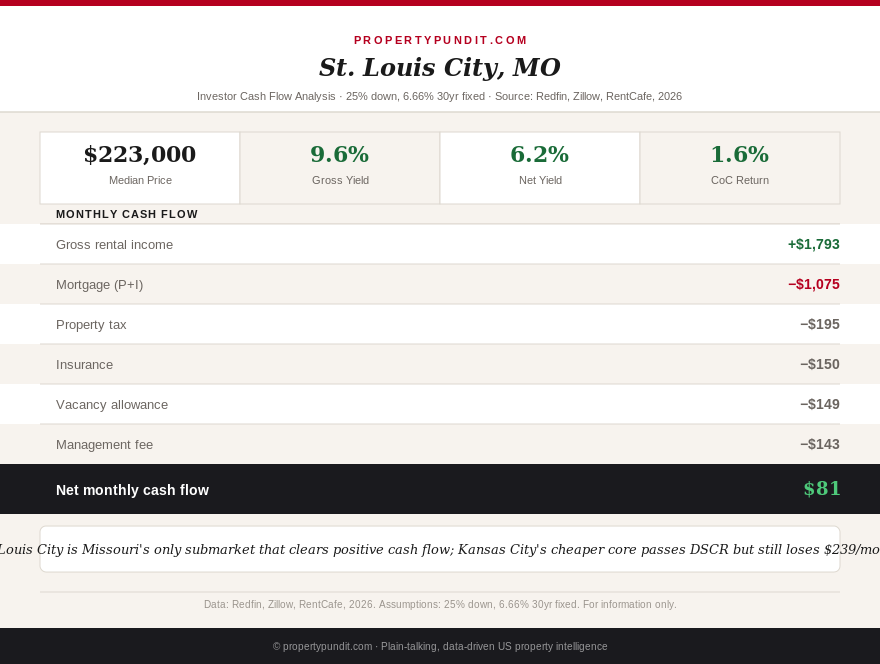
St. Louis City is the outlier, and it's the cheap, flat-priced half of the St. Louis divergence that makes it work. At a $223,000 median (roughly flat year over year) with 25% down, principal and interest runs about $1,075 a month. St. Louis City's property tax runs an effective 1.05%, adding roughly $195 a month, and a $150 insurance estimate brings PITI to $1,420. Against RentCafe's reported $1,793 average 3-bedroom rent for the city, that's a DSCR of 1.26, comfortably above the lender minimum. After subtracting vacancy ($149) and an 8% management fee ($143), net cash flow lands at roughly positive $81 a month, the only market in this analysis that actually clears into positive territory.
St. Louis County tells the opposite story. At $312,000, up 3.6% year over year, the county is priced 40% above the city without a proportional rent premium to match, which is why the county reads as an appreciation-and-lifestyle market rather than a cash-flow one. The city's flat pricing isn't a warning sign here; it's the reason the numbers still work.
If your search has been anchored on St. Louis County because it "feels" like the safer, more established suburb, the cheaper city core is where this month's actual cash flow lives.
Springfield: tight inventory, still short of breakeven
Springfield sits at a $224,619 typical home value with just 1.8 months of supply, tight enough that sellers still hold the upper hand even though prices have barely moved over the past year. PITI on that median, with the same financing assumptions, runs about $1,414 a month. Springfield's average asking rent citywide is $1,321 (not a 3-bedroom-specific figure, so treat it as a conservative estimate), which produces a DSCR of 0.93 and a net monthly cash flow of roughly negative $309 after vacancy and management. Springfield's tight inventory argues for future appreciation, not for a deal that pencils today.
If you're drawn to Springfield's low prices specifically because they look like an entry point, the inventory numbers say other buyers have already noticed. Underwrite it as a patience play, not a current cash-flow market.
The tax question Missouri voters just answered
Two days before this article published, Missouri voters rejected Amendment 5 by an 82.4% margin, an August 4, 2026 ballot measure that would have directed the legislature to phase out the state's individual income tax over five years, offset by expanded sales taxes with real estate, healthcare, and agriculture specifically carved out as exempt. Its failure means Missouri keeps its existing graduated income tax, topping out at 4.7% for the 2025 tax year, with no change to how rental income gets taxed at the state level. If you were underwriting a Missouri deal on the assumption that the state might soon join the zero-income-tax column alongside Texas or Tennessee, that assumption is off the table for the foreseeable future.
Missouri did already deliver one real investor advantage in 2025: it eliminated the state tax on capital gains, which applies to profit on the eventual sale of a rental property, separate from the income tax question voters just settled. The income tax on your monthly rental income stays; the tax on your exit gain is gone.
If a Missouri deal's projected returns depended partly on a future income tax cut that never showed up on your pro forma, this week's vote is the signal to re-underwrite it on the tax code as it exists today, not as it might someday become.
The call: where the Missouri math actually works
Of the four Missouri submarkets underwritten here, St. Louis City is the only one that clears positive cash flow at today's 6.66% rate, and it does so specifically because its prices have stayed flat while its rents have not. Kansas City's cheaper core is a marginal DSCR pass, not a cash-flow story, and both the Kansas City metro and Springfield fail outright under standard 25%-down financing. Most investors who run this kind of state-by-state comparison end up gravitating toward the market with the fastest headline appreciation. In Missouri this month, that instinct points the wrong direction. If cash flow is the priority, the flat, unglamorous city market is the one that actually pays you every month, while the county and metro markets remain appreciation bets dressed up as cash-flow deals. For a look at how another Midwest market in this same rate environment shakes out, the Kansas spotlight, covering the other half of the Kansas City metro, is a useful side-by-side comparison, and the DSCR loan investor guide walks through how lenders calculate the 1.0 minimum referenced throughout this piece. If you're screening markets by yield rather than city name, the SFR yield county map is the faster starting point than working state by state.
Frequently asked questions
Is Kansas City, Missouri a good real estate investment in 2026? It depends which Kansas City you mean. The broader metro, at a Zillow-reported $297,174, fails to clear the 1.0 DSCR minimum most investor lenders require. Kansas City's own cheaper city-proper stock, closer to $255,647, clears DSCR at 1.02 but still runs roughly $239 a month negative once vacancy and management costs are included, so it works for appreciation, not day-one cash flow.
Does Missouri have a state income tax? Yes. Missouri's individual income tax is graduated, topping out at 4.7% for the 2025 tax year filed in 2026. Missouri did eliminate its state tax on capital gains starting with the 2025 tax year, which benefits investors specifically on the sale side, even though ordinary rental income is still taxed.
What happened to Missouri's Amendment 5 income tax measure? Missouri voters rejected Amendment 5 on August 4, 2026, by an 82.4% margin. The measure would have directed the legislature to phase out the state's individual income tax over five years and replace the revenue with expanded sales taxes, with real estate, healthcare, and agriculture exempted from the new sales tax base. Its defeat means Missouri's existing graduated income tax structure stays in place with no change.
Is St. Louis a good market for rental property investors? St. Louis City is the strongest cash-flow market in Missouri right now. At a $223,000 median with 25% down and a $1,793 average 3-bedroom rent, it clears a 1.26 DSCR and produces roughly $81 a month in positive cash flow after vacancy and management, the only Missouri submarket in this analysis to do so. St. Louis County, at a pricier $312,000 median, does not carry a proportionally higher rent and is a weaker cash-flow case. For financing structure specific to this kind of purchase, see the DSCR loan investor guide.