 Property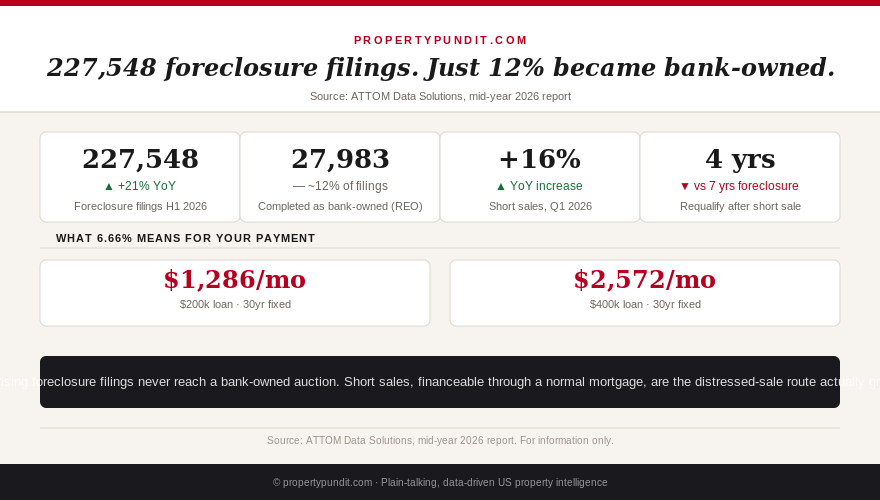
You've seen the headlines about foreclosures surging again, and part of you is quietly hopeful, because a foreclosure sounds like the one lane where a $78,000 income might actually buy you a real discount. Then you picture what that means in practice: a courthouse auction, a cashier's check, a property you can't even walk through first, and the whole idea starts to feel like something meant for investors with cash, not you. Here's the part that changes the math: most of what's actually flowing onto the market right now under "distressed" isn't that at all.
ATTOM Data Solutions' mid-year 2026 foreclosure report shows filings are indeed rising fast. But buried in the same report is a number that gets skipped almost every time this story runs: how few of those filings ever turn into an actual bank-owned auction property. Once you see that number, the whole "wait for a foreclosure" plan looks a lot less useful than a much less scary alternative already sitting on your local MLS.
The number nobody explains: 227,548 filings, 27,983 bank-owned
ATTOM logged 227,548 U.S. properties with a foreclosure filing in the first half of 2026, up 21% year over year and up 28% versus the first half of 2024 (ATTOM Data Solutions, mid-year 2026 report). Foreclosure starts rose to 82,631 in the first quarter alone. But REO completions, the point where a bank actually takes the property back and lists it for sale, totaled just 27,983 properties in that same six-month window. That's roughly 12% of all filings. The other 88% were still moving through the process, got cured when the homeowner caught up on payments or landed a loan modification, or were sold by the homeowner before the bank ever took title.
For you, that means the "foreclosure wave" driving these headlines is mostly a wave of homeowners in distress, not a wave of bank-owned bargains hitting Zillow. If you've been holding off on house-hunting waiting for a flood of REO listings, the data says that flood isn't coming the way you'd pictured it.
Short sale vs. foreclosure: the difference that actually matters to a buyer
A short sale is homeowner-initiated. The owner is still on title, often still living in the home, and is selling it for less than the remaining mortgage balance with the lender's sign-off. It moves through the same standard purchase agreement, inspection period, and mortgage financing as any other resale, with one extra step: the seller's lender has to approve the final price and terms before closing. A foreclosure, by contrast, is lender-initiated. The bank has already repossessed the home, usually through a non-judicial or judicial auction process, and any listing that follows is the bank selling a property it now owns outright, typically with far fewer closing safeguards than you're used to and no seller disclosures at all, since the bank never lived there.
So the property you should actually be watching for isn't the one with a "foreclosure" tag stuck on it. It's the one quietly listed as a short sale, because that's the version of this story you can buy the same way you'd buy any other resale.
Get this in your inbox every Friday.
One email. The number that matters and what it means for you.
Why short sales are growing faster than the scary foreclosure headline
Short-sale transactions rose 16% in the first quarter of 2026 compared with a year earlier (ATTOM Data Solutions and Realtor.com, Q1 2026). That's not a coincidence next to the foreclosure numbers above. It's homeowners choosing the less damaging exit before the bank forces the worse one. A short sale typically dings a credit score 50 to 150 points and shows up on a credit report as a settled account; a completed foreclosure hits harder and stays visible longer. Conventional lenders generally want four years after a short sale before they'll approve a new mortgage, versus seven years after a completed foreclosure, and both windows can shrink to two or three years respectively if the borrower can document a genuine hardship. Every one of those numbers is the homeowner's incentive to sell short rather than let the process run to auction, and it's exactly why short sales, not bank-owned listings, are the part of this story actually showing up in rising volume.
What that means for you is straightforward: the "distressed" inventory worth watching is being created by sellers trying to avoid foreclosure, not by the foreclosure process itself finishing. Treat a short-sale listing as a serious, financeable option, not a fallback.
What actually changes when you make an offer on each one
On a short sale, your purchase agreement, financing contingency, and inspection period all work the way they normally would, but expect the timeline to stretch, since the seller's lender has to review and approve the deal before you can close, a process that can add weeks or months versus a standard resale. You still get a home inspection. You still get to walk away if something's seriously wrong. On a bank-owned foreclosure, the bank's asset manager usually sells strictly as-is, with no repair credits and no seller disclosure obligations, and some properties sit vacant long enough that deferred maintenance becomes a real underwriting problem, which is part of why cash buyers dominate that specific slice of the market and a standard down payment won't get you very far if the home can't pass a lender's own condition requirements.
If you're financing at a $78,000 income, that difference should shape which listings you actually pursue. A short sale gives you most of the protections of a normal purchase with a longer wait. A bank-owned foreclosure gives you speed once it's listed, but shifts real repair risk onto you the moment you sign.
So what should you actually do with this
Stop filtering your search around the word "foreclosure" and start paying attention to short sales instead, since that's the inventory genuinely growing right now and the one you can buy with a normal mortgage. The math points toward getting fully pre-approved before you start looking, since your credit score and documented income are what let you move fast once a short sale clears lender approval, and building in extra time expectations rather than assuming any distressed listing closes on a normal 30-day schedule. If you do find genuine bank-owned inventory, budget a real repair contingency on top of your down payment and closing costs, because "as-is" is not a negotiating position, it's the entire deal. For the fuller picture on why foreclosure activity is rising without resembling anything like 2008, our foreclosure-surge breakdown covers the state-by-state numbers behind this same ATTOM report.
Frankly, most people chasing a "foreclosure deal" end up disappointed by the auction process and the cash requirement behind it. The buyers who actually land a discount this year are the ones quietly watching short sales instead.
Frequently asked questions
What's the actual difference between a short sale and a foreclosure? A short sale is homeowner-initiated: the owner is still on title, still living there in most cases, and is selling with the lender's approval for less than the remaining mortgage balance. A foreclosure is lender-initiated: the bank has already taken the home back through a legal process, usually after an auction, and any listing you see afterward is the bank selling a property it now owns outright, often with no seller disclosures at all.
Do most foreclosure filings end up as bank-owned homes? No. ATTOM Data Solutions logged 227,548 U.S. properties with a foreclosure filing in the first half of 2026, but only 27,983 completed as bank-owned (REO) properties in that same window, about 12%. The rest were still working through the process, cured by the homeowner catching up on payments or getting a loan modification, or sold as a short sale before the bank ever took title.
Can I get a regular mortgage on a short sale or a foreclosure? On a short sale, yes, almost always. It runs through a standard purchase agreement with the same financing, inspection, and appraisal contingencies as any other resale, just with an extra approval step from the seller's lender. On a bank-owned foreclosure, it depends on the property's condition, since many are sold strictly as-is and some need repairs completed before a lender will approve a loan against them, which is why cash buyers are more common at that stage.
Is buying a foreclosure a good deal for a first-time buyer? It can be, but a short sale is usually the more realistic entry point for a financed first-time buyer, since it moves through a normal transaction rather than a bank-owned as-is sale or a courthouse auction. If you're set on true bank-owned inventory, budget extra cash for repairs and a longer closing timeline, and get pre-approved before you start looking so you can move when one becomes available.