 Property
You've been circling Chicago listings for months, running the numbers every time a new one hits the market, and the same problem shows up before you even get to the mortgage line: the property tax bill. Illinois carries the second-highest effective property tax rate in the country, and it doesn't care whether you're an owner-occupant or a landlord holding a rental for cash flow. Here's the full underwriting on three Illinois markets, including the one that surprised us: a downstate capital that just posted a 22% one-year price jump.
Illinois's tax problem in one number
Illinois's statewide median home price hit $333,814 in May 2026, up 5.6% year over year (Redfin). That's a modest, unremarkable appreciation number. What isn't modest is the tax bill layered on top of it. Cook County's effective rate runs about 2.14% on a median basis, but a rental without a homestead exemption typically lands closer to 2.20%, and the collar counties ringing Chicago, Lake, Kane, and Will, run anywhere from 2.0% up to 2.8% (Ownwell County Tax Data, 2026). Illinois's flat 4.95% income tax gets most of the attention from investors relocating from higher-tax states, but for a landlord, the property tax line is what actually decides whether a deal cash-flows.
So what for you: run the county-specific rate before you run anything else, because a 0.6-point spread on a $400,000 property is $2,400 a year, more than most rent increases will ever recover.
There's a second trap worth knowing before you make an offer anywhere in Cook County: the tax bill on the listing is almost always based on the seller's old assessed value, not the price you're about to pay. Cook County reassesses by township on a three-year cycle, and a sale resets the basis. That means a property advertising a modest historical tax bill can see it jump 30% to 60% within 18 to 36 months of your purchase, once the county catches up to what you actually paid. Model your Cook County tax line off the purchase price, not the listing's historical figure, or you'll be underwriting a deal that looks better on paper than it will in year two.
Get this in your inbox every Friday.
One email. The number that matters and what it means for you.
Chicago: Cook County's bill beats the deal
Chicago's median sale price ran $420,000 over the three months ending May 2026, up 6.3% year over year (Redfin). At 25% down and 6.55% rates, that's a $315,000 loan with monthly principal and interest of $2,002. Add Cook County's 2.20% investor-rate property tax ($770/month) and insurance ($150/month), and PITIA lands at $2,922. Against a Zillow Rental Manager rent estimate of $2,300 for a comparable single-family rental, that's a DSCR of 0.79, well under the 1.0 minimum most investor lenders require. After an 8% vacancy allowance and an 8% management fee, monthly cash flow lands at roughly -$998.
So what for you: Chicago still works as an appreciation and equity-building play for a long-term hold, but it does not clear as a cash-flowing rental at today's rates, no matter which up-and-coming neighborhood you're circling.
Springfield's 22% spike: appreciation story, not cash flow story
Springfield is the surprise in this analysis. The state capital's median sale price jumped to $186,000 in March 2026, up 22.4% year over year, a rate of appreciation that would be a headline on its own in a bigger market (Redfin). Run the same math: 25% down on $186,000 is a $139,500 loan, $887 a month in principal and interest. Sangamon County's 2.41% effective rate, the highest of the three markets here, adds $374/month, plus $95/month in insurance, for a PITIA of $1,356. Against a RentCafe-reported three-bedroom rent of $1,543, Springfield actually clears a 1.14 DSCR before expenses. But after vacancy and management, cash flow lands at roughly -$65 a month, essentially breakeven, still negative.
So what for you: a 22% price jump sounds like the market telling you to buy now, but rent hasn't caught up to the new price fast enough to make the deal pencil as a cash-flowing rental yet. It's a market to watch for its next data point, not to chase this month.
Peoria: the only Illinois market that clears DSCR
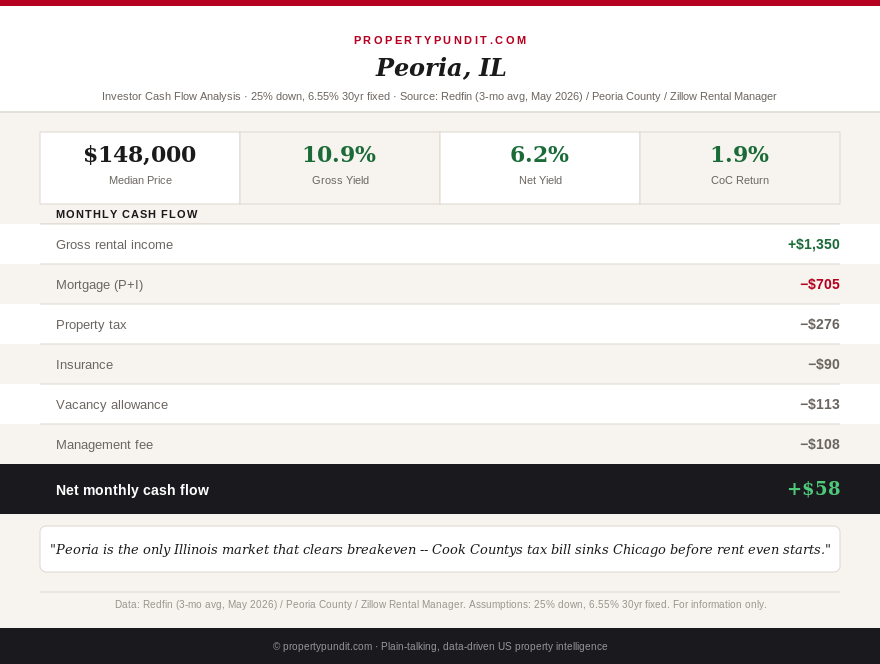
Peoria is the one market here where the math actually works. The median sale price ran $148,000 over the three months ending May 2026, up a modest 2.0% year over year (Redfin). A 25%-down, $111,000 loan carries $705 a month in principal and interest; add Peoria County's 2.24% effective tax ($276/month) and insurance ($90/month) for a PITIA of $1,071. Against an estimated $1,350 monthly rent for a comparable single-family rental, that's a 1.26 DSCR, comfortably above the 1.0 minimum, and after an 8% vacancy allowance and an 8% management fee, cash flow lands at roughly +$58 a month.
That's not a large number, but it's the only positive one on this page. So what for you: if Illinois is on your list this year, Peoria is the market that actually clears underwriting today, not just on a spreadsheet built on optimistic assumptions.
How Illinois compares to its neighbors
It's worth putting Illinois's tax bill next to a neighboring state to see how much of the problem is genuinely structural rather than just a Chicago problem. Indiana's effective property tax rate runs closer to 0.75% to 0.85% statewide, less than half of what a Peoria or Springfield investor pays, and roughly a third of Cook County's investor-rate burden. Run the same $148,000 purchase through Indiana's lower rate instead of Peoria County's 2.24%, and the monthly tax line drops from $276 to around $103, which alone would turn Peoria's already-positive $58-a-month cash flow into something closer to $230 a month.
That gap isn't a knock on Peoria specifically; it's a reminder that Illinois's property tax structure is a statewide drag, not just a Cook County problem, and it applies whether you're buying in a Chicago suburb or three hours downstate. So what for you: if you're cross-shopping the Midwest for rental cash flow rather than committed to Illinois specifically, run the same address-level math in Indiana, Ohio, or Missouri before assuming Illinois's lower entry prices make up for its tax rate. Often they don't.
What this means if you're building an Illinois position
Illinois's investor math hasn't changed much since our last look at this state: the property tax bill, not the income tax rate, is what breaks most deals. Chicago fails badly enough that it only makes sense as a long-horizon equity play, the same conclusion we reached looking at HOA-heavy condo deals elsewhere: fixed monthly costs outside your control are usually what sink a DSCR calculation, not the mortgage itself. Springfield's 22.4% run-up is real and worth a second look once rents catch up, but it isn't a green light yet. Peoria, unglamorous as it is, is the market that clears the bar right now.
The math points toward treating Peoria as your entry point if you're set on Illinois, and using our DSCR loan guide to understand exactly what a lender will and won't count as income before you make an offer. If you're weighing Illinois against other states, our county-level yield map and our notes on what property management really costs are worth reading before you commit capital here instead of somewhere with a lower property tax floor. Most investors who run these numbers end up concluding the same thing: Illinois is a state to buy in selectively, county by county, not statewide.