 Property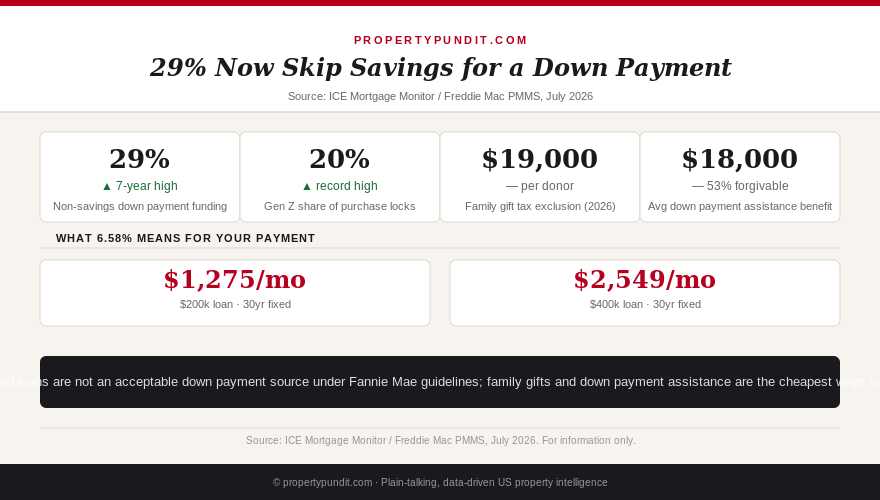
You've saved $14,000. The house is $300,000. Between the down payment and closing costs, you need closer to $24,000, and the number you're staring at is a $10,000 gap that your paycheck isn't going to close before your rate lock expires. Your first instinct is the same one a lot of buyers land on right now: take out a personal loan for the difference. It feels like the obvious fix. It's also one the lender will not let you use.
You're not alone in looking somewhere other than a savings account. Nearly three in ten 2026 buyers, 29%, funded their down payment from a source other than personal savings, gifts, retirement withdrawals, or other borrowed money, the highest share in seven years (ICE Mortgage Monitor, July 2026). Freddie Mac's PMMS just climbed to 6.58%, the highest level in nearly a year (Freddie Mac PMMS, July 23, 2026), which means the payment math on that $300,000 loan keeps getting less forgiving the longer you wait to close the gap. Here's which funding source actually works, in the order that actually makes sense for you.
The 7-year high, and why it's happening now
Down payment funding from something other than straight savings just hit its highest share since 2019. Gift funds from family remain the single most common source. Retirement account withdrawals and loans are rising too. And Gen Z buyers, who now account for a record 20% of all purchase mortgage rate locks, with Gen Z and Millennials combined making up two-thirds of purchase volume (ICE Mortgage Monitor, July 2026), are driving a lot of this shift simply because they've had less time to save at today's $440,600 median home price than the buyers who came before them. Prices grew faster than paychecks for most of this decade, so the math increasingly requires a second source of cash, not a bigger paycheck.
If you're staring at a gap between what you've saved and what closing actually costs, you're not behind some imaginary schedule. You're just running into the same math nearly a third of this year's buyers already hit.
The option that feels obvious but isn't actually allowed
A personal loan seems like the cleanest fix: borrow $10,000, deposit it, move on. It isn't available to you, at least not for this purpose. Fannie Mae's Selling Guide (B3-4.3-17) states plainly that personal unsecured loans, including signature loans, credit card lines of credit, and overdraft protection, are not an acceptable source of funds for a down payment, closing costs, or reserves. Freddie Mac and most FHA-approved lenders apply the same standard. Underwriters specifically look for large, unexplained deposits in the 60 days before closing, and a $10,000 lump sum with no clear origin is exactly what triggers a follow-up request for a full paper trail.
Even setting the rule aside, the math works against you twice over. A $10,000 unsecured loan at a typical 11% APR over five years runs roughly $217 a month, and that new payment gets added straight into your debt-to-income ratio right when you need every point of room under the 43% ceiling to qualify for the mortgage itself. This is the same re-verification window that has killed real loans days before closing when buyers open new credit they assumed wouldn't matter. So the takeaway for you isn't just "avoid this," it's that a personal loan can't get you across the finish line even if you're willing to carry the extra payment.
The gift: usually your cleanest option
If a parent, grandparent, or sibling can cover some or all of that $10,000 gap, this is the option to use first. Each donor can gift up to $19,000 per recipient in 2026 without triggering any gift tax paperwork ($38,000 for a married couple gifting jointly), and there is no dollar cap on gifts overall, larger amounts simply count against the donor's lifetime estate and gift tax exclusion rather than costing anyone money today. Lenders require a signed gift letter confirming the money is a gift with no expectation of repayment, plus a documented bank transfer, not a cash handoff. There's no 60-day seasoning rule buried in Fannie Mae or Freddie Mac guidelines either, despite how often that's repeated; what matters is the paper trail, not a waiting period.
A gift is the only option on this list that costs you nothing, no interest, no repayment, no tax bill, no lost retirement growth. If it's available to you, every other option on this list is a worse deal by comparison.
Down payment assistance: the underused safety net
If a gift isn't available, look at down payment assistance before anything else. Down Payment Resource counted 2,619 active homebuyer assistance programs nationwide in its Q4 2025 report, an average benefit of $18,000, and 53% of those programs are partially or fully forgivable if you stay in the home long enough (typically 5 to 10 years). These run through state housing finance agencies and, in some regions, the Federal Home Loan Banks: FHLB of New York alone allocated $31.67 million to grants of up to $30,000 per household in 2026, stackable to $60,000 with a second program layer. Income limits generally run 80-120% of area median income and most require a credit score of 620-640, so not every buyer qualifies, but the ones who do are often getting money they never have to pay back at all.
The paperwork takes longer than a wire transfer from your parents, but for a $10,000 gap, a forgivable or deferred grant is genuinely free capital if your income and location clear the bar, and it's worth the extra week of applications before you consider anything below it on this list.
Get this in your inbox every Friday.
One email. The number that matters and what it means for you.
The retirement withdrawal: the expensive last resort
A 401(k) hardship withdrawal will get you the cash, but it's the costliest source on this list by a wide margin. Pulling from a traditional 401(k) before age 59 1/2 loses roughly 34% of the withdrawal to federal tax withholding and the 10% early withdrawal penalty before it ever reaches your bank account, meaning you'd need to withdraw close to $15,150 just to net that $10,000 gap. A 401(k) loan avoids the tax hit since you're borrowing your own money, but it has to be repaid, usually within five years, and if you leave your job the outstanding balance can come due in full almost immediately. Either version also means those dollars stop compounding for you starting today, not just for five years but for every year between now and retirement.
This option works in the sense that the money shows up, but it's the one place on this list where the true cost is hidden in a number you won't see until tax season or your account statement three decades from now.
Which one should you actually use
Work down this list in order. First, ask family whether a gift is possible, it's free and it closes the gap fastest. Second, apply for down payment assistance through your state housing finance agency or a regional Federal Home Loan Bank grant before you assume you don't qualify, more than half of these programs never have to be paid back. Third, if you're still short, a 401(k) loan beats a hardship withdrawal because you avoid the immediate tax hit, even though both cost you real retirement growth. What should not be on your list at all is a personal loan: it's explicitly barred as a down payment source, it will surface during underwriting regardless of how you explain it, and the new monthly payment eats into the same debt-to-income room you need to qualify in the first place. Frankly, if you're staring down a four-figure gap two weeks before your rate lock expires, the math points toward exhausting the free money, family and assistance programs, before you ever touch a retirement account or waste time structuring a loan your lender is going to reject anyway.