 Property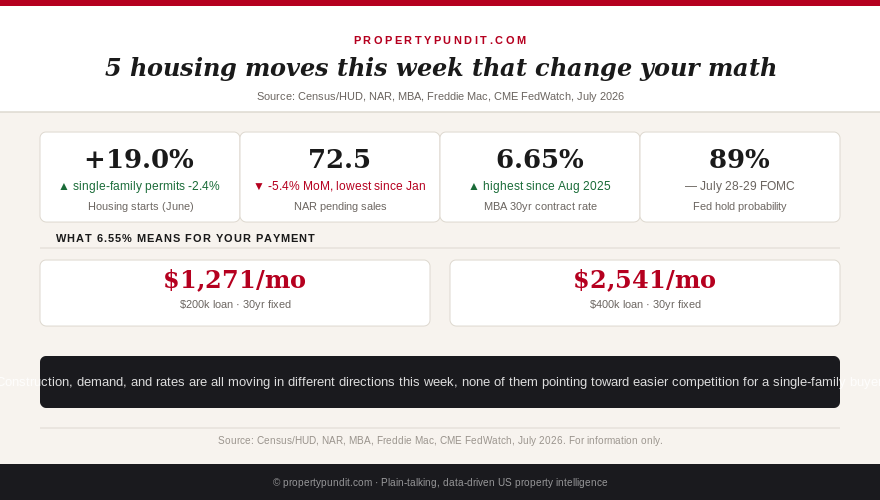
Five things moved in US housing this week, and they don't all point the same direction. Construction, buyer demand, and rates are each telling a slightly different story, and none of them are the story last week's headlines led with. Here's each one, with the number, the source, and what it actually changes for you.
1. Housing starts jumped 19%, and almost none of it was houses. New residential construction rose to a seasonally adjusted annual rate of 1,427,000 in June, up 19.0% from May, but the increase was driven almost entirely by multifamily buildings of five or more units, which surged to 513,000. Single-family building permits, the better forward-looking signal for future for-sale homes, actually fell 2.4% to 871,000 (U.S. Census Bureau/HUD, released July 17, 2026). So what for you: a headline that reads like more supply for buyers is really more supply for renters. It follows the same pattern we flagged in builder confidence's slide to a two-year low: builders are still choosing apartments over the entry-level single-family homes first-timers actually need, so don't expect this report to ease competition for the house you're trying to buy.
2. Pending home sales just hit their lowest point since January. NAR's Pending Home Sales Index fell 5.4% month over month in June to 72.5, down 0.3% year over year, with the decline broad-based across all four major US regions (NAR, released July 16, 2026). So what for you: fewer buyers are signing contracts right now, which typically shows up as softer competition and more negotiating room over the next month or two once those contracts would have closed, room worth using to push for the closing cost credits a softer market makes easier to ask for.
Get this in your inbox every Friday.
One email. The number that matters and what it means for you.
3. Purchase applications fell as the weekly rate hit an 11-month high, but refis didn't blink. The MBA's Weekly Applications Survey for the week ending July 10 showed the average 30-year contract rate rising to 6.65%, the highest since August 2025, and the seasonally adjusted Purchase Index fell 7% for the week. Refinance applications still rose 4% week over week, with FHA refis up 9% and VA refis up 10% (MBA, released July 15, 2026). So what for you: if your existing rate is well above today's market, the refi math can still work even in a week when headline rates are climbing, because the gap to your original rate is what matters, not the direction of this week's move. If a lump-sum payment rather than a full refinance is more your situation, our recasting vs. refinancing breakdown from yesterday covers which option actually saves you more.
4. The official rate is still 6.55%, but the market is already pricing higher. Freddie Mac's PMMS has held at 6.55% for two straight weeks as of July 16, an 11-month high, with the next official reading due Thursday, July 23. Daily trackers were already quoting well above that this week, with standard 30-year purchase quotes near 6.74% as renewed Iran-related oil price volatility pushed Treasury yields higher (Mortgage News Daily, U.S. News, July 21-22, 2026). So what for you: if you have a rate locked near or below 6.55% today, the gap between daily trackers and Thursday's likely official print is a real reason to move on it rather than wait and see. If your own home has appreciated sharply this year, today's data drop on New York's record price and rising inventory walks through what that does, and doesn't do, for your PMI and refinance options.
5. The Fed meets next week, and almost nobody expects a cut. The FOMC meets July 28-29, with CME FedWatch pricing roughly an 89% probability of a third consecutive hold at the current 3.50%-3.75% target range (CME FedWatch, verified July 21, 2026). So what for you: don't hold out for this specific meeting to bring rate relief. Mortgage rates track the 10-year Treasury, not the Fed funds rate directly, so oil prices and inflation data are more likely to move your rate than next week's decision.
Taken together, these five numbers describe a market that's cooling on the demand side (pending sales, purchase applications) while construction keeps adding supply in the one segment, apartments, that doesn't directly compete with a single-family buyer. Rates are elevated and trending slightly higher into Thursday's official reading, and the Fed isn't the lever that changes that story next week. If you're actively shopping for a rate or a home right now, this week's real signal is softer buyer competition paired with a rate environment that argues for locking in what you can get rather than waiting on a Fed meeting that almost certainly won't move.
None of these five numbers is a reason to panic in either direction, and that's worth saying plainly. A softer pending-sales print and a 19% starts headline sound alarming or encouraging depending on which one you read first, but neither changes the fundamentals you should already be underwriting: your own local months of supply, your own rate quote against Thursday's official PMMS print, and your own household budget against the 28% housing-payment guideline. Use this week's numbers as a check on your assumptions, not as a trigger to act faster or slower than the math on your specific situation actually supports.