 Property
Say a $20,000 bonus lands in your account, or your grandmother leaves you an inheritance, or you finally sell an old car you'd been meaning to get rid of. You do the responsible thing and throw it at your mortgage principal. Next month, you check your statement expecting a smaller bill. It's identical to what it was last month, down to the penny. At $78,000 income, watching every dollar, that's not a small disappointment. It feels like the math lied to you. It didn't. You just skipped a step almost nobody explains.
Here's the direct answer: a lump-sum principal payment by itself does not lower your required monthly payment. It shortens how long you'll be paying, which does save real interest, but your bill stays the same unless you take one additional, separate action called recasting. Most homeowners have never heard the term, which is exactly why so many end up paying thousands of dollars to refinance when a $300 phone call would have gotten them the lower payment they actually wanted.
The myth: extra payments automatically lower your bill
The confusion makes sense, because a lump-sum payment does reduce your loan balance immediately, and a lower balance should logically mean a lower bill. It would, if your lender automatically recalculated your payment every time your balance dropped. It doesn't. Your monthly payment was fixed at closing based on your original loan amount, rate, and term, and it stays fixed at that number until the loan is paid off, refinanced, or specifically recast, regardless of how much extra principal you send in along the way.
What a lump sum does change, on its own, is your payoff date. Extra principal skips you ahead in the amortization schedule, so you reach a $0 balance years earlier and pay meaningfully less total interest over the life of the loan. That's a real, valuable outcome. It's just a different outcome than a lower monthly bill, and conflating the two is where the myth comes from. So what for you: decide which problem you're actually trying to solve, a lower required payment or a shorter loan, before you send the money, because they require two different next steps.
Get this in your inbox every Friday.
One email. The number that matters and what it means for you.
What a recast actually does, and costs
Recasting is the specific request that gets you the lower bill. You make your lump-sum payment, then ask your lender in writing to recast the loan. The lender takes your new, smaller balance, keeps your original interest rate and your original payoff date, and recalculates your required monthly payment from there. No new rate, no new term, no new closing costs. Most lenders charge a flat processing fee, typically $150 to $500, and there's no credit pull, no appraisal, and no income re-verification, because you're not applying for new credit. You're asking the lender to do arithmetic on money it already has.
Not every lender offers recasting on every loan, and there's often a minimum lump-sum amount required to qualify, commonly $5,000 to $10,000, so confirm both details with your servicer before you count on it. So what for you: if lowering your monthly bill is the goal, a five-minute call to your servicer costs you nothing to find out whether recasting is even on the table.
The worked example: $20,000, three ways
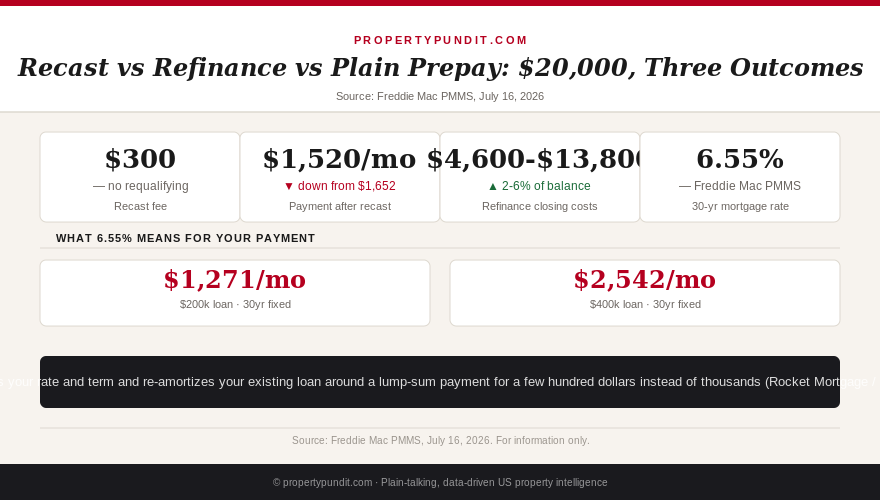
Take a $260,000 loan at 6.55%, the current 30-year fixed rate (Freddie Mac PMMS, July 16, 2026). The original principal-and-interest payment is $1,652 a month. Three years in, the balance has paid down to roughly $250,800, and a $20,000 windfall arrives, bringing it to $230,800.
Option one, plain prepayment, no recast: the balance drops to $230,800, but the required payment stays $1,652 a month. The loan simply finishes paying off years earlier than originally scheduled, and total lifetime interest drops.
Option two, recast: for a $300 fee, the lender re-amortizes the $230,800 balance over the remaining 27 years at the same 6.55% rate. The new required payment comes to roughly $1,520 a month, a $132 monthly reduction, locked in immediately, with no new rate risk and no reset to a fresh 30-year clock.
Option three, refinance: the same $230,800 balance gets rolled into a brand-new loan. Even at an identical 6.55% rate, refinancing typically costs 2% to 6% of the loan balance in closing costs, roughly $4,600 to $13,800 here, plus a full credit pull, new appraisal, and income re-verification. Unless you can also secure a meaningfully lower rate than 6.55% to justify that cost, you've spent thousands of dollars to arrive at a similar payment a $300 recast would have gotten you directly.
Put the three options side by side in dollars: the recast fee is $300. The midpoint of the refinance closing-cost range is roughly $9,200. That's close to $9,000 more than recasting, for a comparable outcome, an outcome the refinance doesn't even beat unless it also comes with a meaningfully lower rate. So what for you: if your goal is simply a lower payment after a lump sum, and your rate hasn't become uncompetitive, recasting gets you there for roughly 3% of what refinancing costs.
The catch almost nobody checks first
Recasting is standard on conventional loans backed by Fannie Mae or Freddie Mac. It generally isn't available on FHA, VA, or USDA loans, the loan types most common among first-time buyers putting down less than 10%. If that's your loan, a lump sum still shortens your term and cuts total interest, which is genuinely valuable, but it will not lower your required payment. Your only path to a smaller monthly bill on a government-backed loan is a refinance, with all the cost and requalification that involves, or in some FHA cases, reaching enough equity to drop mortgage insurance and refinance into a conventional loan at the same time, which we cover in our PMI cancellation guide.
One more detail worth flagging: recasting your loan balance down does not automatically cancel private mortgage insurance, even if the new balance would put you under 80% loan-to-value. PMI cancellation is a separate request with its own paperwork, and a strong credit score at origination doesn't change that requirement later. So what for you: before you assume recasting solves everything a windfall could solve, confirm your specific loan type with your servicer, since the FHA-versus-conventional distinction determines whether recasting is even an option.
What this means for you this week
If a windfall lands and your rate is still competitive with today's 6.55% (Freddie Mac PMMS, July 16, 2026), the math points toward recasting over refinancing almost every time, provided you have a conventional loan. It's the lowest-cost way to convert extra cash into a lower required payment without touching your rate, your term, or your credit file. Most people who run these numbers end up choosing recast over refinance specifically because refinancing only makes sense when you're also chasing a meaningfully better rate, not just a smaller bill.
Frankly, if you're on an FHA or VA loan and you're hoping a lump sum will shrink your payment, call your servicer this week and ask directly whether recasting is offered on your loan type before you plan around it. If it isn't, understanding how your amortization schedule actually works will at least tell you exactly how many years that lump sum buys you back, even without a smaller monthly number to show for it today.