 Property
Every headline this month says home prices keep setting records. Nobody's telling you that the people building those homes are more nervous right now than at almost any point in the last 15 years. Five numbers from this week explain why builders are flinching even while resale prices climb, and what that split actually means if you're shopping new construction this summer.
This gap between builder sentiment and resale prices is the single most useful thing a buyer can understand about the market right now. It isn't a contradiction. It's two different groups of sellers reacting to the same weak buyer traffic in two different ways, and each one leaves a different kind of opening on the table depending on which type of home you're actually shopping for.
1. Builder confidence just hit its lowest point since December 2023
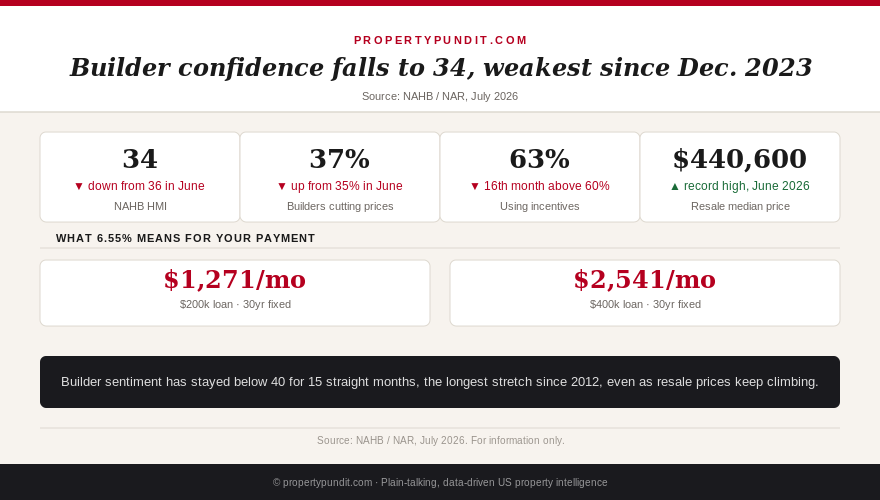
The NAHB/Wells Fargo Housing Market Index fell two points to 34 in July 2026, down from an upwardly revised 36 in June. That reading has now stayed below the neutral 40 mark for 15 consecutive months, the longest stretch since 2012. Builders aren't reacting to one bad week. They're describing a market that has felt structurally difficult for well over a year, driven by elevated mortgage rates, high land and material costs, and buyers who keep hesitating at the closing table.
Get this in your inbox every Friday.
One email. The number that matters and what it means for you.
2. Buyer foot traffic through model homes is the weakest number on the whole report
Of the three components that make up the headline index, the one measuring prospective buyer traffic fell two points to just 23, the softest reading of the three and far below the readings for current and future sales conditions (37 and 43). Regionally, the West posted the weakest three-month average at 26. Fewer people are even walking through new-construction model homes right now, which tells builders something buyer surveys can't: real foot traffic, not stated intentions, is drying up. If you're one of the buyers still touring new-construction communities this summer, you have far more attention from a sales team than the traffic numbers suggest is typical.
3. More than a third of builders cut prices in July, and the cuts are getting more common, not rarer
Thirty-seven percent of builders reported cutting prices in July 2026, up from 35% in June and 32% in May, three straight months of an increasing share. The average price cut held steady at 6%. That trend line matters more than any single month's number: builders aren't testing a one-off discount, they're stepping down prices in a sustained pattern because the traffic numbers above aren't giving them another option.
4. Nearly two-thirds of builders are buying down your rate, not just cutting the sticker price
Sixty-three percent of builders used sales incentives, most commonly mortgage rate buydowns, in July 2026, marking the 16th consecutive month this share has stayed at or above 60%. A rate buydown into the high-4% to low-5% range on a new-construction loan is frequently worth more to your monthly payment than an equivalent price cut, because it compounds over the life of the loan rather than reducing your principal by a flat amount. If a builder offers you a choice, run both scenarios against your actual mortgage before picking the smaller number on the price tag.
5. Resale prices hit a record the very same month, which is the whole point
Existing-home sales fell 2.4% month over month in June 2026, yet the median resale price still climbed to a record $440,600, the 36th consecutive month of year-over-year gains. Builders aren't cutting prices because the housing market broadly is crashing. They're cutting because they compete directly against a resale market where prices keep rising anyway, forcing new construction to buy attention with discounts and incentives that existing-home sellers don't need to offer.
Where builders are actually gaining ground
The national number hides real regional variation. On a three-month moving average, the Northeast rose one point to 45 and the Midwest rose two points to 45, both comfortably ahead of the national reading of 34. The South fell one point to 33 and the West fell one point to 26, the weakest region in the country. If you're shopping new construction in the South or West, you're dealing with builders facing the toughest conditions on this entire report, which is exactly where the price cuts and incentives in the numbers above are concentrated hardest. A builder in Ohio or Massachusetts is operating from a meaningfully stronger position than one in Arizona or Texas right now, and that difference should shape how hard you push in negotiations depending on where you're buying.
What this means for you
The math points toward treating new construction and resale as two separate negotiations right now, not one market. On a new-build purchase, ask for both a price reduction and a rate buydown quote, since more than a third of builders are cutting and nearly two-thirds are buying down rates simultaneously, and most buyers only ask about one. On a resale purchase, don't expect the same bargaining power. That market is still setting price records even as sales volume softens, which means sellers there have far less incentive to negotiate the way a builder with a stalled model-home lot does. If you're deciding between a new-construction community and a comparable resale listing this summer, the builder is very likely the more motivated seller of the two, and a buyer in the South or West has the strongest hand of all.
For more on how builder rate buydowns actually pencil out against a straight price cut, see our guide to builder confidence and new home sales, and if you're weighing whether to lock a rate now or wait on a purchase, our float-down option breakdown covers the mechanics for either a resale or new-construction loan. Buyers still building their down payment should also check our explainer on down payment assistance programs, since several are usable on new construction as well as resale.