 Property
You own rentals that cover themselves, and the pitch for Utah sounds like the next one: a 4.45% flat income tax, a property tax rate near 0.5%, and a population that keeps showing up. Then you run the loan at today's 7.18% (Freddie Mac PMMS, November 5, 2026) and the number that was supposed to land near break-even comes back negative $618. Utah was already a hard place to make a rental pay in our September pass at 6.66%, and the rate has moved 52 basis points since.
This is our third pass on Utah, so the focus is different: what the rate move did to the three big metros, why the price you read depends on which source you open, and what it would take for a Utah rental to pencil. For the tax mechanic that makes landlords pay nearly double the advertised rate, see our second Utah analysis.
Get this in your inbox every Friday.
One email. The number that matters and what it means for you.
What 52 basis points did to Utah cash flow
The method is the same as in September: 25% down, a 30-year fixed loan, rent discounted 8% for management and 5% for vacancy, county tax at the investor-adjusted rate, and about $115 a month of insurance. Prices and rents are carried from the earlier pass, so the only change is the rate, from 6.66% to 7.18%.
| Market (25% down) | Monthly payment, Sept at 6.66% | Monthly payment, now at 7.18% | Net cash flow now | Rent-to-payment ratio |
|---|---|---|---|---|
| Salt Lake City ($609,000) | $3,558 | $3,717 | -$1,794 (was -$1,635) | 0.59 |
| Provo ($485,000) | $2,776 | $2,903 | -$1,196 (was -$1,069) | 0.67 |
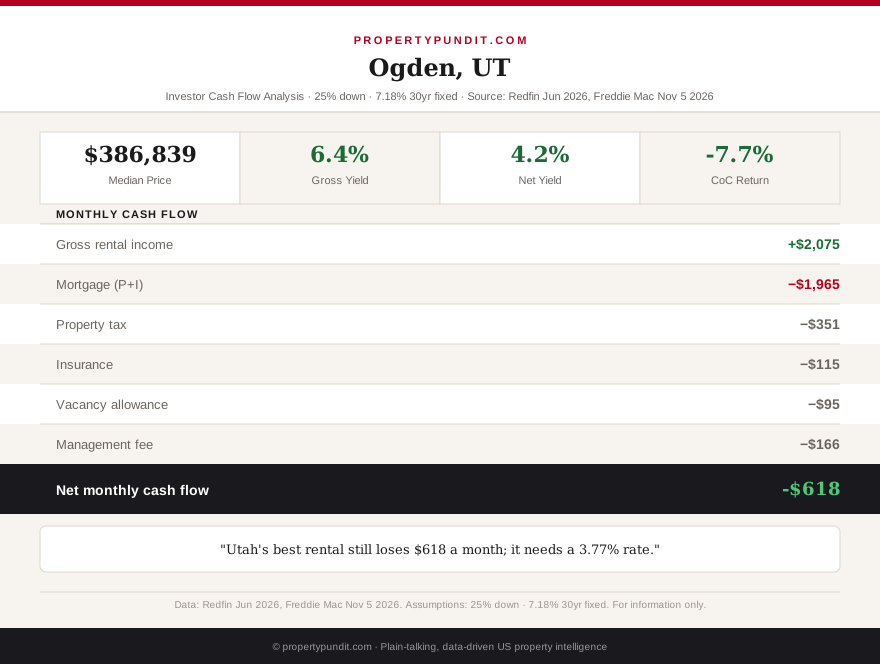
| Ogden ($386,839) | $2,332 | $2,432 | -$618 (was -$518) | 0.85 |
The rate alone cost the Salt Lake City buyer $159 a month, the Provo buyer $127 and the Ogden buyer $100. The ratio in the last column is rent divided by the full payment, the figure DSCR lenders test, and none of the three clears the 1.0 that most of them require (see our DSCR loan guide). A bigger price means a bigger hit, which is why Salt Lake City, the market with the highest price and the weakest cash flow, took the worst of it.
So what for you: if you underwrote Utah in the summer, your cash flow is now $100 to $159 a month worse before anything else changed, so re-run the loan at 7.18% before you make an offer.
Which Utah price is the right one?
Two legitimate sources disagree about what a Utah home costs, and the gap changes your answer. Redfin put Salt Lake City at $609,000 (three-month average through June 2026) and Zillow's home value index put it at $579,572 (August 2026 pass). The Salt Lake Board of Realtors, reported by the Standard-Examiner on July 21, 2026, put the Salt Lake County single-family median at a record $645,000 for the second quarter. Those differ because the county includes pricier suburbs, the board's figure counts single-family homes only, and Redfin's and Zillow's figures cover different home types and different averaging periods.
The same pattern shows up elsewhere. The Utah County single-family median fell 0.83% to $600,000, against $485,000 for Provo from Redfin. Weber County's single-family median rose 3.11% to $499,000, against $386,839 for Ogden. If you buy a detached single-family home in the county, and not the city's mix of condos and townhomes, you're paying the higher number. At Weber County's $499,000 and the same Ogden rent, the monthly payment is $3,104 and the cash flow is -$1,290, more than double the -$618 for the city median.
So what for you: decide which kind of property you're really buying before you trust any median, because the single-family number can run 29% higher than the city figure and it moves your cash flow by hundreds of dollars.
What it takes for Ogden to break even
Ogden is Utah's best case, so test the levers there. Each line below changes one input and holds the rest, with the 7.18% rate unless noted.
| Change one input | Result | Net cash flow | Rent-to-payment ratio |
|---|---|---|---|
| Base case, 25% down | $386,839 price | -$618 | 0.85 |
| Put 30% down | Loan $270,787 | -$487 | 0.90 |
| Put 40% down | Loan $232,103 | -$225 | 1.02 |
| Put 50% down | Loan $193,420 | +$37 | 1.17 |
| Rate falls to 6% | 25% down | -$392 | 0.94 |
| Rate falls to 5% | 25% down | -$210 | 1.03 |
| Price falls to about $283,000 | 25% down | about +$4 | 1.15 |
| Rent rises to about $2,783 | Up 34% from $2,075 | about $0 | 1.14 |
The sharpest number is the rate: with 25% down, Ogden doesn't break even until the 30-year rate reaches about 3.77%. Salt Lake City needs about 0.16% and Provo about 1.57%. Putting 40% down gets you past the DSCR line at 1.02 but still loses $225 a month, so qualifying for the loan and earning a profit are two separate tests.
So what for you: borrowing in Utah is a cost, not a tool, and only a 50% down payment in Ogden turns the monthly number positive.
The all-cash comparison
If you skip the mortgage, Ogden works on paper: $2,075 of rent discounted to $1,814 after management and vacancy, minus $351 of tax and $115 of insurance, leaves $1,347 a month, or about 4.18% a year on the $386,839 price. The 3-month Treasury bill yielded 4.21% (Meridian Macro Weekly, November 3, 2026), so a buyer paying all cash earns roughly what a bill pays, with maintenance, capital repairs and the risk of a bad tenant on top.
The gap is the story. Treasury bills pay about the same with no roof to replace, which means Utah real estate has to win on appreciation, and the data doesn't promise that: the Salt Lake County condo median fell 2.81% to $417,900 in the second quarter, and Utah County's single-family median slipped 0.83%.
So what for you: an all-cash Ogden purchase earns about what a T-bill does, so only buy it if you want the property for appreciation or the tax benefits, not for the income.
Utah's income tax and landlord rules
Utah's flat income tax fell to 4.45% for 2026 (Tax Foundation), its sixth straight cut, and it applies to rental income too. The state also preempts rent control, so you can raise rents as the market allows. Both are real advantages, and neither fixes a monthly payment that's $618 above the rent. A tax cut only helps once you have taxable profit, and at 7.18% most Utah buyers have a loss.
So what for you: count the tax savings after you've found a deal that pays, not as a reason to accept one that doesn't.
The call: hold off on Utah unless you can put 40% down
The math points toward waiting. At 7.18% no Utah metro we tested cash flows with 25% down, and the closest, Ogden, needs a 3.77% rate. Frankly, if you already own rentals and want another, you'll find better numbers in a cheaper market; our county yield map shows where rent covers the loan. If you're set on Utah, the only configuration that comes close to working is Ogden with 40% to 50% down, a DSCR loan that qualifies at 1.02 or better, and a plan to hold through a rate drop.
So what for you: set a trigger now, such as a 30-year rate near 6% plus a price under $320,000 in Ogden, and revisit Utah when both arrive.
Frequently asked questions
Is Utah a good state for rental property investing in 2026?
Not at current mortgage rates. At 7.18% with 25% down, Salt Lake City loses $1,794 a month, Provo loses $1,196 and Ogden loses $618 after management, vacancy, tax and insurance.
Why do landlords in Utah pay a higher property tax rate?
Utah assesses a primary residence at 55% of market value but a rental at 100%, so the 0.44% to 0.60% county rates quoted for homeowners roughly double for investors, to about 0.80% to 1.09%.
What is the median home price in Salt Lake County?
The Salt Lake Board of Realtors reported a record $645,000 single-family median for the second quarter of 2026. Redfin put Salt Lake City alone at $609,000, and the two figures differ by geography and home type.
What rate would make a Utah rental break even?
With 25% down, about 3.77% in Ogden, 1.57% in Provo and 0.16% in Salt Lake City, at the rents and prices in this analysis.
Does a DSCR loan work for a Utah rental?
Only with a large down payment. Ogden reaches a rent-to-payment ratio of 1.02 with 40% down, but still loses $225 a month at 7.18%.
What was the Freddie Mac 30-year mortgage rate on November 5, 2026?
7.18% for the 30-year fixed, down from 7.24% the week before (Freddie Mac PMMS via FRED).