 Property
You've been told for years that Texas is where landlords go to win: no state income tax, big metros, endless demand. Then you run a real purchase through a lender's numbers and the best Texas metro on the page still bleeds $1,206 a month. This is the third time we've run the state, and the answer has gotten worse, not better: the 30-year rate is 7.18% (Freddie Mac PMMS, November 5, 2026), up from 6.66% when we ran it in August, and every one of the four big Texas metros now loses between $1,206 and $1,861 a month.
The loss isn't a rounding error you can fix with a better tenant. At today's rate, no Texas metro we model reaches a debt service coverage ratio of 1.0, so a typical DSCR lender would either decline the loan or quote a worse rate. Nothing about Texas rents or insurance changed enough since August to matter. The rate did, and the rate alone moved the monthly loss by $80 to $118 depending on the city.
Get this in your inbox every Friday.
One email. The number that matters and what it means for you.
What 7.18% did to the four big Texas metros
We re-ran the same four purchases from our August Texas spotlight at the November 5 rate. Prices, county tax rates, insurance and rents are unchanged from that pass: Houston at $325,000 with $650 a month of hurricane-repriced insurance, Dallas at $383,000, San Antonio at $305,000 and Austin at $452,000, each with 25% down and a 30-year fixed loan. Cash flow is rent after a 5% vacancy allowance and 8% management fee, minus the full payment, minus a maintenance reserve of 1.5% of the price a year.
| Metro (25% down) | Price | PITI Aug. at 6.66% | PITI now at 7.18% | Coverage now | Cash flow Aug. | Cash flow now |
|---|---|---|---|---|---|---|
| Houston | $325,000 | $2,766 | $2,851 | 0.72 | -$1,383 | -$1,468 |
| Dallas | $383,000 | $2,904 | $3,004 | 0.76 | -$1,387 | -$1,487 |
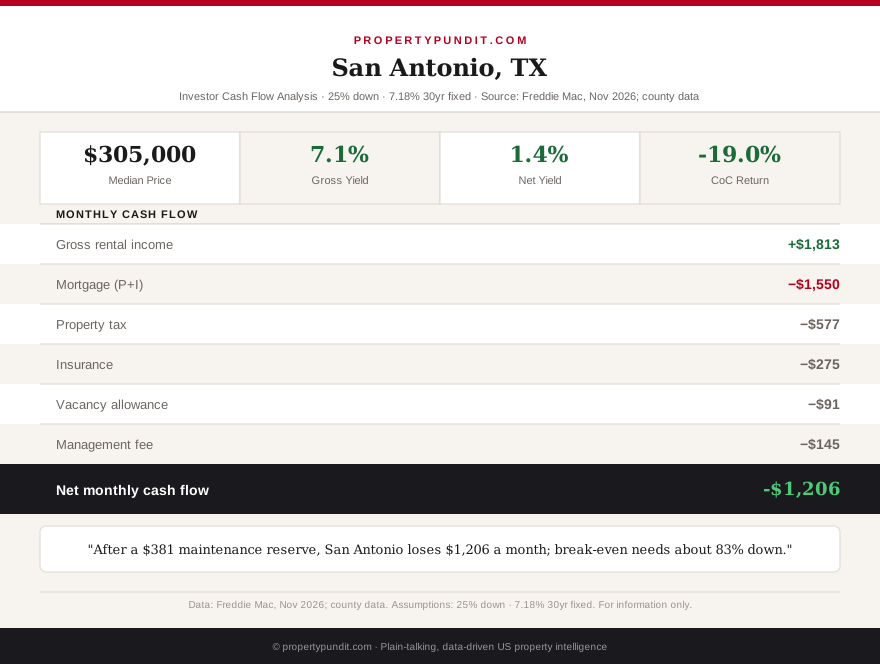
| San Antonio | $305,000 | $2,322 | $2,402 | 0.75 | -$1,126 | -$1,206 |
| Austin | $452,000 | $3,266 | $3,384 | 0.71 | -$1,743 | -$1,861 |
Two things stand out. San Antonio is still the least-negative metro, but its coverage ratio (gross rent divided by the full payment) slipped from 0.78 to 0.75. Dallas, which was within a rounding error of Houston in August, now loses $1,487 against Houston's $1,468, because its larger loan is more sensitive to the rate while Houston's problem is insurance, which doesn't care about the rate at all. Austin remains the worst of the four, and it is the one that lost the most ground, -$118 a month, because it carries the biggest mortgage.
So what for you: if you're comparing Texas metros today, rank them by loan size first and insurance second, because a 7.18% rate punishes the expensive markets hardest and the loss gap between the best and worst Texas city is now $655 a month.
San Antonio: how much would have to change to break even
The San Antonio rental is the closest thing Texas offers, so it is the fairest place to ask what it would take to stop losing money. We moved one lever at a time and left everything else alone.
| San Antonio lever | Monthly cash flow | Gap to break-even |
|---|---|---|
| Today: $305,000, 25% down, 7.18% | -$1,206 | $1,206 |
| Down payment to 40% | -$896 | $896 |
| Down payment to 50% | -$689 | $689 |
| Down payment to 60% | -$482 | $482 |
| Rate down to 6.00% | -$1,027 | $1,027 |
| Rate down to 4.00% | -$748 | $748 |
| Insurance cut to $150 a month | -$1,081 | $1,081 |
| Price cut to $158,000 | $3 | -$3 |
| Rent up to $3,200 a month | $1 | -$1 |
The honest read is that no single realistic lever fixes it. Dropping the rate to 6.00%, well below any weekly reading this fall, still leaves a loss of $1,027. Even a 4% rate loses $748, and a rate of essentially zero still loses about $292. Cutting insurance by $125 a month helps by exactly $125 and no more. The levers that work are the ones that shrink the loan: roughly 83% down gets you to break-even before any appreciation, the same house priced near $158,000 does the job instead, or rent would have to reach about $3,200 a month, which is 77% above the $1,813 a 3-bedroom commands today. Because Bexar County's 2.27% tax rate takes $577 a month on this house no matter what you do to the rate, only a much lower price or an almost all-cash purchase gets you there.
That arithmetic is why the military-adjacent entry tier near Joint Base San Antonio keeps showing up in our Texas work: a cheaper purchase price is the one lever that works at any rate. We covered it in the August spotlight, and the lesson from that piece still holds, which is that a DSCR pass tells a lender the loan qualifies, not that the property pays for itself. Our DSCR loan guide explains how lenders count that ratio and why the cash flow they ignore is the part that comes out of your pocket.
So what for you: if you're set on San Antonio, either buy close to all cash or shop for a far cheaper house than the $305,000 median, because at 25% down and 7.18% the numbers don't close and waiting for a rate cut closes only a small fraction of the gap.
Two Texas price numbers, and why they disagree
Statewide, we have two figures that sound like they should match and don't. Redfin put the Texas median sale price at $347,911 for June 2026, down 0.17% from a year earlier (Redfin, June 2026). Texas Realtors reported a first-quarter 2026 statewide median sales price of $328,000, down 0.8% from the first quarter of 2025 (Texas Realtors, Q1 2026, via search summary). The gap is $19,911, or about 6%.
We can't reconcile them exactly without both methodologies side by side. A gap of this size is consistent with differences in timing (a spring-quarter median against a summer month, when larger homes tend to close), in the mix of property types counted, and in the sample each organization draws on. Both agree on the direction that matters: Texas prices are flat to slightly down year over year, which is why we model each metro at its own local median instead of leaning on any statewide figure. The metro medians in the tables above come from county and local sources carried from our August pass, so treat them as the same vintage as the rents beside them, not as November closings.
So what for you: when a headline quotes a Texas median, check which source and which month it comes from before you price a deal off it, because a 6% spread between two respected sources is the size of an entire down payment on a modest rental.
What Texas still gives investors
None of this makes Texas a bad state for a landlord. Zero state income tax on rental income is real money, but it shows up on your tax return each April, not in your monthly rent check, and it can't offset a $1,206 monthly shortfall. Texas also has no statewide rent control, which means the rent you set is the rent you collect, and the 10% homestead assessment cap that governs many Texas tax bills applies only after a property's first year of ownership. If you model your tax bill off the seller's old assessment you'll be low, as we explained in our piece on how Texas resets the tax bill after a purchase.
The state's real strength for an investor is long-run: a growing population, deep job markets in all four metros, and no income tax drag on whatever rents you do collect. That is a reason to hold a Texas property you already own. It is a weak reason to buy a new one at a 7.18% rate. For a county-by-county look at where single-family yields actually clear their costs, our single-family yield map is the better starting point than any state's reputation.
So what for you: treat Texas's tax advantages as a bonus on a deal that already works on cash flow, not as the reason a deal works.
The call: use Texas as a hold, not a buy, at 7.18%
The math points toward a plain conclusion. If you own Texas property financed at a lower rate, keep it; the rate you hold is worth more than any purchase on the market. If you're shopping for a first Texas rental, the numbers say to wait for a lower price or a much larger down payment rather than stretch at 25% down. Frankly, if you're in San Antonio at $305,000 with 25% down and no tenant waiting, you're signing up to subsidize a stranger's rent by roughly $14,466 a year for the hope of appreciation.
The middle path for most investors is a smaller, cheaper property in the entry tier, where the payment is far lower and a DSCR lender will still say yes. Our Dallas versus San Antonio comparison shows how the two big cities stack up on price and rent. Most people who run these numbers end up looking at a cheaper house, not a cheaper rate.
So what for you: before you make an offer in Texas, run the full payment, including a real insurance quote, through the lever table above and don't proceed unless you can say which lever closes your gap.
Frequently asked questions
Is Texas a good state for rental property in 2026?
Not on monthly cash flow at current rates. At 7.18% and 25% down, all four large metros lose money after vacancy, management, insurance and maintenance, from about $1,206 a month in San Antonio to about $1,861 in Austin.
What is the best Texas city for rental cash flow?
San Antonio is the least negative of the four big metros we model, at about -$1,206 a month on a $305,000 house at 25% down. Its entry tier near Joint Base San Antonio gets closer to break-even because the purchase price is much lower.
How much down payment does a San Antonio rental need to break even?
About 83% down on a $305,000 house at 7.18%, with rent of $1,813 and the full operating budget counted. Dropping the rate to 6.00% still leaves a loss of roughly $1,027 a month.
What was the Freddie Mac 30-year mortgage rate on November 5, 2026?
7.18% for the 30-year fixed, down from 7.24% the week before. The 15-year fixed was 6.57% (Freddie Mac PMMS via FRED).