 Property
You've saved for three years, you finally have a number in the bank that looks like a real down payment, and now the lender's worksheet is asking a question you don't have a clean answer to: put 20% down and drain the account, or put 10% down and keep a cushion at the cost of mortgage insurance. With the 30-year rate at 7.18% (Freddie Mac PMMS, November 5, 2026), the answer is more expensive than the usual advice admits. On a $400,000 home, the extra $40,000 you keep by putting 10% down costs about $511 a month, and the account balance it protects earns about $140.
That is a steep price for flexibility, and it deserves a straight comparison before you sign anything. We use a $400,000 purchase, a $112,000 gross income and the same 0.82% Nashville property tax rate used in our rent versus buy break-even. The numbers below are illustrations built on stated assumptions, and your lender's quote will differ.
Get this in your inbox every Friday.
One email. The number that matters and what it means for you.
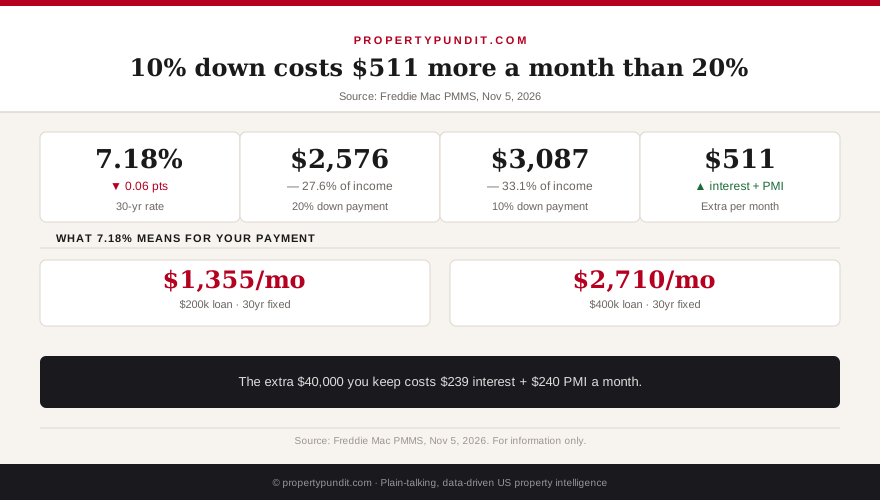
What the extra $40,000 does to your monthly payment
The table sets 20% down against 10% down on the same house. The 10%-down buyer borrows $360,000 instead of $320,000 and pays private mortgage insurance, which we assume at 0.80% of the loan a year. That PMI rate is an illustrative figure for a borrower with a good credit score; real quotes run lower and higher depending on score and loan size, so use the table of PMI prices further down to see how much it changes the result.
| Monthly cost on a $400,000 home | 20% down ($80,000) | 10% down ($40,000) | Difference |
|---|---|---|---|
| Loan amount | $320,000 | $360,000 | +$40,000 |
| Principal and interest at 7.18% | $2,168 | $2,439 | +$271 |
| Private mortgage insurance (0.80% a year) | $0 | $240 | +$240 |
| Property tax (0.82%) and insurance | $408 | $408 | $0 |
| Total monthly payment | $2,576 | $3,087 | +$511 |
| Share of $112,000 gross income | 27.6% | 33.1% | +5.5 pts |
Two things in that table matter more than the total. First, the 20%-down payment of $2,576 is 27.6% of your gross income, inside the 28% front-end guideline of $2,613 a month, while the 10%-down payment of $3,087 is 33.1%, outside it. Second, of the $271 extra in principal and interest, only about $32 the first month is principal that comes back to you as equity; the other $239 is pure interest on the additional $40,000. Add PMI and the true carrying cost of keeping that cash is $479 a month.
So what for you: the choice isn't between a bigger and a smaller payment, it's between a payment that fits a 28% budget and one that doesn't, so check your own ratio before you decide how much to keep.
What the cash you keep actually earns
The case for 10% down rests on the $40,000 you hold back. Parked in short-term Treasury bills at about 4.21% (3-month bill, Meridian Macro Weekly, November 3, 2026), it earns about $140 a month before tax, or about $109 after tax at the 22% federal bracket a single filer at $112,000 falls into. Against a carrying cost of $511 a month, you are paying roughly $402 a month net for the privilege of holding that cash.
Put another way, keeping the $40,000 costs about 14.4% a year in interest and PMI, against a 4.21% yield. You would only come out ahead if you used the cash for something that earns more than your 7.18% mortgage plus PMI, which a savings account never does. The comparison also ignores one thing in the 10% buyer's favor: if the money funds a repair, a job gap or a move, it saves you from borrowing at a far higher rate on a credit card or a home equity line.
So what for you: the extra cash is insurance, not an investment, and the premium is about $402 a month, so only buy as much of it as you would actually need in an emergency.
How long PMI actually lasts
PMI isn't permanent. Under the Homeowners Protection Act, you can ask your servicer to cancel it once your balance reaches 80% of the original home value, and it ends automatically at 78%, provided you are current on payments. On a $360,000 loan at 7.18% that first threshold, a $320,000 balance, arrives after about 103 months, or 8.6 years, if you only make scheduled payments, because early payments are mostly interest. Over that stretch you would pay roughly $24,720 in PMI at the 0.80% assumption.
| PMI price (annual rate) | Monthly PMI | Extra monthly cost of 10% down | PMI paid before it ends (about 103 months) |
|---|---|---|---|
| 0.40% | $120 | $391 | $12,360 |
| 0.80% | $240 | $511 | $24,720 |
| 1.20% | $360 | $631 | $37,080 |
Two things shorten the wait. Appreciation can: if the home's value rises 15% to $460,000, your $360,000 balance is already under 80% of the new value, and many servicers will cancel after a new appraisal. Extra principal can too. Our PMI cancellation guide walks through the paperwork, and the piggyback loan comparison shows the other way some buyers avoid PMI at 10% down, with its own tradeoffs.
So what for you: if you buy with 10% down, plan on 8 to 9 years of PMI unless the home appreciates or you pay extra principal, and put the cancellation date in your calendar the day you close.
The six-month reserve test
Here is the practical test that decides this. Six months of the 20%-down payment is $15,457. Closing costs on a $400,000 purchase typically run 2% to 5% of the price, so budget about $12,000 at 3% (see our closing costs guide). Say you have $100,000 in total. Twenty percent down uses $80,000, adds $12,000 of closing costs and leaves $8,000, which is about three months of payments and below the six-month line. Ten percent down leaves $48,000, which is roughly fifteen months of the 10%-down payment.
That is the real tradeoff. If 20% down leaves you with at least $15,457 on top of closing costs, the extra interest and PMI on the 10% path buy you a cushion you don't need, and putting 20% down saves roughly $511 a month while lowering your debt ratio below the 28% guideline. If 20% leaves you thin, the $511 is what an adequate cushion costs, and it is cheaper than a financial emergency with no savings. Our down payment myth article makes the same point from the other direction: 20% is a target, not a requirement.
So what for you: count your cash after closing, not before, and let the six-month reserve line decide which side of the table you are on.
The call: 20% only if six months of reserves survive it
The math points toward 20% down for any buyer who can still hold $15,457 in cash after the down payment and closing costs. At 7.18%, that buyer saves $511 a month, avoids about $24,720 of PMI, and sits under the 28% payment ceiling. Frankly, if you're in that position and still leaning toward 10%, you are paying a high price for a cushion you already have.
If 20% would leave you with less than that, take 10% down, accept PMI, and attack the principal until the balance reaches 80% of the home's value. Most people who run these numbers end up choosing 10% down because the reserve test fails, not because they like PMI, and that is a sound decision as long as the cancellation plan is real.
So what for you: write down your cash after closing under both scenarios today, and pick 20% only if the reserve line still holds.
Frequently asked questions
Is it worth putting 20% down instead of 10% at current mortgage rates?
Usually yes, if you keep six months of payments in reserve afterward. On a $400,000 home at 7.18%, 20% down saves about $511 a month in interest and PMI compared with 10% down.
How much does PMI cost on a $360,000 loan?
At an illustrative 0.80% a year it is about $240 a month. At 0.40% it is $120 and at 1.20% it is $360; your credit score and loan type set the real price.
When can I cancel PMI on a conventional loan?
You can request cancellation when your balance reaches 80% of the original value, which takes about 103 months on a 10%-down loan at 7.18% if you pay on schedule. It ends automatically at 78%.
What was the Freddie Mac 30-year mortgage rate on November 5, 2026?
7.18% for the 30-year fixed, down from 7.24% the week before. The 15-year fixed was 6.57% (Freddie Mac PMMS via FRED).