 Property
You keep hearing that South Carolina is where the Sun Belt money is heading, and you keep re-running the Columbia numbers hoping the next rate drop flips the sign. The third pass gives you a number to wait for: a $276,000 Columbia rental with 25% down only breaks even if the 30-year rate falls from 7.24% to about 4.79%.
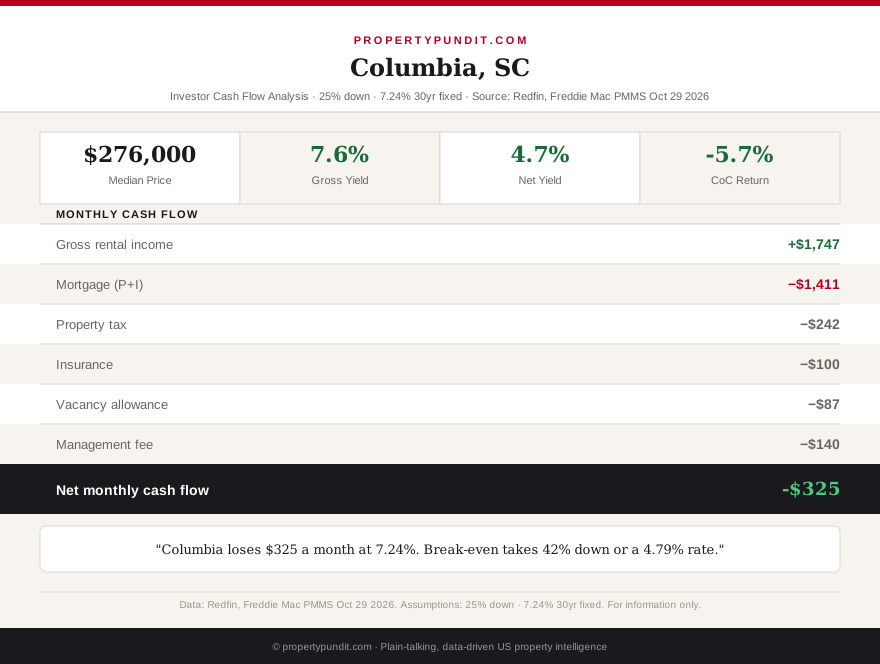
This is the third pass on the state. The August South Carolina spotlight found no market clearing a 1.0 coverage ratio at 6.65%, and Freddie Mac's 30-year average has climbed 0.59 points since (Freddie Mac PMMS, October 29, 2026). Prices, rents, taxes and insurance below are carried from August, not refreshed. One method change: vacancy and management now come off rent as percentages (rent x 0.92 x 0.95), so August's figures shift by a few dollars before the rate does anything.
Get this in your inbox every Friday.
One email. The number that matters and what it means for you.
South Carolina at 7.24%: Columbia loses $325, Charleston loses $1,039
The assumptions are the same as August: 25% down, a 30-year fixed loan, 8% management, 5% vacancy, a $100 monthly capex reserve, and each county's tax rate adjusted for the 6% investor assessment ratio. Only the rate moved.
| City | Price | Rent | Monthly PITI | Cash flow | Coverage | August cash flow |
|---|---|---|---|---|---|---|
| Columbia | $276,000 | $1,747 | $1,752 | -$325 | 0.87 | -$250 |
| Greenville | $368,146 | $1,971 | $2,218 | -$595 | 0.78 | -$494 |
| Charleston | $639,000 | $3,200 | $3,736 | -$1,039 | 0.75 | -$862 |
Prices are Redfin figures (Columbia 3-month average through May 2026, Greenville County May 2026, Charleston 3-month average through June 2026). Rents are three-bedroom house estimates from rental aggregators and Zillow (2026). Coverage is effective rent divided by the full mortgage payment, so it ignores the capex reserve. On the Columbia house you'd put in $69,000 and lose about $3,900 a year, a cash-on-cash return of -5.7%. Charleston loses about $12,500 a year.
So if you're pricing a South Carolina rental this month, plan to fund a loss of $325 to $1,039 a month, and don't count on a lender or a listing page to make it disappear.
What it takes for Columbia to break even
Columbia is the closest of the three, so it's the fair test. We solved for each lever on its own, holding the others at today's values.
- Down payment: about 42% ($116,700) for cash flow of zero.
- Rate: about 4.79% with 25% down, 2.45 points below today's 7.24%.
- Price: about $221,700, roughly 20% below the $276,000 median.
- Rent: about $2,119, roughly 21% above the $1,747 estimate.
| Down payment | Cash in | Monthly cash flow | Coverage |
|---|---|---|---|
| 25% | $69,000 | -$325 | 0.87 |
| 40% | $110,400 | -$43 | 1.04 |
| 50% | $138,000 | +$145 | 1.19 |
| 60% | $165,600 | +$333 | 1.40 |
Notice that coverage passes 1.0 at 40% down while cash flow is still -$43. The gap is the $100 reserve for roofs and water heaters, which lenders ignore and your bank account doesn't. At 25% down the property fails the 1.0 test a DSCR lender applies, which the DSCR loan guide explains in full.
That means if you want Columbia to pay for itself, plan on putting in roughly $117,000, not $69,000, and treat any rate drop as a bonus rather than the plan.
The 6% assessment ratio costs you about $80 a month
South Carolina assesses an owner-occupied primary residence at 4% of fair market value and everything else, including rentals, at 6% (SC Code Section 12-43-220). Same local millage, 50% more taxable base. Act 388 of 2006 shifted school tax burden away from owner-occupants, which has kept pressure on investment property in fast-growing counties.
On a $276,000 Columbia house, the owner-occupied effective rate in Richland County is 0.70% (SmartAsset, 2026) and the landlord rate is 1.05%. That's $161 a month for an owner and $242 for you, a gap of $80 a month or $966 a year. Greenville's gap is about $79 a month and Charleston's about $85.
Listing pages and generic tax calculators quote the owner-occupied figure, and some bills still show the prior owner's 4% status until the property is reassessed, so check the actual bill and underwrite at 6%. For you, that means a tax number that looks $80 a month too low is the single most common error in South Carolina rental math.
Charleston: the insurance bill is real, but the price is the problem
Charleston has the lowest tax rate of the three, 0.48% on our investor-adjusted basis, and the worst cash flow. Part of that is insurance: $2,570 a year (Insure.com, 2026) against about $1,200 inland, with coastal renewals still reflecting the 2024 hurricane losses. That extra $114 a month is real money.
It isn't the main story, though. Give Charleston Columbia's $1,200 insurance and the loss only improves from $1,039 to $925 a month. The bigger issue is price against rent: $3,200 on a $639,000 house is a 6.0% gross yield, against 7.6% in Columbia and 6.4% in Greenville. Charleston would need about $4,389 in monthly rent, 37% above the estimate, to break even at 25% down.
If you're drawn to Charleston's growth story, understand that you'd be paying for it at roughly $1,000 a month at today's rate.
Greenville: the price you pick changes the answer
Greenville has two defensible price points. Redfin's Greenville County median was $368,146 (May 2026), while the city of Greenville itself ran $524,789 (3-month average through June 2026), skewed by downtown and luxury sales. We underwrote the county figure because it better reflects typical rental stock. The two sources aren't wrong, they're measuring different housing: the county includes the cheaper suburbs where most landlords actually buy.
The gap matters. On the $524,789 city figure with the same $1,971 rent, the loss at 7.24% grows to roughly $1,500 a month and the gross yield falls to 4.5%. If you're shopping Greenville, you're either buying in the suburbs at a $595 monthly loss or buying downtown at a loss two and a half times that.
What a South Carolina investor should do now
The math points toward skipping Charleston and Greenville as cash-flow plays and treating Columbia as a cash-heavy purchase or a patient hold. Frankly, if you can't put in about 42% down, most investors who run these numbers end up looking at cheaper rent-to-price markets, which the SFR yield county map ranks by county.
If you're weighing the Carolinas against each other, run the latest North Carolina spotlight with the same 25% down and see which state's loss is smaller before you pick a lender.
Frequently asked questions
Is South Carolina a good state for rental property investors in 2026? Not for cash flow at today's rates. At Freddie Mac's 7.24% (October 29, 2026), Columbia, Greenville and Charleston all lose money with 25% down, between $325 and $1,039 a month, and coverage ratios run 0.75 to 0.87.
How much down payment does a Columbia, SC rental need to break even? About 42%, or roughly $116,700 on a $276,000 house at 7.24%. At 50% down it earns about $145 a month.
Why are South Carolina rental property taxes higher than owner-occupied? The state assesses owner-occupied homes at 4% of market value and rentals at 6% (SC Code Section 12-43-220), so a landlord pays about 50% more on the same house, roughly $80 a month in Columbia.
What mortgage rate would make a Columbia rental break even? About 4.79% with 25% down, using the August price, rent, tax and insurance inputs. At 6.2% it would still lose about $182 a month.