 Property
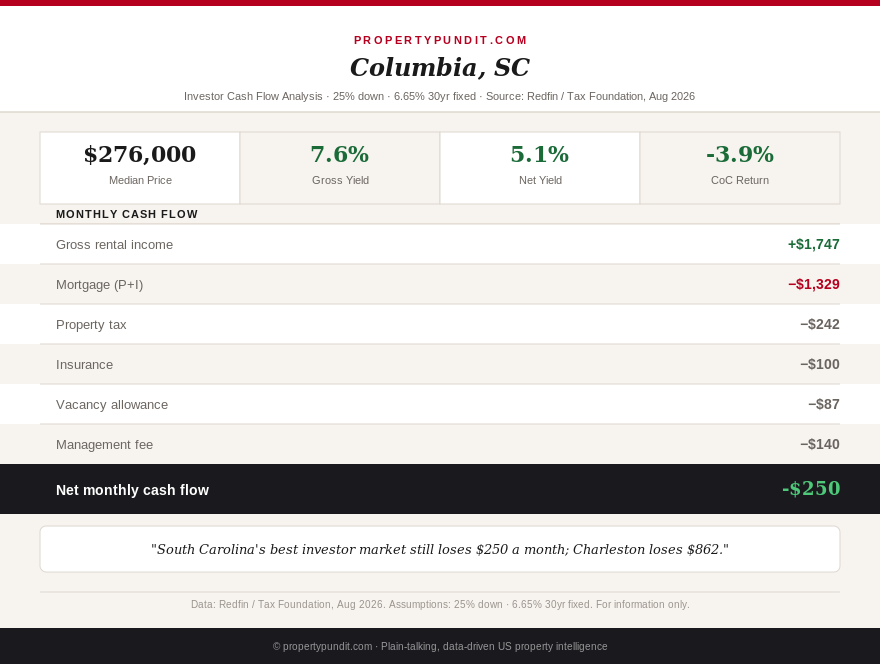
You've watched the migration headlines for years: South Carolina is one of the fastest-growing states in the country, people are leaving high-tax states for the Carolinas, and every "best states for landlords" listicle puts it near the top. That reputation is exactly why you're running the numbers on a Columbia, Greenville, or Charleston rental right now, and it's exactly why the actual math matters more than the headline. Run a full underwrite on all three at today's prices and 6.65% rates, and every single one loses money every month. Columbia comes closest to breaking even, at -$250 a month. Charleston, the metro with the state's strongest growth story, loses the most: -$862 a month.
This is a first-pass underwrite of South Carolina, using current three-month-average sale prices, house-specific 3-bedroom rents rather than blended apartment averages, and the state's actual 6%-versus-4% property tax assessment split, which most out-of-state investors don't know exists until their first tax bill arrives. Here's the full math, why Charleston's growth story doesn't translate to cash flow, and what would need to change for Columbia to flip positive.
South Carolina's statewide median sale price sits at roughly $360,000 as of mid-2026, according to Redfin, up modestly year over year. That single number hides three very different city stories, and none of them currently pencil for a cash-flow investor.
Get this in your inbox every Friday.
One email. The number that matters and what it means for you.
The math: Columbia, Greenville, and Charleston side by side
All three models below use 6.65% (Freddie Mac PMMS, August 20, 2026), 25% down, 8% property management, 5% vacancy allowance, and a $100/month capex reserve, matching this site's standard investor underwrite. Property tax uses each county's owner-occupied effective rate, scaled to South Carolina's 6% non-owner-occupied assessment ratio (a 50% higher taxable base than the 4% homestead rate).
| Item | Columbia ($276k) | Greenville ($368k) | Charleston ($639k) |
|---|---|---|---|
| Loan amount (75% LTV) | $207,000 | $276,110 | $479,250 |
| P&I at 6.65% | $1,329 | $1,773 | $3,077 |
| Property tax (investor rate) | $242 (1.05%) | $236 (0.77%) | $256 (0.48%) |
| Insurance | $100 | $100 | $214 |
| Total PITI | $1,670 | $2,109 | $3,546 |
| Gross monthly rent (3BR house) | $1,747 | $1,971 | $3,200 |
| Effective rent (8% mgmt, 5% vacancy) | $1,520 | $1,715 | $2,784 |
| Capex reserve | ($100) | ($100) | ($100) |
| Net cash flow | -$250/month | -$494/month | -$862/month |
| DSCR (effective rent / PITI) | 0.91 | 0.81 | 0.79 |
Columbia's price ($276,000, Redfin three-month average through May 2026) and rent ($1,747 for a 3-bedroom house) produce the tightest gap of the three: a 0.91 DSCR that misses most DSCR lenders' 1.0-1.25 minimum by a real but modest margin. Greenville uses the county-wide median ($368,146) rather than the city's downtown-skewed $524,789 figure, since a typical rental purchase is far more likely to land in the broader county than in Greenville's luxury urban core. So what this means for you: if you're set on South Carolina, Columbia is the market to underwrite first, not because it works today, but because it needs the smallest rate or rent move to get there.
South Carolina's 6% investor tax trap
South Carolina assesses owner-occupied primary residences at 4% of fair market value. Everything else, including every rental property, second home, and investment condo, gets assessed at 6%, a 50% higher taxable base applied against the exact same local millage rate. On a $400,000 property, that's the difference between a $16,000 assessed value and a $24,000 one, before a single mill rate is even applied. Out-of-state investors who price a South Carolina deal off a Zillow "estimated taxes" figure, which typically assumes owner-occupied status, routinely underestimate their actual tax bill by a third or more.
The gap shows up differently by county. Charleston County's owner-occupied effective rate is a low 0.32%, so even after the 6% adjustment it lands at roughly 0.48%, among the lowest effective investor tax rates in the state. Richland County (Columbia) runs a considerably higher 0.70% owner-occupied baseline, meaning its investor-adjusted rate of roughly 1.05% is more than double Charleston's. Greenville County sits in between at about 0.51% owner-occupied, or 0.77% for a rental. A South Carolina investor comparing counties purely on the advertised owner-occupied tax rate will consistently underestimate the gap between Charleston and Columbia, because the 6% multiplier widens whatever spread already exists.
So what this means for you: pull the county-specific millage sheet and apply the 6% ratio yourself before you underwrite, rather than trusting a listing site's tax estimate. A property that looks tax-competitive against a 4% assumption can be meaningfully worse once the real investor rate is applied.
Charleston's growth story doesn't survive contact with its insurance bill
Charleston has the strongest population growth narrative of the three cities and, on paper, the lowest effective property tax rate. It's also the worst investment of the three by a wide margin. The reason is a combination of price and insurance that a low tax rate can't offset. Charleston's median sale price of $639,000 is more than double Columbia's, but its 3-bedroom rent of roughly $3,200 a month doesn't scale proportionally: that's a 0.50% gross monthly rent-to-price ratio, meaningfully worse than Columbia's 0.63%. On top of that thinner yield, Charleston-area homeowners insurance runs about $2,570 a year, more than double Columbia and Greenville's roughly $1,200 landlord-policy baseline, driven by direct Atlantic hurricane exposure. South Carolina absorbed Hurricane Debby and Hurricane Helene in 2024, and insurers are still pricing 2026 renewals off that loss history, with statewide rates up nearly 10% in 2025 alone.
Put the price gap and the insurance gap together and Charleston's low tax rate becomes almost irrelevant to the outcome. A market can have the best advertised tax rate in a state comparison and still be the worst investment once price, rent, and insurance are all on the table, exactly the same pattern this site has documented in other coastal and high-growth metros.
So what this means for you: don't let a population-growth headline or a low tax rate substitute for the actual rent-to-price math. Charleston's fundamentals as a place to live are real. Its fundamentals as a cash-flow rental in 2026 are the weakest of any major South Carolina market.
South Carolina's tax cut is real. It's not a cash flow fix.
South Carolina's 2026 tax reform cut the top marginal individual income tax rate to 5.21%, down from 6.0% the prior year, according to the Tax Foundation. That's a genuine improvement and one of the more investor-friendly state income tax rates in the Southeast. On $15,000 of net annual rental income, the rate cut saves an investor a little under $120 a year compared to the old 6.0% top rate. That's a real number. It's also nowhere close to covering a monthly cash flow gap that runs from $250 in Columbia to $862 in Charleston, a difference measured in thousands of dollars a year, not hundreds.
So what this means for you: treat South Carolina's income tax advantage as a bonus on a property that already cash-flows, the same way you'd treat it in any other state, not as a reason to accept negative monthly cash flow today. The tax code rewards a deal that already works. It doesn't rescue one that doesn't.
What would need to change for Columbia to work
Columbia's $250 monthly gap is the smallest of the three markets, and it's small enough to be closed by a realistic combination of moves rather than a market crash. A rate drop from 6.65% to roughly 6.10% on the same $207,000 loan would cut the P&I payment by about $75 a month. Pair that with 3-bedroom rents catching up another $150 a month toward the $1,900-$2,000 range some newer Columbia-area listings are already commanding, and the deal crosses into positive cash flow without any price decline at all. Neither move is guaranteed, and neither is far-fetched given where rates and rents have moved over the past year.
The math points toward a clear read for anyone set on South Carolina specifically: Columbia is the market to underwrite and re-check quarterly, not Charleston or Greenville. Frankly, if you're choosing between South Carolina and another Southeast growth state on cash flow alone, most people who run this comparison end up looking at markets that already clear DSCR 1.0 today rather than betting on a $250 gap closing. For context on how a similarly positioned neighboring state is faring, North Carolina's cash-flow math tells a nearly identical story one state over. Before you commit capital anywhere in the Carolinas, check how South Carolina's yields stack up nationally on the SFR yield county map, and make sure you understand how a DSCR loan actually qualifies a deal before you assume a sub-1.0 property will finance the way you expect. If you're funding the down payment from savings rather than a 1031 exchange, the down payment myth piece is worth a read before you lock up capital in a market this tight.