 Property
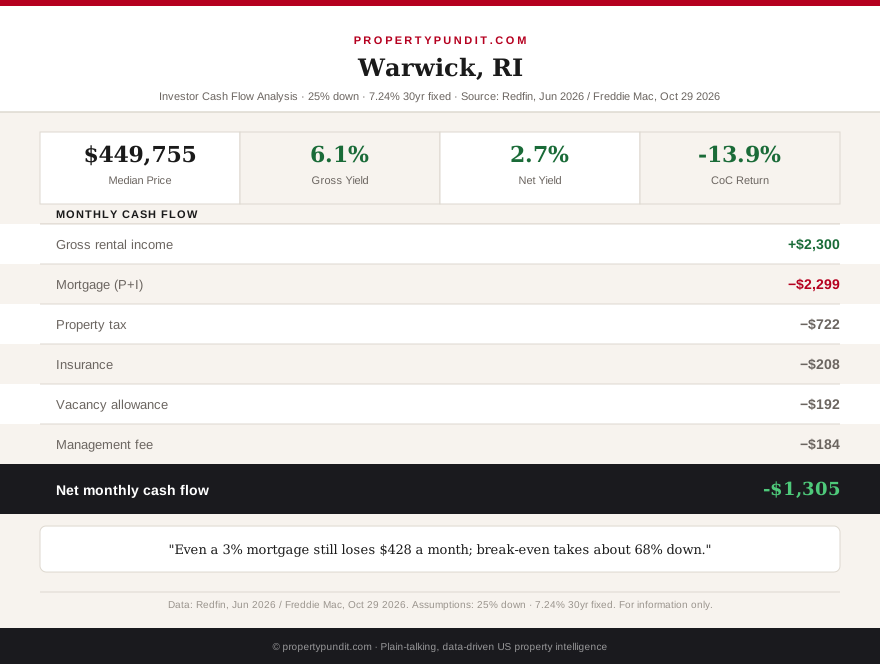
You've read the Rhode Island numbers twice now, and part of you is still holding onto the idea that rents this high must pencil out if you just find the right house at the right rate. The third pass says otherwise, and it says it in a way that should change how you shop: you could get a 3% mortgage tomorrow and a Warwick rental with 25% down would still lose $428 a month.
This is the third pass on the state. The August Rhode Island spotlight found no market clearing a 1.0 coverage ratio at 6.65% and corrected Warwick's tax rate by 52%. Since then Freddie Mac's 30-year average has climbed to 7.24% (Freddie Mac PMMS, October 29, 2026), so every number below is worse than the last time you saw it. Prices and rents are carried from that August pass, not refreshed, and the disclaimer at the bottom says which inputs are estimates.
Get this in your inbox every Friday.
One email. The number that matters and what it means for you.
Rhode Island at 7.24%: all three cities got worse
The assumptions match August: 25% down, a 30-year fixed loan, one month of vacancy a year, an 8% management fee, and the same tax and $2,500 annual insurance lines. Only the rate moved, up 0.59 points from 6.65%. On Warwick's $337,316 loan that adds $133 a month to principal and interest, and the cash flow drops by the same amount.
| City | Price | Rent | Monthly PITI | Cash flow | Coverage | August cash flow |
|---|---|---|---|---|---|---|
| Providence | $574,687 | $2,600 | $4,022 | -$1,847 | 0.54 | -$1,676 |
| Warwick | $449,755 | $2,300 | $3,229 | -$1,305 | 0.60 | -$1,171 |
| Pawtucket | $414,752 | $2,050 | $3,175 | -$1,460 | 0.54 | -$1,337 |
Prices are Redfin figures (3-month average ending June 2026 for Providence, June 2026 for Warwick, most recent reading as of August 2026 for Pawtucket). Coverage here is effective rent divided by the full mortgage payment, the same way the August table measured it. Warwick is still the least bad, but "least bad" now means losing $15,656 a year on $112,439 of down payment, a return of -13.9%.
So if you were holding a Rhode Island rental on your shortlist because the August loss looked survivable, the higher rate has made it a bigger hole, and nothing in the statewide numbers suggests it closes soon.
Why a 3% mortgage still loses money in Warwick
Most investors assume the problem is the rate. In Rhode Island it's mostly the price-to-rent ratio and the tax bill. Take Warwick's $2,300 rent. Vacancy and management take $376 of it. Property tax at $19.26 per $1,000 of assessed value is $722 a month, and insurance is $208. That leaves $994 to cover the mortgage before you earn a dollar.
| 30-year rate | Principal and interest | Monthly cash flow |
|---|---|---|
| 3.00% | $1,422 | -$428 |
| 4.00% | $1,610 | -$616 |
| 5.00% | $1,811 | -$817 |
| 6.00% | $2,022 | -$1,028 |
| 6.65% (August) | $2,165 | -$1,171 |
| 7.24% (today) | $2,299 | -$1,305 |
A $337,316 loan costs $1,422 a month even at 3%, and $994 of operating income can't carry it. The gross rent yield is 6.1% a year ($27,600 on $449,755), but taxes, insurance, vacancy and management leave a net operating yield of only 2.7%. No mortgage rate in the table is below that, which is why waiting for rates to fall is not a plan for Rhode Island rentals.
That means if your thesis is "I'll buy now and refinance when rates drop," the numbers say the refinance won't rescue the cash flow, only reduce how much you bleed.
The levers: how much down payment actually fixes Warwick
You can fix the math with cash, and the cost is steep. Here's Warwick at 7.24% as the down payment grows.
| Down payment | Cash in | Monthly cash flow | Coverage |
|---|---|---|---|
| 25% | $112,439 | -$1,305 | 0.60 |
| 40% | $179,902 | -$845 | 0.69 |
| 50% | $224,878 | -$538 | 0.78 |
| 60% | $269,853 | -$232 | 0.89 |
| 70% | $314,828 | +$75 | 1.04 |
Break-even takes about 68% down, roughly $304,000 of your own money, to earn nothing. The other routes are no kinder. At 25% down the price would have to fall to about $255,500 (43% below the June median), or the rent would have to rise to about $3,860 (68% above the estimate). A DSCR lender wants a coverage ratio of 1.0 to 1.25, so the DSCR loan guide point applies: at 25% down this property wouldn't qualify on its own rent.
For you, that means a Rhode Island rental only works as a cash-heavy purchase, and putting $304,000 into a property that returns zero a month is a poor use of capital next to almost any alternative.
The appreciation story: still there, but smaller
The bull case for Rhode Island has always been price growth, not rent. Redfin put Warwick at +6.6% year over year (June 2026) and Providence at +5.1%, down sharply from +23.2% in March (Redfin, 2026). A 6.6% gain on $449,755 is about $29,700 a year on paper, against $15,656 of cash lost at 25% down.
On paper that looks like a profit, but selling costs of roughly 6% of price (an assumption, about $27,000 on this house) would eat nearly all of a single year's gain, and you'd be betting on the Providence slowdown not spreading to Warwick. One more flag: Pawtucket's median reads $414,752 now against $340,000 in our June pass, a gap that is probably a shift in which homes sold, not 22% appreciation. We haven't confirmed it with a third source.
So if you're buying Rhode Island for appreciation, run it as a multi-year hold with a funded reserve for the cash losses, and treat the 6.6% as a recent reading, not a promise.
Property tax: the line you can't negotiate
Taxes are why Rhode Island doesn't look like the rest of New England on paper. Providence classifies non-owner-occupied property as commercial, taxed at about 3.5 times the owner-occupied rate (RIPEC, FY2026), for an effective rate near 1.83% in our model. Warwick charges a flat $19.26 per $1,000 with no homestead exemption, and Pawtucket charges landlords $24.50 per $1,000 (Warwick and Pawtucket city rate tables, 2026).
The state's new non-owner-occupied tax, which took effect July 1, 2026, applies only above $1 million of assessed value and exempts leases of 183 days or more (RIPEC, 2026), so it doesn't touch any house in this article. The everyday landlord surcharge is the real cost. Compared with Pennsylvania, where our latest Pennsylvania spotlight found a suburban pocket still clearing +$57 a month, none of the three Rhode Island markets we modeled has one.
If you're comparing states, count taxes before rent, because in Rhode Island they take more of your income than the lender does in the early years.
What a Rhode Island investor should do now
The math points toward skipping Rhode Island as a cash-flow play. Frankly, if you have $300,000 or more to put down, most investors who run these numbers end up buying where rent covers the payment at 25% down, which the SFR yield county map shows is still possible in parts of the Midwest.
If you still want Rhode Island, buy for appreciation only, expect to feed the property $1,000 or more a month, keep 12 months of those losses in reserve, and verify the rent against active listings before you offer.
Frequently asked questions
Is Rhode Island a good state for rental property investors in 2026? Not for cash flow. At Freddie Mac's 7.24% rate (October 29, 2026), Warwick, Providence and Pawtucket all lose $1,305 to $1,847 a month with 25% down, and coverage ratios sit at 0.54 to 0.60. It works only as an appreciation bet, and Providence appreciation slowed from 23.2% to 5.1% (Redfin, 2026).
How much down payment does a Rhode Island rental need to break even? About 68% in Warwick, or roughly $304,000 on a $449,755 house at 7.24%. At 70% down the property earns about $75 a month, and at 60% down it still loses $232.
Would lower mortgage rates make Rhode Island rentals profitable? Not by themselves. At 3% a Warwick rental with 25% down still loses $428 a month, because rent after vacancy, management, tax and insurance covers only about $994 of a $1,422 payment.
Does Rhode Island's new non-owner-occupied property tax affect landlords? Almost never. It applies only above $1 million of assessed value and exempts leases of 183 days or more (RIPEC, 2026), so a typical single-family rental is untouched. Providence's commercial classification of rentals matters far more.