 Property
The inspection report just landed, and page three says the roof and the air conditioner are "functional." You exhale, because you've got about $0 of room in the budget for a surprise and "functional" sounds like "fine." What it means is that both worked on the day the inspector looked, and it says nothing about whether the AC dies in March.
The myth is that a passing inspection means the big systems are good for years. It's one of the quietest ways a first-time purchase goes wrong, because the cost shows up after closing, when your down payment is already gone. We covered what inspectors skip in our look at what a home inspection doesn't check, and this piece goes deeper on the two most expensive items that usually pass.
Get this in your inbox every Friday.
One email. The number that matters and what it means for you.
What "functional" actually tells you
A home inspection is a snapshot of condition, not a forecast. The inspector turns the system on, looks for visible defects, and writes what they saw. InterNACHI, the largest inspector trade group, says in its standards material that estimating a roof's remaining life lies beyond its standard of practice, so many reports simply won't give you a number (InterNACHI, 2026). A roof with 2 years left and a roof with 20 can both come back "functional."
The report may still contain the clue you need: a note like "approaching end of expected service life" or a photo of granule loss on the shingles. Those lines are easy to skim past when you're reading 60 pages of caveats.
So if your report says "functional" and nothing else about age, treat that as a question you still have to answer, not a green light.
Age is the number to find: lifespans for roofs and HVAC
You can get the age yourself in about ten minutes. The air conditioner and furnace each have a data plate with a serial number, and manufacturers publish how to decode the year. For the roof, ask the seller for the permit or invoice from the last replacement; most counties keep roofing permits on file.
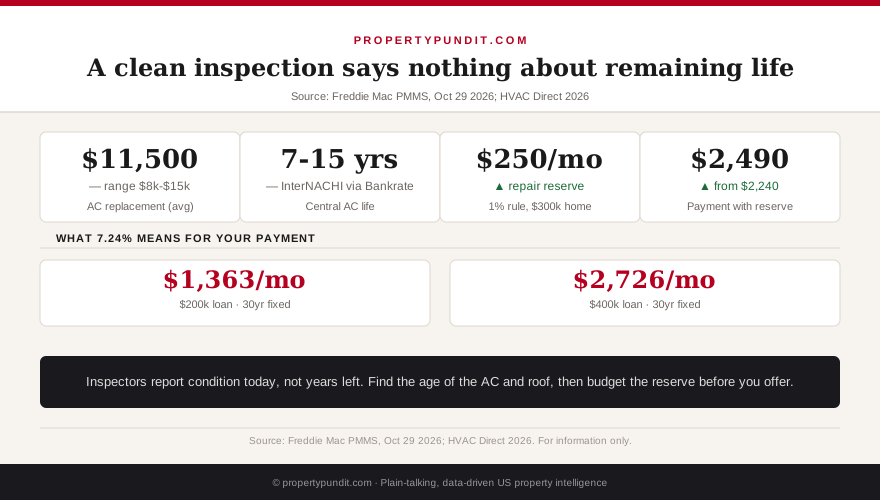
Then compare the age with typical ranges. Bankrate, citing InterNACHI's life-expectancy chart, puts central air conditioning at 7 to 15 years and furnaces at 15 to 25 (Bankrate, 2026). Secondary summaries of the same chart give architectural asphalt shingles about 30 years and 3-tab shingles about 20, though hot, humid or storm-heavy climates cut that substantially (InterNACHI chart, 2026). Sources disagree on exact figures, so use them as ranges.
| System | Typical life | Question to ask if it is older than |
|---|---|---|
| Central air conditioner | 7 to 15 years | 10 years |
| Furnace | 15 to 25 years | 15 years |
| 3-tab asphalt roof | about 20 years | 15 years |
| Architectural asphalt roof | about 30 years | 20 years |
That means if the AC is 12 and the roof is 18, you're not buying a house with working systems, you're buying a house with a countdown, and you should price it that way.
What it costs when the countdown ends
A contractor-sourced 2026 guide puts the average HVAC replacement near $11,500, with most homeowners paying $8,000 to $15,000, and costs run higher when ductwork has to be replaced too (HVAC Direct, 2026). Another contractor source lists central AC alone at $3,500 to $8,000 and a gas furnace at $2,500 to $7,000. These are contractor-published estimates, not government data, so get a local quote.
I haven't put a dollar figure on the roof because published roof prices swing too widely by size, pitch and material to be useful here. Ask a roofer for a written estimate before your inspection contingency expires, and use that number in place of mine.
Here's the worked example. You find a $300,000 starter home with a 12-year-old AC. At the outer edge of the 7-to-15-year range you have 3 years, or 36 months. Saving $11,500 in 36 months takes $319 a month. If the unit lasts only to year 13, it's $479 a month over 24 months.
For you, the useful question is not "will it fail" but "how many months do I have to build the fund," because that decides whether the cost is a plan or an emergency.
The reserve nobody adds to the monthly payment
The standard budgeting rule of thumb is to set aside about 1% of the purchase price per year for maintenance, though it's a heuristic and ranges up to 2% or more for older homes (University of Illinois Extension guidance, cited by multiple budgeting guides, 2026). On a $300,000 home that's $3,000 a year, or $250 a month.
Now put it next to a first-time buyer's budget. At $78,000 of income the 28% front-end rule allows about $1,820 a month in housing cost. Buy that $300,000 home with 10% down at Freddie Mac's 7.24% (October 29, 2026) and the payment is $1,840 in principal and interest, plus about $400 for tax and insurance (a 1.6% assumption), for $2,240. That's already 34% of gross monthly income. Add the $250 reserve and the real monthly cost is $2,490, or 38%.
| Line | Monthly |
|---|---|
| Principal and interest ($270,000 loan) | $1,840 |
| Tax and insurance | $400 |
| Payment before reserve | $2,240 |
| Repair reserve (1% of price a year) | $250 |
| True monthly cost | $2,490 |
If you're a buyer at that income, the reserve is the line that turns a stretch into a squeeze, so it belongs in the affordability math before you make an offer, not after the first repair bill.
Using the age to negotiate, not just worry
Once you know the ages, you have bargaining power in the contingency window. Get a written quote from an HVAC technician or roofer, then ask the seller for a price reduction or a closing credit for part of it. Our repair-credit guide explains why credits beat repairs, and the seller concessions guide covers the limits on how much a lender lets the seller contribute.
Roof age matters for a second reason: some insurers surcharge, restrict or decline older roofs, which can raise your premium before you ever file a claim (see how roof age affects insurance). Ask for an insurance quote with the roof's actual age before you remove the inspection contingency.
That means a 10-minute call to an insurer and a roofer can be worth more than the inspection fee, so make both calls before the deadline, not after.
What to do before you close
The math points toward treating system age as a line item. If the AC is past 10 years or the roof is past 15 to 20, ask for a credit sized to a written quote, and keep roughly $10,000 of cash beyond your down payment and closing costs. Most people who run these numbers end up lowering their offer by a few thousand dollars or choosing a house with a newer system over one with a nicer kitchen.
A home warranty is not a substitute for a reserve, because coverage limits and age exclusions often apply (our home warranty breakdown has the details). Your down payment plan matters here too; the down payment myth piece shows why putting every dollar into the down payment can leave you short for the first repair.
So before you sign, find the ages, get the quotes, and hold back the reserve, because that's the difference between a repair bill you planned for and one that goes on a credit card.
Frequently asked questions
Does a passing home inspection mean the roof and AC are good? No. It means they worked and showed no visible defects on inspection day. Inspectors generally don't estimate remaining life, so a 12-year-old air conditioner and a 2-year-old one can both be reported as functional.
How long does a central air conditioner last? Typically 7 to 15 years, per InterNACHI's life-expectancy chart as cited by Bankrate (2026). Heat, humidity and maintenance shift that range, so a unit past 10 years deserves a technician's opinion before you buy.
How much does it cost to replace an HVAC system? A contractor-sourced 2026 guide puts the average near $11,500, with most homeowners paying $8,000 to $15,000 (HVAC Direct, 2026). Replacing ductwork can push the total higher, so get a local written quote.
How much should a new homeowner budget for maintenance? A common rule of thumb is 1% of the purchase price per year, which is $250 a month on a $300,000 home. Older homes with aging roofs or HVAC often need more, so size the reserve to the actual system ages.