 Property
You've locked your rate, cleared the inspection, and you're counting down the days to closing when your insurance agent calls with a question nobody asked you before: how old is the roof? If the answer is somewhere north of 15 years, that single number can rewrite your coverage, your premium, and possibly your closing date, days before you're supposed to get the keys. It has nothing to do with whether the roof leaks. It has everything to do with a line insurers drew years ago that most buyers never hear about until it's their problem.
This is the part of buying a home nobody puts on a checklist. You budget for the down payment, the closing costs, the first year of maintenance. You do not budget for a carrier declining to write a policy on a roof that looks perfectly fine, or for an appraiser flagging the same roof and holding up your FHA loan. Both of those things happen constantly, and both are avoidable if you know to check before you're locked into a contract.
Insurers care about roof age more than they care about roof condition
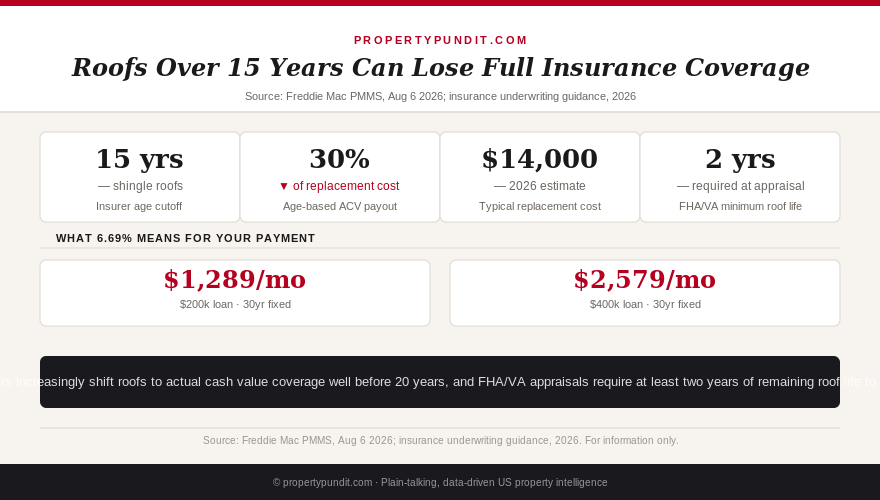
A home inspector checks whether a roof functions: no active leaks, no missing shingles, no sagging decking. An insurance underwriter checks a different number entirely, and it's printed on the property record or the seller's disclosure, not on the inspection report. In 2026, the 15-year mark has become the effective line for asphalt shingle roofs, the material on the large majority of American homes. Cross it, and many carriers simply won't write a new policy, regardless of how the roof looks on a walk-through. Tile and metal roofs generally get more runway, often 20 to 25 years, but the same principle applies: age drives the underwriting decision, not condition.
This catches first-time buyers off guard because it's counterintuitive. A roof that just passed inspection with zero flagged issues can still get you a same-day decline from an insurance carrier, purely on the birth date of the shingles. If you're shopping in a neighborhood built in the late 2000s or earlier, ask for the roof's age on every house you tour, not just the one you're ready to offer on, because a clean inspection report tells you nothing about whether a carrier will actually insure it.
What actually changes when your roof crosses the line
Before the cutoff, most policies offer replacement cost coverage: the insurer pays what it actually costs to install a new roof of similar quality, no deduction for age. Somewhere around 10 to 15 years, many carriers quietly shift roofs to actual cash value coverage instead, which subtracts depreciation from the payout before you ever see a check.
Carriers calculate that depreciation two different ways, and the two methods land in very different places on the exact same roof. Say a full replacement runs $14,000, a realistic 2026 cost for a mid-size single-family home. Under a straight-line 30-year depreciation schedule, a 15-year-old roof is roughly 50% depreciated, so the insurer pays around $7,000 and you cover the rest. Under an age-based payout schedule, which some carriers use instead, that same 15-year-old roof might be covered at only 30% of replacement cost, an insurer payout of about $4,200, leaving you responsible for $9,800 plus your deductible. Two policies can look identical on the declarations page and still differ by $2,800 in what the insurer actually pays on the exact same claim. Ask your agent in writing which method your specific carrier uses; don't assume "I have insurance" means "I'm covered for what you think you're covered for."
Get this in your inbox every Friday.
One email. The number that matters and what it means for you.
How this actually delays a closing, not just a repair bill
There are two separate ways an old roof can push back your closing date, and buyers usually only know about one of them. First, your lender will not fund without proof of a bound hazard insurance policy. If your first-choice carrier declines outright because of roof age rather than just downgrading you to actual cash value, you're now shopping for a new carrier days before closing, sometimes landing in the surplus or excess-and-surplus lines market at a materially higher premium just to get anything bound in time.
Second, and this one is specific to government-backed loans: FHA and VA loans carry minimum property standards that require a roof to have at least two years of remaining useful life at the time of appraisal. An appraiser who flags a roof as failing that standard triggers a required repair or replacement before the loan can close, full stop, not a note you deal with after you move in. Since FHA and VA loans are the low-down-payment path most first-time buyers use, this hits exactly the buyers who can least afford a surprise five-figure repair bill mid-transaction. If the home you're eyeing looks original to a 1990s build and you're financing FHA or VA, treat the roof line on the appraisal as a genuine closing risk, not a formality.
What to check before you write an offer, not after
The single best point of negotiating power you'll ever have on an old roof is before you're under contract with an expired inspection window, not during a closing-week scramble. Ask the listing agent for the roof's install or permit date before you offer; many counties post permit history online for free, and it's a five-minute check. Don't rely on "looks newer in the photos." Have your home inspector specifically note the roof's estimated age and remaining life as part of the standard inspection, and if that estimate comes back at 12 years or older, get an actual insurance quote before your inspection contingency deadline passes, not after, so you still have room to negotiate a credit or walk away if a carrier declines outright.
This is also where the math gets concrete enough to act on. A written roof certification from a licensed contractor, confirming three to five years of remaining life, typically costs a few hundred dollars. Compare that to a seller credit fight over a full $14,000 replacement, or worse, a rate lock that expires while you scramble for a new carrier. Most buyers who run this math end up asking for the certification first and the credit only if the roof actually fails it, because the certification is the cheaper, faster path in the majority of cases where the roof has real life left. It belongs on the same pre-offer checklist as your closing costs, not something you discover after you've already budgeted down to the dollar.
If you're already under contract and just found out
Don't panic and don't assume you need a full roof replacement to close. Start with a roofing contractor's written certification; many carriers will accept a documented three-to-five-year remaining-life certification in place of requiring a brand-new roof, and it's dramatically cheaper and faster to obtain. If the roof fails that certification, negotiate a seller credit toward replacement rather than walking away from a house you otherwise want. And shop at least two insurance carriers immediately rather than stopping at the first decline, since underwriting appetite on the identical roof varies significantly company to company. One carrier's flat no can be another's standard-rate yes.
The math points toward acting on roof age the same way you'd act on any other line-item cost: verify it before you're financially committed, not after. A rate-anxious buyer already stretching to make a purchase work does not have room in the budget or the closing timeline for a surprise this size. Check the permit date, get the inspector to note it explicitly, and price the insurance before your contingency window closes, not during the week you're supposed to be signing.
None of this is a reason to walk away from an otherwise good house. It's a reason to know the number before it knows you. The buyers who get blindsided by roof age are, almost without exception, the ones who never asked the question until someone else asked it for them, usually an underwriter, days before closing, with no time left to negotiate. Insurance is exactly the kind of cost that flows into your monthly tax-and-insurance escrow, and it's one of the hidden homeownership costs that never shows up on a mortgage calculator. A $300 certification is a lot cheaper than finding out the hard way.