 Property
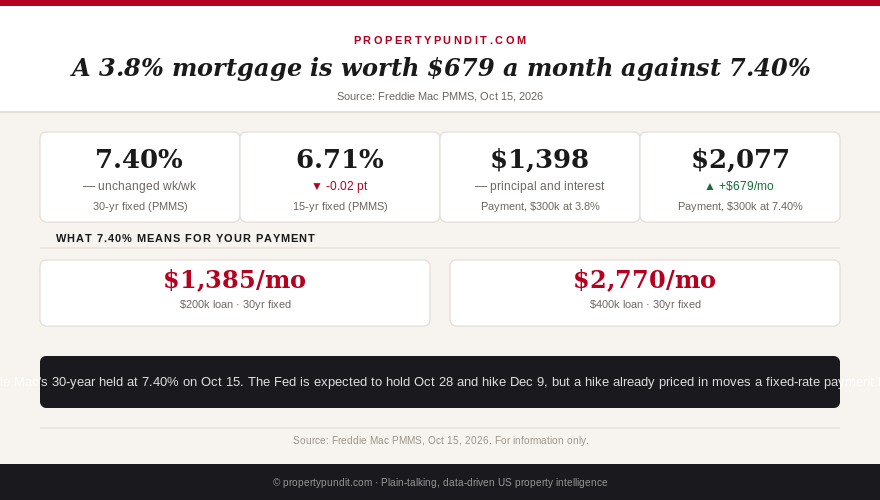
You locked in 3.8%, and Freddie Mac's latest weekly average for a new 30-year loan is 7.40%. On a $300,000 mortgage, that gap is worth $679 a month, or $8,151 a year, and nothing the Fed does on October 28 is likely to shrink it (Freddie Mac PMMS, October 15, 2026).
The rate held at 7.40% for a second straight week, matching the highest reading since November 2023, while the 15-year fixed eased two basis points to 6.71% (Freddie Mac via Mortgage News Daily, October 15, 2026). A year ago the 30-year averaged 6.27%. Freddie Mac publishes its next reading today at noon ET, so check freddiemac.com/pmms before you quote any number from this piece as current.
The question for a homeowner at 3.8% is what the high rate costs you if life forces a move, and whether a Fed hike changes that cost. Both have concrete answers below.
Get this in your inbox every Friday.
One email. The number that matters and what it means for you.
Where the 30-year rate stands after eight weeks of climbing
| Freddie Mac PMMS week | 30-year fixed | 15-year fixed |
|---|---|---|
| September 10, 2026 | 6.76% | 6.09% |
| September 17, 2026 | 6.95% | 6.26% |
| September 24, 2026 | 7.03% | 6.42% |
| October 1, 2026 | 7.28% | 6.60% |
| October 8, 2026 | 7.40% | 6.73% |
| October 15, 2026 | 7.40% | 6.71% |
That's 64 basis points in five weeks. On a new $300,000 loan, the move from 6.76% to 7.40% adds about $129 a month. Trading Economics counts October 15 as the eighth consecutive week without a weekly decline (Trading Economics, October 2026).
The daily gauges have started to ease. Mortgage News Daily's index read 7.40% on October 20, down from 7.43% the day before and from 7.56% on October 14, the day after the September CPI report (Mortgage News Daily, October 20, 2026). Its writer tied the recent drop to worries about deleveraging in the AI sector, with oil and war headlines adding noise. The index's 52-week range runs from 5.99% to 7.61%, so today's level sits close to the top of it.
So what for you: a daily reading under the weekly average hints that today's Freddie Mac number could print lower, but it's one week of data. Treat 7.40% as the working price of a new loan until the 10-year Treasury yield, which was 5.09% on October 16 versus 5.36% on October 7, stays down for several weeks (FRED via FatTail, October 20, 2026; Mortgage News Daily, October 8, 2026).
What the Fed can and can't do on October 28
The Fed raised its target range 25 basis points to 3.75%-4.00% on September 16, its first hike since 2023. For October 28, 94 of 100 economists in a Reuters poll taken October 16 to 20 expect a hold, and Bloomberg's futures-implied odds of an October hike fell below 20%, down from roughly two in three in late September (Reuters and Bloomberg via FatTail, October 20, 2026).
December is a different story. All 100 economists in the same poll expect a hike at the December 9 meeting, and traders put about 90% odds on a hike by year end (Reuters and Bloomberg via FatTail, October 20, 2026; Forbes, October 19, 2026).
A move that traders price at 90% two months early has mostly happened already in the bond market. Mortgage rates follow the 10-year Treasury yield, not the Fed's overnight rate, which is why the 30-year mortgage sits at 7.40% while the Fed's target is 3.75%-4.00%. A decision that matches expectations tends to move the 10-year very little. A surprise, such as an October hike or a hawkish dissent count, is what would push rates up.
So what for you: you don't need to time the Fed meetings. If you hold a 3.8% loan, neither a hold on October 28 nor a hike on December 9 changes your payment by a dollar. It only changes what a replacement loan would cost.
What your 3.8% is worth: a worked example
Take a $300,000, 30-year loan at 3.8% taken out in late 2021. The principal and interest payment is $1,398 a month. The same $300,000 at 7.40% costs $2,077. The gap is $679 a month, which is $8,151 a year before taxes and insurance.
Your real balance is smaller than $300,000 now. After five years of payments (60 of 360), the balance on that loan is about $270,456. If you sold, bought an identical house and financed the same $270,456 at 7.40%, your payment would rise from $1,398 to $1,873. That's $475 a month, $5,697 a year, or $28,483 over five years, for a house you already own.
| Scenario | Loan | Rate | Monthly principal and interest | Change vs. staying |
|---|---|---|---|---|
| Stay in your home | $270,456 balance | 3.8% | $1,398 | - |
| Move to an identical house | $270,456 | 7.40% | $1,873 | +$475 |
| Trade up to $450,000, 20% down | $360,000 | 7.40% | $2,493 | +$1,095 |
The trade-up row is the one that stops most people. A $450,000 purchase with 20% down means a $360,000 loan, and the payment rises by $1,095 a month before property tax and insurance, which also rise with price. Your 3.8% works like an asset attached to your address, and you give it up the day you sell.
So what for you: price any move at today's rate, not your current one. If a larger house or a new job doesn't justify an extra $475 to $1,095 a month, staying put is the cheaper choice, and it's not close.
Is the lock-in effect easing anyway?
Slowly. Redfin's analysis of FHFA data for the third quarter of 2025 found 21.2% of mortgaged homeowners had a rate of 6% or higher, the highest share since 2015, while the share under 3% had shrunk to 20%, the smallest since the end of 2021 (Redfin, February 27, 2026). Adding Redfin's 3% to 3.99% bucket (31.5%) puts about half of mortgaged owners, roughly 51.5%, under 4%.
That means you're in a group that's still large but shrinking, and the people moving are increasingly those who already carry a 6% or 7% loan and have little left to lose. It also means more sellers have no lock-in at all, which is part of why the market looks the way it does. Redfin reported that 14.5% of September contracts were canceled, a record for the month (Redfin, October 12, 2026). Realtor.com counted 20.8% of listings with a price cut in September, also a record for that month (Realtor.com, October 2026). Sellers offered concessions on 44.7% of August sales, the highest August share since at least 2020 (Redfin, September 2026).
So what for you: if you must buy, the lock-in is working against sellers more than it did a year ago. Ask for a concession toward a rate buydown or closing costs, because nearly half of recent sellers granted one.
Three rules for the next six weeks
Keep the loan unless the move pays for itself. Don't refinance a 3.8% mortgage; a refinance at 7.40% would raise the payment by $679 on a $300,000 balance. Use the table above to price a move before you list.
Watch the 10-year yield and Thursday's PMMS, not Fed headlines. A quarter-point change in the mortgage rate moves a $300,000 payment by about $51 a month, which is small next to the $475 gap you already have. The Fed headline matters for your savings account; the Treasury yield matters for your next loan.
If you plan to buy in 2027, put your effort into the down payment. You can't control the rate, but you can control the loan size: every extra $10,000 down cuts the payment by about $69 a month at 7.40% (the author's calculation), and that holds whether rates rise or fall.
Questions homeowners are asking this week
Will a Fed hike on October 28 raise my mortgage payment? No. A fixed-rate mortgage doesn't reset. Only variable-rate loans and new loans respond to rate moves, and the market expects a hold on October 28.
Should I refinance my 3.8% loan? No. At 7.40% a refinance on a $300,000 balance adds about $679 a month. Only a cash-out for a specific purpose, priced against a home equity line, could justify touching it.
Will rates fall before December? Nobody knows. The daily index fell from 7.56% to 7.40% in six days, but the 10-year yield remains above 5%. Plan around 7.40% and treat any drop as a bonus.
Is it worth giving up 3.8% to move for a bigger house? Only if the extra $475 to $1,095 a month fits your budget and the move has a reason beyond the rate. The 3.8% saves you thousands a year; it doesn't trap you if the move is worth it.