 Property
You liked Oklahoma for one reason: a property tax bill that costs about $216 a month less than the same house in Texas. In August that edge still left both big Oklahoma metros short of covering their payments, and you've been waiting to see if lower rates would close the gap. They went the other way. The 30-year fixed is now 7.32% (Freddie Mac PMMS, October 22, 2026), up from 6.67% when this site last ran the numbers.
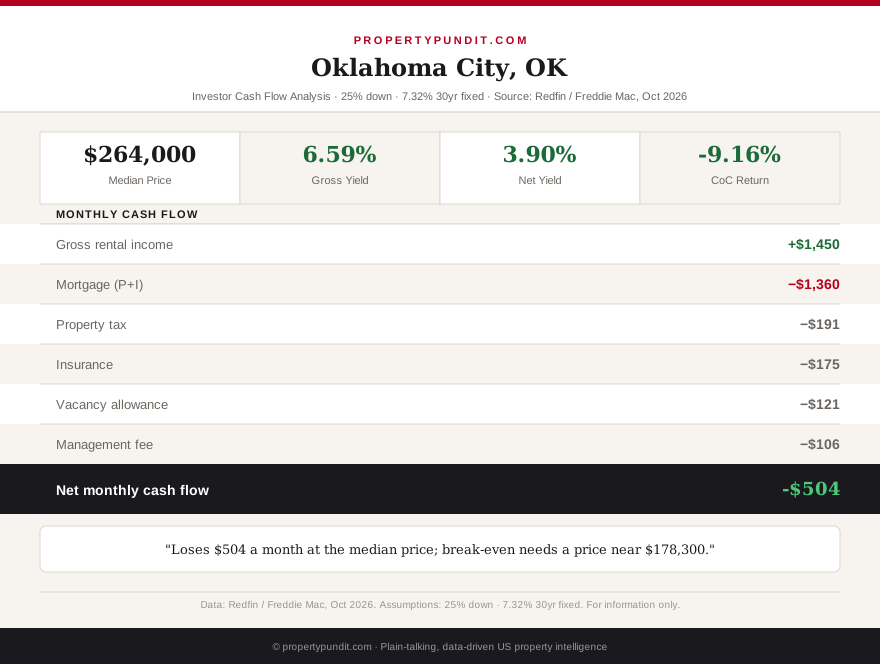
This is a third-pass re-underwrite of Oklahoma at the new rate, building on the August Oklahoma spotlight. The short version: Oklahoma City now loses $504 a month, Tulsa loses $420, and one lever in Tulsa gets you back to break even.
Get this in your inbox every Friday.
One email. The number that matters and what it means for you.
Oklahoma City at 7.32%: $87 a month worse than August
The inputs are the same as August's: a $264,000 median price (Redfin, July 2026), 25% down, a 0.87% effective property tax rate, $175 a month in landlord insurance, and $1,450 in rent. The $198,000 loan now costs $1,360 a month in principal and interest, up from $1,274. Add $191 in tax and $175 in insurance and the full payment is $1,727. After a one-month vacancy allowance and an 8% management fee, that rent nets $1,223.
The result is a $504 monthly loss and a coverage ratio of 0.71, down from a $417 loss and 0.75 coverage in August. A lender running a DSCR test wants to see at least 1.0, and most want 1.25, so this deal doesn't qualify on a median-priced house. Your $66,000 down payment is earning a negative 9.2% cash-on-cash return before you replace a single roof.
So if you're sizing an Oklahoma City purchase at the median price this year, assume you're funding about $6,000 a year out of pocket, not collecting a check.
Tulsa loses less, but it still loses
Tulsa's $252,000 median (Redfin, July 2026) with 25% down means a $189,000 loan at $1,298 a month. Property tax at Tulsa County's roughly 1.01% effective rate adds $212, insurance adds $175, and the full payment is $1,685. Against $1,265 in effective rent from a $1,500 single-family rental, that's a $420 monthly loss and 0.75 coverage, compared with a $338 loss and 0.79 coverage in August.
Tulsa's higher rent is what keeps it ahead of Oklahoma City. The cooling signal is the one to watch: Redfin's county-level days on market had stretched to about 45, up from 35 a year earlier, which usually shows up in prices a few months later. That means Tulsa's median may have more room to fall than the headline suggests, so paying today's median for a rental is the riskier side of that bet.
The price conflict that changes the answer
Two reputable sources disagree on what an Oklahoma City house costs. Redfin's mid-year review put the January-through-June average monthly median sale price at $268,512, up 0.4% from a year earlier. Zillow's typical home value for Oklahoma City was $207,421 as of August 2026. The gap is mostly a definition problem: Redfin counts what homes actually sold for, which skews toward newer and larger houses, while Zillow's index estimates the typical value of every home, including older, smaller ones that rarely trade.
It matters because the same $1,450 rent produces very different results at each price. At Redfin's $268,512 the monthly loss deepens to about $530. At Zillow's $207,421 it shrinks to about $171. Tulsa shows the same split: Zillow's index put it at $221,628 in May 2026 against Redfin's $252,000, which would cut the loss to about $238.
If you're buying in the $200,000 to $215,000 range, the older, smaller houses that Zillow's index is capturing, you're underwriting a much smaller loss, but you're also taking on the roof, HVAC, and tornado-season deductible risk that come with an older house.
Every lever on the same house
Here's what moves each market toward break even. All figures use 7.32% unless noted.
| Lever | Oklahoma City monthly cash flow | Tulsa monthly cash flow |
|---|---|---|
| Today: 25% down, 7.32%, median price | -$504 | -$420 |
| Rate back at August's 6.67% | -$417 | -$338 |
| Insurance at $125 a month instead of $175 | -$454 | -$370 |
| 50% down | -$50 | +$12 |
| All cash | +$856 | +$878 |
| Price needed to break even at 25% down | about $178,300 (32% below median) | about $181,900 (28% below median) |
| Rent needed to break even at median price | about $2,047 | about $1,998 |
| Rate needed to break even at median price | about 3.2% | about 3.8% |
No plausible rate drop fixes either market, because the break-even rates sit near 3.2% and 3.8%. Rent would have to rise about 41% in Oklahoma City or 33% in Tulsa. Only price, down payment, or both do the work. Frankly, if you want an Oklahoma rental to pay you each month, the lever that works is putting half down in Tulsa or buying 28% to 32% below the median.
The cost Oklahoma investors forget: wind and hail
The $175 insurance line already reflects Tornado Alley pricing, against a statewide median premium of $1,497 a year, or about $125 a month (Steadily, 2026). What it doesn't capture is the deductible. Many Oklahoma landlord policies set wind and hail deductibles at 1% to 5% of insured value rather than a flat dollar amount. At 2% on a $264,000 house, one hailstorm claim costs you $5,280 before the insurer pays anything.
The landlord math should carry that as a reserve, not a monthly expense. If you're buying here, budget a cash cushion equal to one deductible on top of your down payment, because a roof claim in your first year turns a $504 monthly loss into a much larger one.
Where Oklahoma still beats Texas, and where it doesn't
The tax edge is real. A 0.87% effective rate against Texas's 1.85% saves about $216 a month on a $264,000 house. Oklahoma's top income tax rate is 4.5%, and depreciation typically wipes out most taxable rental income for an investor carrying a mortgage, so the state tax is rarely the issue. Demand is also durable: Tinker Air Force Base employs roughly 26,960 people, and American Airlines' Tulsa maintenance base employs 5,500 to 6,000. Oklahoma has no statewide rent control, and its eviction timelines are among the faster ones in the country.
What the tax edge can't do is overcome a $1,727 payment against $1,223 in net rent. For you, that means Oklahoma's advantages are about holding costs and tenant demand, and they only pay off if the purchase price is right.
What an Oklahoma investor should do now
The math points toward waiting for a price, not a rate. At median prices, neither Oklahoma City nor Tulsa covers its payment at 7.32%, and no realistic rate move changes that. Most people who run these numbers end up in one of two places: buying Tulsa with 50% down, which breaks even at about +$12 a month, or hunting for houses 28% to 32% below the median, which is where the cash flow lives.
Before you bid, run the address through the DSCR loan investor guide to see what rent a lender will count, and compare Oklahoma County against the rest of the country in the SFR yield county map. If you're weighing a state where more of the cash flow holds up at today's rate, those two pieces will show you where to look first.
Frequently asked questions
Is Oklahoma a good state for rental property at 7.32% mortgage rates? Not at median prices. An Oklahoma City rental loses about $504 a month and a Tulsa rental about $420 on 25% down at 7.32% (Freddie Mac PMMS, October 22, 2026). Tulsa breaks even at about 50% down.
How much does Oklahoma property tax save compared with Texas? About $216 a month on a $264,000 house, based on a 0.87% effective rate in Oklahoma against 1.85% in Texas. It is a real edge, but it does not cover a $1,727 monthly payment against $1,223 in net rent.
What price makes an Oklahoma City rental break even? About $178,300 with 25% down, $1,450 in rent, and 7.32%. That's about 32% below the $264,000 median price used in this analysis.
Why do Redfin and Zillow disagree on Oklahoma City home prices? Redfin reports a $268,512 average monthly median sale price for the first half of 2026, while Zillow estimates a typical home value of $207,421 as of August 2026. Redfin tracks actual sales, which skew toward newer and larger homes, while Zillow estimates values across all homes, including older ones that rarely sell.