 Property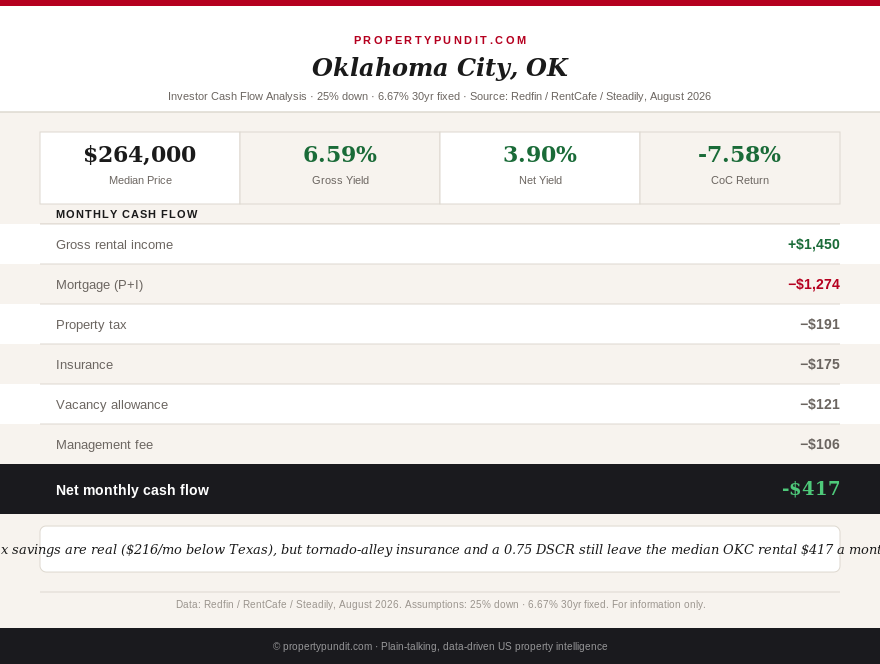
You've been circling Texas for months, drawn in by the no-income-tax pitch, and every time you actually run the numbers, Austin's or Dallas's property tax bill quietly eats whatever you thought you were saving. Oklahoma is the state right next door that flips that math, at least on paper: a property tax rate less than half of Texas's, on homes that already cost tens of thousands of dollars less. Run the full underwriting on Oklahoma City and Tulsa, though, and the state's other defining feature, sitting at the exact center of Tornado Alley, claws most of that advantage straight back.
This is a second-pass, full re-underwrite of Oklahoma, following up on this site's original Oklahoma spotlight from June. That first pass found Oklahoma City barely clearing a 1.006 DSCR and Tulsa clearing 1.05 at the median, both technically cash-flow positive. Neither holds up today: a 20-basis-point rate increase (6.47% then versus 6.67% now), a more conservatively sourced single-family rent figure, and a corrected, higher insurance line that better reflects Oklahoma's actual tornado-alley risk all moved against the deal at once. Here's the full re-underwrite across both metros, at a 25%-down investor purchase and today's 6.67% rate (Freddie Mac PMMS, August 13, 2026, the most recent reading, with a new one due today).
Oklahoma's tax edge over Texas is real, and it's worth $216 a month
Oklahoma City's median sale price sits at $264,000, up 1.5% year over year (Redfin, July 2026); the statewide figure runs slightly higher at $272,000, up 2.64% year over year (Houzeo/Redfin aggregation, 2026), a gap that reflects OKC pulling the average down relative to pricier suburbs. Oklahoma's average effective property tax rate is 0.87%, ranking 35th nationally and well below the 1.10% national average (Tax Foundation-sourced analysis, 2026), with residential property assessed at just 11% of fair market value. On the $264,000 OKC median, that works out to about $191 a month in property tax.
Run the identical $264,000 purchase in Texas, where the effective rate averages 1.85%, and the monthly tax bill jumps to roughly $407, a difference of about $216 a month, or nearly $2,600 a year, in Oklahoma's favor. Oklahoma's homestead exemption, which knocks $1,000 off assessed value for owner-occupants, doesn't apply to rental property, but the dollar impact of losing it is small, on the order of $100 a year, nowhere near enough to close a $2,600 gap. Oklahoma does levy a graduated income tax, topping out at 4.5% on income above $7,200 in 2026, that Texas doesn't charge, but for a leveraged rental running at a loss or near breakeven on paper once depreciation is applied, that income-tax bill is often close to zero in the early years of ownership. If you've been comparing Oklahoma to Texas purely on the no-income-tax headline, you're comparing the wrong number.
Get this in your inbox every Friday.
One email. The number that matters and what it means for you.
The insurance catch: Tornado Alley doesn't send a flat bill
Oklahoma sits at the geographic center of Tornado Alley, averaging 62 tornadoes a year across its 77 counties, with peak activity concentrated between April and June (National Weather Service). Hail damage alone affects an estimated 15% of structures statewide in an active storm season, and Oklahoma City and Tulsa both see repeated hail events every spring. Median landlord insurance in Oklahoma runs around $1,497 a year statewide (Steadily, 2026), but single-family rental premiums specifically, quoted by Oklahoma City brokers, commonly run $1,200 to $2,800 a year depending on roof age and location. This analysis uses $175 a month, or $2,100 a year, a figure toward the upper half of that local range given the weather exposure, rather than the lower statewide median.
The bigger trap for a first-time Oklahoma investor isn't the premium, it's the deductible structure. Most Oklahoma landlord policies set the wind and hail deductible as a percentage of the insured value, typically 1% to 5%, rather than a flat dollar figure. On a $264,000 property with a 2% wind and hail deductible, that's $5,280 of out-of-pocket exposure before the carrier pays a dime on a hailstorm claim, not the $1,000 flat deductible an out-of-state buyer might assume from experience in other markets. Moore, Oklahoma, a single suburb of OKC, has been hit by four EF4 or EF5 tornadoes since 1999, a reminder that this isn't a theoretical risk baked into a spreadsheet. If you're underwriting an Oklahoma rental off the premium alone, you're underwriting half the real cost; the deductible structure is the other half, and it belongs in your reserve fund, not just your insurance budget.
Oklahoma City: the math, and why it still misses DSCR
At the $264,000 OKC median, 25% down finances a $198,000 loan, running about $1,274 a month in principal and interest at 6.67%. Add the $191 property tax line and $175 in insurance, and total PITI lands at $1,640 a month. Against a 3-bedroom rent of roughly $1,450 (RentCafe pegs the city's apartment-composite 3-bedroom rate at $1,412 as of August 2026; single-family rentals typically command more, so this analysis uses $1,450), and after a one-month vacancy allowance and an 8% management fee, effective rent works out to about $1,223. That produces a DSCR of 0.75 and a monthly loss of roughly $417, a 6.59% gross rental yield, and a cash-on-cash return of about -7.6% on the $66,000 down payment.
Oklahoma City doesn't fail because the tax bill is high; it fails for the same reason most metros on this site fail right now, purchase price has outrun rent at today's borrowing cost. The tax savings versus Texas are real money in an investor's pocket every single month, but they're not large enough on their own to flip a 0.75 DSCR into a 1.0. If you're underwriting OKC at the median, plan for negative monthly cash flow and treat the tax advantage as a smaller loss, not a profit.
Tulsa: a better ratio, and a market cooling faster than it looks
Tulsa's median sale price runs about $252,000, up 5.2% year over year (Redfin, July 2026); Zillow's home value index reads notably lower, at $221,628 as of May 2026, a gap consistent with Zillow's broader housing-stock index diverging from Redfin's closed-sale figures. At 25% down, a $189,000 loan costs about $1,216 a month in principal and interest, and Tulsa County's roughly 1.01% effective property tax rate adds about $212. With the same $175 monthly insurance assumption, PITI totals $1,603. Against a 3-bedroom rent of about $1,500 (RentCafe's Tulsa apartment-composite figure runs $1,458 as of July 2026, adjusted upward here for single-family), effective rent comes to roughly $1,265, producing a DSCR of 0.79, a monthly loss near $338, a 7.14% gross yield, and a cash-on-cash return of about -6.4%.
Tulsa's numbers beat Oklahoma City's on every ratio in this comparison, largely because its price sits about $12,000 lower while rent stays close to comparable. But Tulsa County homes are also taking longer to sell, a median 45 days on market versus 35 days a year ago (Redfin, 2026), a real cooling signal for a metro that isn't yet showing up as dramatically in the price data. If you're choosing between the two cities purely on today's cash flow, Tulsa wins by a real but modest margin; if you're underwriting for the next several years of demand, that slowing pace of sales is worth watching before you assume the gap holds.
Tinker Air Force Base is the demand anchor neither city's numbers capture
Oklahoma City's single biggest advantage over Tulsa isn't in the cash-flow table, it's in the job base underneath it. Tinker Air Force Base employs roughly 26,960 people directly, and the broader OKC aerospace cluster, more than 338 establishments, employs 45,539 workers and generates an estimated $8.8 billion in annual regional output, with average aerospace wages near $87,000 a year, well above the metro's general average. Tinker's own long-range plan calls for roughly $11 billion in base construction over the next decade, and Boeing's designation of Oklahoma City as a Regional Sustainment Center for the C-17 fleet is expected to add 300 to 400 engineering and logistics jobs by late 2026. That's a source of stable, above-average-wage renter demand that Tulsa's more diversified but less singularly concentrated economy doesn't match at the same scale.
None of that shows up in this month's DSCR calculation, and none of it turns a negative cash-flow property positive on its own. But if you're choosing where in Oklahoma to hold for five-plus years rather than just chase this quarter's ratio, OKC's base-anchored job growth is the kind of demand driver that tends to support rents even through a broader slowdown, which is exactly the scenario Tulsa's rising days-on-market figure hints could be coming.
So what should an Oklahoma investor actually do
Neither Oklahoma City nor Tulsa clears a 1.0 DSCR at the metro median and today's 6.67% rate, so buying at the median and expecting positive cash flow isn't supported by the numbers here. Solving for breakeven in Oklahoma City, holding rent at $1,450, points to a purchase price closer to $189,000, roughly 28% below the city's current median, meaning the properties that actually cash flow are concentrated in the state's older, cheaper single-family stock, not the metro-wide average a listing site will show you. Frankly, if cash flow today is the goal, the math points toward hunting below-median inventory in either metro rather than buying at the median and hoping rent growth catches up, and toward Tulsa specifically if the choice comes down to today's ratio alone.
Before underwriting a specific Oklahoma City or Tulsa address, run the deal through this site's DSCR loan investor guide and cross-check the county against the SFR yield county map, and budget the percentage-based wind and hail deductible as real reserve capital, not an afterthought. If Texas is still on your shortlist for comparison, this site's full Texas market spotlight lays out the property tax side of that state in the same detail used here, so you can run both states through the identical framework before deciding which one actually pencils.
Frequently asked questions
Is Oklahoma a good state for rental property investment in 2026? Oklahoma is affordable and landlord-friendly, with no rent control and a 10-to-15-day eviction process, but neither Oklahoma City nor Tulsa clears a 1.0 DSCR at a full median purchase price and 6.67% rates. Oklahoma City runs a 0.75 DSCR and roughly -$417 a month; Tulsa runs 0.79 and roughly -$338. Investors need to target homes priced meaningfully below the metro median, roughly $189,000 or less in Oklahoma City, to clear breakeven.
How much does Oklahoma save investors on property tax compared to Texas? On a $264,000 Oklahoma City home, Oklahoma's 0.87% average effective property tax rate costs about $191 a month, versus roughly $407 a month at Texas's 1.85% rate on the same price, a savings of about $216 a month. Oklahoma does levy an income tax, up to 4.5% in 2026, that Texas doesn't charge, so the full comparison depends on an investor's income bracket and depreciation position.
Why is landlord insurance so expensive in Oklahoma? Oklahoma sits at the center of Tornado Alley, averaging 62 tornadoes a year across its 77 counties (National Weather Service), with hail damage alone affecting roughly 15% of structures statewide in active storm seasons. Most Oklahoma landlord policies also carry a wind and hail deductible set as a percentage of the insured value, typically 1% to 5%, rather than a flat dollar amount, which can mean thousands of dollars of out-of-pocket exposure on a single claim.
Is Oklahoma City or Tulsa the better rental market? On the numbers alone, Tulsa currently edges out Oklahoma City, with a 0.79 DSCR and a 7.14% gross rental yield against Oklahoma City's 0.75 DSCR and 6.59% yield, largely because Tulsa's median price sits about $12,000 lower while rents are comparable. Oklahoma City carries the larger, more diversified job base anchored by Tinker Air Force Base, so the better market depends on whether an investor is optimizing for near-term cash flow or long-term demand stability.