 Property
You've got an offer accepted, a loan estimate on the table, and a line on it that says property taxes are $293 a month. You're a first-time buyer on $78,000 of income, so you checked it against the seller's listing, and the seller's tax bill looked even lower. It's a comfortable thought: the tax bill goes with the house, so whatever the seller paid is roughly what you'll pay. In some states that's close to true. In Texas it can be off by a lot, and in North Carolina it's off in the opposite direction, because the bill you inherit can be smaller than your purchase price implies for years.
The myth is simple: "Property taxes follow the home, and buying changes nothing" or its mirror, "the county reassesses every house the minute it sells." Neither is right everywhere. What a sale does to your bill depends on the state, and the three states most first-time buyers in the South are shopping in (Texas, Georgia and North Carolina) run on three different systems.
Below is what actually happens in each, with a worked example so you can see the dollars on a $400,000 home. We use illustrative tax rates, because rates vary by county, and we flag the one law that is set to expire in Texas.
Texas: a sale resets your protection to market value
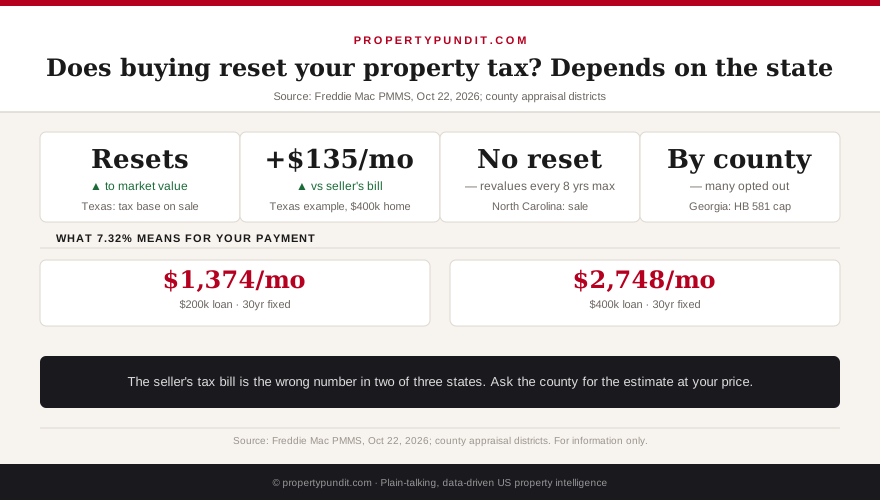
In Texas, homestead properties get a cap: the appraised value for tax purposes can rise no more than 10% a year over the prior year (Texas property tax code, as summarized by county appraisal districts). The cap protects the owner who has been in the house for years. It doesn't transfer to you. Travis Central Appraisal District states that when an owner sells, the existing limit ends and the tax base moves to current market value; the new owner qualifies for a limit starting after one full calendar year. So the seller's low bill is a product of years of capped increases, and you start from the price someone just paid.
Here is the effect on a $400,000 purchase. Say the seller's capped appraised value is $310,000 because the cap has held it back for years. The combined local tax rate in this example is 1.8% (illustrative; actual rates vary by county and school district). The seller's bill is about $5,580 a year. Yours, on the $400,000 market value, is about $7,200, or $1,620 a year more. That's $135 a month, on top of a $2,473 principal and interest payment on a $360,000 loan at Freddie Mac's 7.32% (PMMS, October 22, 2026). Homestead exemptions will reduce both bills, but they reduce them by the same dollar amount, so the $135 gap stays. If you're buying in Texas, ask your agent for the market value and your estimated bill, not the seller's, and build the difference into your budget before you make an offer.
Investors, note: non-homestead property, which includes rentals, is covered by a separate 20% "circuit breaker" cap on annual increases for property valued at $5.32 million or less, but you have to own it for a full calendar year to get it, and under current law it expires at the end of 2026 unless the legislature extends it (county appraisal district guidance; extension status unconfirmed). A buyer closing this year should assume the market value resets and keep an eye on whether the limit survives.
North Carolina: a sale triggers nothing, a revaluation triggers everything
North Carolina works almost the opposite way. A sale doesn't reappraise your home. Counties revalue on a calendar: state law sets a floor of one countywide revaluation every eight years, and counties can do it more often. Wake County, for example, voted in March 2025 to move to a two-year cycle, with the next revaluation effective January 1, 2027 (Wake County Tax Administration). In between, the assessed value on your property is whatever the last revaluation said, no matter what you paid.
Take the same $400,000 purchase, but in a county where the last revaluation put the home at $320,000 (illustrative) and the effective rate is 0.90% (illustrative). Your first bill is $2,880 a year, or $240 a month. That feels like a gift, and it is, until the next revaluation lifts the assessment toward the market. If values have risen about 25% since the last one, the new assessment lands at $400,000 and the bill goes to $3,600, a $60 a month increase that arrives with no sale and no warning except a notice in the mail. A lender's escrow analysis will catch it after the fact, which means your monthly payment can jump in the middle of a year.
For a first-time buyer, the lesson is the opposite of Texas: your tax bill at closing may be too low to trust. Look up your county's next revaluation date, and budget for the bill on your purchase price, not the one on the tax record. Our North Carolina market analysis shows how much the payment matters for investors in this state, and the same discipline applies when you live in the house.
Georgia: assessments change every year, and the cap depends on your county
Georgia sends property owners an assessment notice every year, so a purchase is less likely to cause a one-time reset than in Texas, but the number you see depends on a program most buyers have never heard of. House Bill 581, in effect since 2025, created a floating homestead exemption that limits annual increases in taxable value for a primary residence to inflation, but local governments could opt out of it. Many metro Atlanta counties and school districts opted out, including Gwinnett County (WSB reporting, March 2026), and our search found conflicting accounts on whether a 2026 law removes the opt-out option, so check with your county before you rely on the cap.
If your county opted out, your taxable value can rise with the market each year, and a purchase at a price well above the seller's assessment will usually show up in the next notice. If it didn't opt out, you file for the homestead exemption and the base year is set by the program rules. The practical step is the same either way: ask the county tax assessor (not the seller or the agent) whether your jurisdiction participates in HB 581 and what your exemption will be. So if you're buying in the Atlanta area on a $78,000 income, a $60-a-month surprise in the first notice is the difference between a payment that works and one that strains.
What to do before you make an offer
The seller's tax bill is the wrong number in two of these three states, and the right number is at the county. Three steps get you there. First, get the county's estimate of your bill at your purchase price, not the current bill. Second, find the date of the next revaluation in North Carolina counties and the status of the cap in Georgia and Texas. Third, add the difference to your monthly budget before you finalize the amount you can afford, using the same discipline we describe in our closing costs guide.
Two other pieces matter. If you're closing soon, our seller's tax bill myth-buster explains why the number on the listing doesn't tell you what you'll owe, and our property tax appeal myth-buster shows how to challenge an assessment that comes in high. The math points toward budgeting a 5% to 10% cushion on the tax line when the seller's bill is far below what your price implies. Frankly, if a $135-a-month swing decides whether the loan works at your income, the deal is too tight at 7.32%, and a cheaper home or a larger down payment (see the down payment myth-buster) is the better fix than hoping the county forgets about you.
Frequently asked questions
Does buying a house reset property taxes?
It depends on the state. In Texas, the homestead cap ends at sale and your tax base moves to market value. In North Carolina, a sale triggers no reappraisal; the next countywide revaluation does.
Will my property taxes go up after I buy a house in Texas?
Often, yes. If the seller's value was held down by the 10% homestead cap, your first bill is based on current market value, which can be about $135 a month higher on a $400,000 home in our example.
How often are property values reassessed in North Carolina?
At least once every eight years under state law, and counties can do it more often. Wake County's next revaluation is effective January 1, 2027.
What is Georgia's HB 581 floating homestead exemption?
A program that limits annual increases in a primary residence's taxable value to inflation. Local governments could opt out, and many metro Atlanta jurisdictions did.
Is the seller's property tax bill what I will pay?
Rarely. Check the county's estimate at your purchase price, because the seller's bill can reflect years of capped increases or an old valuation.
What was the Freddie Mac 30-year rate on October 22, 2026?
7.32%, down from 7.40% the previous week and up from 6.19% a year earlier (Freddie Mac PMMS).