 Property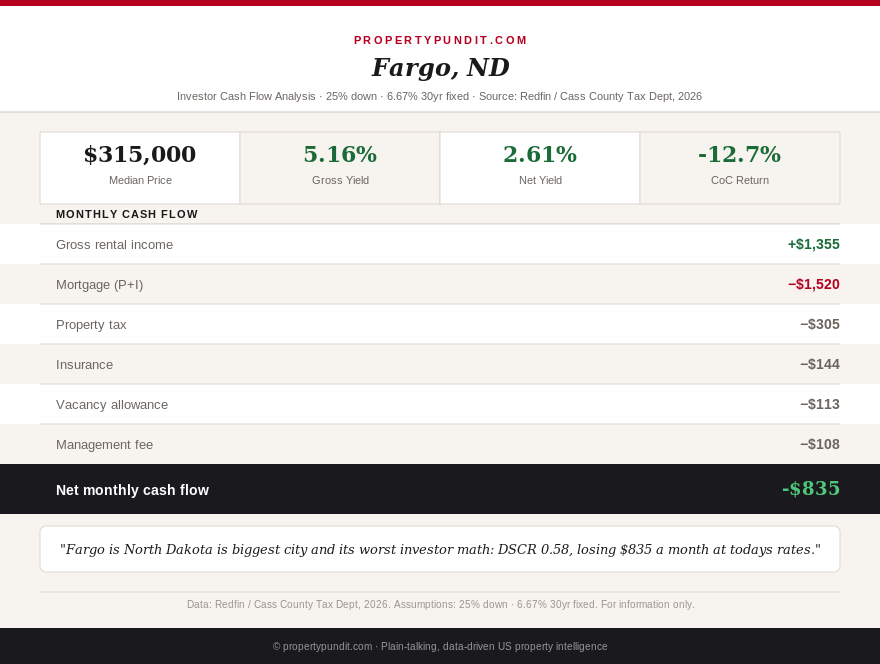
North Dakota advertises a $1,600 credit against your property tax bill. Read the eligibility rules and the credit disappears the moment the home stops being your own bedroom: rent it out, even briefly, and North Dakota's own guidance says you don't qualify. Pair that with a state income tax nearly everyone assumes doesn't exist and property tax rates that swing by nearly double depending which county you're in, and North Dakota looks like a state built around confident assumptions that don't survive contact with the actual numbers. Run the cash flow on the state's four biggest rental markets and the same pattern holds: nothing here clears breakeven at today's rates, and the two cities most investors would guess first, Fargo and the capital, Bismarck, post the worst math in the state.
Fargo at $315,000: the state's biggest city, its worst DSCR
Fargo's median sale price ran $315,000 over the three months through June 2026 (Redfin). At 25% down and Freddie Mac's 6.67% rate (PMMS, August 13, 2026), that's a $236,250 loan carrying $1,520/month in principal and interest. Cass County's effective property tax rate of 1.16%, the highest of the four counties in this piece after Grand Forks, adds $305/month, and a hail-adjusted landlord insurance estimate near 0.55% of value, reasonable for a state that sits squarely in "hail alley" and saw over $1.8 million in hail damage in a single recent year (NOAA/insurance industry data, 2026), adds another $144/month. PITI runs $1,969.
Three-bedroom rental homes in Fargo average $1,355/month (RentCafe/Apartments.com, 2026). After an 8% management fee and a one-month vacancy allowance, effective rent comes to $1,134, leaving a monthly loss of $835 and a DSCR of 0.58, the weakest of any market in this piece. Fargo is the state's largest city and its deepest job base, but at today's financing cost, size alone doesn't buy cash flow. So what that means for you: if you're underwriting Fargo because it's the name you already know, run the math before the reputation, because the reputation is currently the weakest number on this page.
Get this in your inbox every Friday.
One email. The number that matters and what it means for you.
Bismarck at $381,727: the capital's prices outran its rents
Bismarck is the outlier of this piece for the wrong reason: it's the most expensive market in the state despite being the smallest of the four by rent. The average home value hit $381,727, up 5.5% year over year (Zillow ZHVI), driven by state-government employment and inventory so thin that one recent count found just 0.42 months of supply citywide. At 25% down, the $286,295 loan carries $1,842/month in principal and interest. Burleigh County's 0.90% effective property tax rate, the lowest of the four counties here, adds $286/month, and the same 0.55% insurance estimate adds $175/month, for PITI of $2,303.
| Item | Fargo | Bismarck | Grand Forks | Williston |
|---|---|---|---|---|
| Median price | $315,000 | $381,727 | $303,687 | $324,361 |
| PITI (25% down, 6.67%) | $1,969 | $2,303 | $1,915 | $1,903 |
| 3BR rent | $1,355 | $1,810 | $1,815 | $1,792 |
| Effective rent | $1,134 | $1,514 | $1,519 | $1,499 |
| Cash flow | -$835 | -$789 | -$396 | -$404 |
| DSCR | 0.58 | 0.66 | 0.79 | 0.79 |
Three-bedroom houses in Bismarck rent for about $1,810/month (Rentometer, 2026), the highest gross rent of the four cities, which keeps Bismarck from being the worst market outright. After management and vacancy, effective rent comes to $1,514, still $789 short of PITI each month, DSCR 0.66. So what that means for you: Bismarck's low property tax rate is real, but it's being spent covering a purchase price that's climbed faster than what tenants are actually willing to pay, and a landlord buying here today is financing that gap, not collecting it.
Grand Forks and Williston: the state's least-bad markets, and a $54,000 price disagreement
Grand Forks, home to the University of North Dakota and Grand Forks Air Force Base, posts the best DSCR in the state at 0.79. The average home value is $303,687, up a sharp 7.6% year over year (Zillow ZHVI), and Grand Forks County actually carries the highest effective property tax rate of the four at 1.23%, adding $311/month. What saves the math is rent: three-bedroom houses average $1,815/month (2026 market data), the highest in the state, likely a function of steady student and military housing demand. Effective rent of $1,519 against PITI of $1,915 leaves a monthly loss of $396, still negative, but closer to breakeven than anywhere else in North Dakota.
Williston tells a messier story. Zillow's ZHVI puts the average home value at $324,361, down 0.5% year over year, while Redfin's median on 203 recent closings runs $378,900, a $54,539 gap on the same city. That divergence is a thin-market signature: Williston sees a fraction of the closings of Fargo or Bismarck, so a handful of higher-end sales, often newer construction built for oil-company management during the last boom, can pull a closed-sales median well above a broader, smoothed index like ZHVI. This piece underwrites Williston at the lower, broader $324,361 figure; an investor working only from Redfin's closed-sales number would be underwriting a materially more expensive, and worse-performing, deal. At $324,361, 25% down, and Williams County's low 0.70% effective tax rate (the lowest of the four, a byproduct of oil extraction tax revenue offsetting local budgets), PITI runs $1,903. Three-bedroom rent averages $1,792/month, among the highest in the state, a legacy of oil-worker housing demand that hasn't fully unwound. Effective rent of $1,499 leaves a $404 monthly loss, DSCR 0.79, essentially tied with Grand Forks for the best number in the state.
So what that means for you: if you're comparing Williston listings against a single online estimate, check which one, because the gap between sources here is larger than the entire monthly cash flow shortfall in Grand Forks.
The $1,600 credit every rental property in North Dakota is excluded from
North Dakota's Primary Residence Credit is worth up to $1,600 against the property tax bill on a home the owner actually lives in, and the application window runs January through April each year. Read the fine print from the state's own tax commissioner and the exclusions are explicit: a homestead that's rented out, even while the owner is temporarily absent, doesn't qualify, and rental properties, vacation homes, and investment properties generally are excluded outright. An owner-occupant in the house next door to your rental can knock up to $1,600 off a tax bill that looks identical to the one you're paying in full.
That's not unusual as state tax policy goes, most primary-residence credits exclude rentals by design, but it does mean any Fargo, Bismarck, Grand Forks, or Williston listing you're comparing against an owner-occupant's stated tax bill is comparing two different numbers. The effective property tax rates used throughout this piece, 1.16% for Cass County, 0.90% for Burleigh, 1.23% for Grand Forks County, and 0.70% for Williams, already assume no credit, because as an investor, you won't be getting one. So what that means for you: if a listing agent or seller quotes you last year's tax bill, confirm whether it reflects an owner-occupant credit before you use it in your own underwriting; it likely doesn't apply to the deal you're actually buying.
North Dakota isn't a zero-income-tax state, even if it looks like one
It's an easy state to mentally file next to South Dakota and Wyoming, both genuine zero-income-tax states right next door. North Dakota isn't one of them. The state runs a three-bracket structure for 2026, 0%, 1.95%, and 2.5%, and rental income is taxed the same as wage income once it clears the state's exemption threshold. The top rate is low by national standards, well below neighboring Minnesota's, and it rarely changes an investment decision on its own given how small the dollar amounts are relative to the DSCR gaps in this piece. But it's a real distinction worth having correct before you build a multi-state comparison spreadsheet that assumes North Dakota belongs in the zero-tax column.
Combined with the oil-price headlines circulating since crude climbed roughly 23% in July 2026 to near $94 a barrel, it's worth being precise here too: North Dakota's own active rig count fell from 26 to 23 over that same stretch, meaning the price move was geopolitical, tied to the on-again US-Iran conflict, not the start of a new drilling cycle. Williston and Watford City's population growth has been flat since the pandemic, a sharp contrast to the 2010s boom years when both towns more than doubled in population. So what that means for you: don't reprice a Williston or Watford City property based on this summer's oil headline; the fundamentals that would justify it, rising rigs and returning population growth, haven't shown up yet.
What the data means for you
The math points toward North Dakota being a state where the smaller, less obvious markets currently underwrite better than the big names. Grand Forks and Williston, tied at DSCR 0.79, are the closest the state gets to breakeven, while Fargo and Bismarck, the two markets most out-of-state investors would search for first, post the widest monthly losses. None of the four is a standalone cash-flow buy at 6.67% rates; all four require either a lower entry price than the current median, a rate closer to 6% before the numbers turn, or an investor comfortable underwriting appreciation and rent growth over a multi-year hold rather than day-one income. Frankly, if you're screening North Dakota purely on cash flow, Grand Forks' university and Air Force Base demand base gives it the most defensible floor of the four, and it's worth a harder look than the state's bigger, better-known cities. For the underlying loan mechanics behind every DSCR figure in this piece, see our DSCR loan investor guide, and for a broader look at how rent-to-price ratios compare across county lines, our SFR yield county map is worth checking before you commit capital to any single North Dakota metro. Investors weighing a similarly cold-climate, hail-exposed market against North Dakota's numbers may also want to compare notes with our Nebraska spotlight, published earlier this month.