 Property
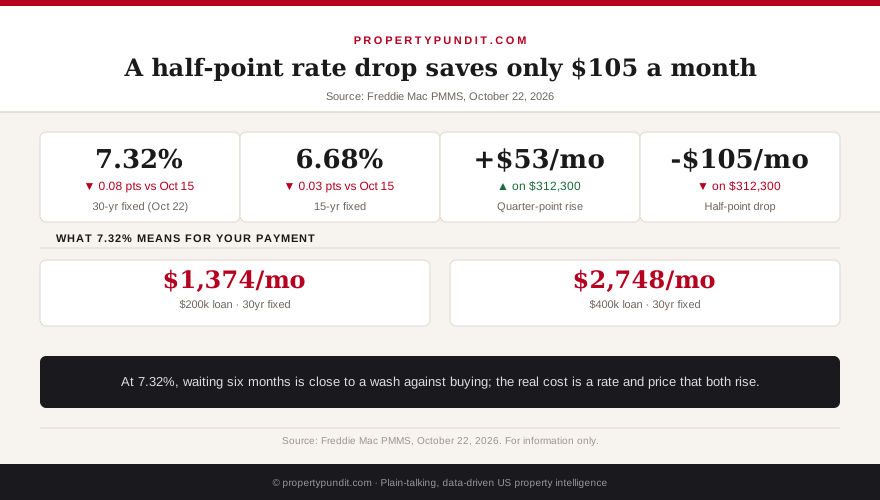
You've been watching Freddie Mac every Thursday for three years, and this week finally gave you a green number: the 30-year rate fell to 7.32% from 7.40%, the first drop in nine weeks (Freddie Mac PMMS, October 22, 2026). Now the question is whether this is the start of the relief you've been waiting for, or a pause before the Fed pushes rates higher. The honest answer sits in a few payments you can calculate yourself.
Take the same example from our Nashville buy-versus-rent break-even: a $347,000 home, 10% down, a $312,300 loan, and $2,050 a month of rent on the comparable three-bedroom (RentHop, October 2026). At 7.32% the principal and interest payment is $2,145, only $17 below the $2,162 at 7.40%. The week's celebrated drop buys you a lunch. What matters is how far rates would have to move before waiting beats buying, and what you give up while you wait.
Waiting isn't free, but it isn't expensive either, and the numbers below show why most people overpay for certainty about rates. The decision comes down to your time horizon, your price, and whether you can refinance; the rate itself is the smallest lever in the table.
Get this in your inbox every Friday.
One email. The number that matters and what it means for you.
What each move in rates does to the payment
| 30-year rate | Scenario | Principal and interest | Change from today |
|---|---|---|---|
| 7.57% | A quarter-point rise | $2,199 | +$53 |
| 7.32% | Today (PMMS, October 22) | $2,145 | $0 |
| 7.07% | A quarter-point drop | $2,092 | -$53 |
| 6.82% | A half-point drop | $2,040 | -$105 |
| 6.50% | A 0.82-point drop | $1,974 | -$171 |
| 6.00% | A 1.32-point drop | $1,872 | -$273 |
Each quarter point moves the payment by $53 on this loan, so a half-point drop saves $105 and a full point saves about $210. Against a total owning cost of about $2,962 a month (P&I $2,145, property tax $237, insurance $135, mortgage insurance $156 and maintenance $289) and a $2,050 rent, the rate is one component of a $912 monthly gap. A half-point move erases 11% of that gap. If you're waiting purely for the rate to fall, you'd need roughly a four-point drop, to about 3%, to close that gap on the loan payment alone.
What six months of waiting costs, and what it doesn't
Owning costs $912 a month more than renting in this example, so six months of waiting keeps $5,472 of cash in your pocket. Buying would have returned part of that: about $1,464 of principal paid down in the first six months, plus roughly $3,470 of appreciation if prices rise 2% a year, the middle case from our October 16 model. Those two add to about $4,934, which is $538 less than the extra cash you'd have spent. Over six months, buying and waiting come out close to even, before counting the 6% cost of selling and the closing costs you'd pay up front.
The picture changes if rates and prices both climb while you wait. A quarter-point rise adds $53 a month for the next 30 years, about $19,000 in total, and a price that rises 2% while you wait adds $6,940 to the purchase. So the real risk of waiting isn't six months of rent; it's a slow-motion version of the same market, 0.25 points higher and 2% more expensive. If you're a renter who has the down payment and the income to qualify, six months is a reasonable pause, and a year is where the cost starts to show.
What the Fed is likely to do, and why it matters less than you think
Futures pricing put the chance of a hike at the October 28 meeting below 20%, and all 100 economists in a recent survey expect a hike in December (Reuters and Bloomberg, October 2026). Mortgage rates track the 10-year Treasury yield more than the fed funds rate, so a December hike doesn't automatically mean 7.57%. But the consensus points up, not down, and the payment table above shows that even a modest rise costs more per month than this week's decline saved. So if you're counting on a drop, you're betting against the consensus: a half-point decline saves $105 a month, but nobody can tell you the odds of getting it before a hike arrives.
Buy now, refinance later: the 24-to-37-month test
The common reason to buy at 7.32% is that you can refinance if rates fall. That works only if the savings outrun the closing costs. After 24 months of payments your balance is about $306,111. Refinancing that into 6.50% saves $168 a month and, assuming costs of 2% of the balance ($6,122), pays back in about 36.5 months. A refinance to 6.00% saves $267 a month and pays back in about 23 months. Our refinance break-even guide walks through the formula, and buy now, refinance later versus waiting compares the two paths in more detail.
Two caveats matter. First, you can only refinance if rates fall and you still qualify; a housing payment near 28.6% of income leaves little room if your income hasn't grown. Second, refinancing at 6.50% in two years requires staying put at least another three, which pushes the break-even year in the plan further out. If you're buying with the expectation that a refinance will rescue the deal, treat it as an option you might not get to exercise, and make the purchase work at today's rate on its own.
The call: match your horizon, not the headline
The math points toward a simple rule. If you expect to stay 11 years or more, can carry about $2,673 a month in housing payments (28.6% of a $112,000 income) plus $289 for maintenance, and can negotiate 5% off the price plus a seller credit for closing costs, buying now makes sense. In the October 16 model that combination put break-even at year 11, with 20% down at year 10. If you might move in the next seven years, keep renting and invest the $912 monthly difference, because at 2% appreciation the buyer was still about $44,000 behind in year seven in that model. Frankly, most people who run these numbers end up in the second group, and that's fine; renting isn't a failure of discipline.
Before you decide, price the lowest-cost version of your purchase. Read what you'll actually need at closing in our closing costs guide, check whether a bigger down payment is worth it in the down payment myth-buster, and see how the $156 monthly mortgage insurance falls away in our PMI cancellation guide. A 0.08-point rate dip shouldn't move you; a price cut, a lower insurance bill or a longer stay should.
Frequently asked questions
Should I wait for mortgage rates to fall before buying a house?
Only if you'd otherwise move within seven years. A half-point drop saves $105 a month on a $312,300 loan, while six months of waiting is close to a wash against buying.
How much does a quarter-point rate change cost on a $312,300 loan?
About $53 a month, or roughly $19,000 over 30 years. A half-point change moves the payment by about $105 a month.
Can I buy now and refinance if rates drop?
Yes, if you still qualify. After 24 months, refinancing from 7.32% to 6.50% saves $168 a month and pays back $6,122 of costs in about 36.5 months.
What was the Freddie Mac mortgage rate on October 22, 2026?
7.32% for the 30-year fixed, down from 7.40% the previous week, the first decline in nine weeks. The 15-year fixed was 6.68% (Freddie Mac PMMS).