 Property
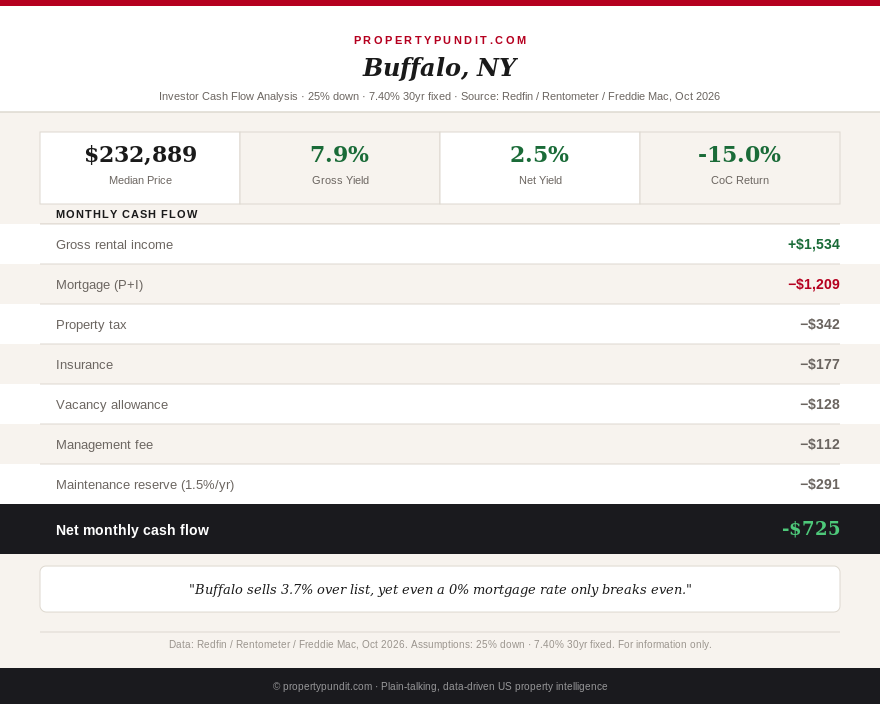
A median-priced Buffalo house costs $232,889, sells at 103.7% of its list price in about two weeks, and loses $725 a month as a rental at today's 7.40% mortgage rate. Cut the rate to 0% and the same house only reaches break-even, because tax, insurance, repairs, vacancy and management take $1,050 of the $1,534 rent and leave about $484 for the lender. Principal alone on a $174,667 loan over 30 years is $485 a month.
Buyers keep paying up. Redfin's September data shows Buffalo's median sale price at $232,889, up 1.7% from a year earlier, with 579 homes sold (up 10.5%). The sale-to-list ratio was 103.7%, down 1.3 points, 59.7% of homes sold above list, and 33.2% had a price drop, up 5.6 points (Redfin, September 2026). Statewide, the New York State Association of Realtors reported a September median of $450,000, up 5.9%, with 9,893 closed sales (down 1.4%), inventory up 9.8% to 35,294 homes and pending sales down 5.4% (NYSAR, released October 20, 2026).
This is the third New York pass of the year (June and August came first). The method matches the recent state passes: 25% down, a 30-year fixed at 7.40% (Freddie Mac PMMS, October 15, 2026), $2,125 a year of landlord insurance, 8% management, one month of vacancy a year, a 1.5% annual maintenance reserve, and county effective tax rates of 1.76% in Erie (Buffalo), 2.59% in Onondaga (Syracuse) and 2.63% in Monroe (Rochester).
Get this in your inbox every Friday.
One email. The number that matters and what it means for you.
Buffalo, Syracuse and Rochester cash flow at 7.40%
| Market | Price | Rent | Full payment | Net cash flow | Coverage | Break-even rent | Break-even price |
|---|---|---|---|---|---|---|---|
| Buffalo | $232,889 | $1,534 | $1,728 | -$725 | 0.89 | $2,394 | $141,170 |
| Syracuse | $211,000 | $1,600 | $1,728 | -$643 | 0.93 | $2,362 | $136,289 |
| Rochester | $247,500 | $1,758 | $2,005 | -$832 | 0.88 | $2,744 | $151,195 |
"Full payment" is principal and interest plus tax and insurance. Coverage is gross rent divided by that payment; DSCR lenders typically want 1.0 or better. Buffalo's $232,889 is Redfin's September median sale price; Syracuse's $211,000 is Redfin's August median (up 14.1%, with 263 sales, down 15.3%); Rochester's $247,500 is Redfin's January to March median (up 8.9%, per a Stacker republication dated April 30, 2026), so it's the stalest price in the table. Buffalo's $1,534 and Rochester's $1,758 are Rentometer's 3-bedroom averages across all property types (October 21 and 22, 2026), and Syracuse's $1,600 is carried from the August pass.
Every row loses money, and none gets above a coverage ratio of 0.93. Syracuse is the least bad at -$643 because its price is lowest, but its 2.59% tax rate takes back most of that advantage. As I showed in the DSCR loan guide, a lender approving the loan and the property paying for itself are different tests.
So what for you: at median prices, none of the three upstate cities covers its own payment. If you want to own one, the question is how far below median you can buy, not which city to pick.
Why August's -$377 became -$725
| Step | Change | Buffalo net cash flow |
|---|---|---|
| August published result ($246,321, 6.67%, $1,600 rent) | - | -$377 |
| Add the 1.5% maintenance reserve | -$308 | -$685 |
| Rate rises to 7.40% | -$91 | -$776 |
| Price falls to $232,889 | +$106 | -$670 |
| Rent switches to $1,534 | -$56 | -$725 |
Figures are rounded to the nearest dollar, so steps may differ from totals by $1. The reserve is the largest single change, at $308 a month. The rate rise costs $91, and the 5.5% lower price gives back $106. The rent figure also fell, from the carried $1,600 to Rentometer's $1,534, which costs another $56. The earlier pass left out the cost of keeping a house standing, and that omission explains more of the change than the market does.
So what for you: any Buffalo pro forma that skips a repair reserve is overstating your monthly result by about $300, so ask to see the line before you trust the total.
Why a hot market and a losing rental go together
Buffalo's 103.7% sale-to-list ratio and its 15-to-16-day sales pace tell you who is bidding: families buying a place to live, who value a home by what it costs them against renting, not by what it earns. Redfin rates the market "Very Competitive," with a Compete Score of 83 out of 100 (Redfin, September 2026). Syracuse looks the same: 104.5% sale-to-list, 26 days on market and 59.8% of homes sold over list in August (Redfin, August 2026). Rochester showed 9 days and about 7 offers per home in July, per the August pass.
An owner-occupant can pay more than an investor can justify because the owner isn't counting on rent. The wedge shows up in the coverage ratio: rent equals 0.66% of Buffalo's price per month (1,534 / 232,889), well under the 1% that investors often treat as a screen.
The softening signs are small but real. Buffalo's price-drop share rose 5.6 points to 33.2%, and the sale-to-list ratio slipped 1.3 points. A market that still clears above list can nonetheless be moving toward the buyer's side.
So what for you: don't bid over list on a Buffalo rental to win. If the house is bid up, the best offer is your break-even price, and you should accept losing the auction.
What would have to change for Buffalo to break even
Three levers can close a $725 monthly gap, and none looks close.
Price. Break-even is $141,170, which is 39% below the median. Syracuse needs $136,289 (35% below) and Rochester $151,195 (39% below).
Rent. Buffalo needs $2,394 a month, which is 56% above $1,534. At 3% annual rent growth with costs held flat, that takes about 15 years.
Rate. Even a 0% rate leaves Buffalo at roughly -$1 a month, so no rate cut alone fixes it. For comparison, a 6.00% rate would still leave the house at about -$563 a month.
The 25% down payment is $58,222, so the cash tied up is large relative to a result that's negative every month.
So what for you: this is a market for an existing owner with a paid-down property or a cash buyer who values appreciation. A financed purchase at the median price doesn't work on rent.
The New York landlord rules that change the math
The STAR exemption is for owner-occupants. Rental parcels pay the full levy, which is why the county effective rates above are the right ones for an investor and not the lower figures buyers hear quoted.
Good Cause Eviction depends on the city. Buffalo has never opted in, Syracuse rejected opting in on a 4-4 Common Council tie on February 23, 2026, and Rochester has opted in. Under the state law, annual increases above the lower of 10% or 5% plus CPI are presumptively unreasonable, so with CPI near 3.7% (BLS, September 2026) the ceiling would be about 8.7%. The cap doesn't bind at upstate rent growth today, but it binds in Rochester exactly when rents run hot.
Non-residents pay New York tax on rent and on the sale. New York taxes non-residents on New York-source income, including rental income and gain on the sale of New York real property, at 6.41% in the $80,650 to $215,400 bracket, with an estimated payment due at closing. If your plan depends on appreciation, the tax lands on the only return in the deal.
So what for you: if you live outside New York, add the non-resident return and an estimated tax payment at closing to your plan before you price the deal.
What the $450,000 statewide median hides
The statewide September median of $450,000 is 93% above Buffalo's $232,889 (NYSAR, October 20, 2026; Redfin, September 2026). It's also below June's record $475,000 (NYSAR, July 21, 2026), and a statewide median can move with the geographic mix of the homes that sold in a given month. Inventory is up 9.8% statewide and months' supply rose to 4.0 from 3.6, yet Buffalo still closes above list. Upstate scarcity is a local story, not a statewide one.
So what for you: never underwrite an upstate rental from a statewide headline. Use the city's own sale-to-list ratio and days on market, because they tell you how hard you will have to bid.
Questions investors ask about New York rentals
Does Buffalo have positive cash flow at 7.40%? Not at the median. The median house loses about $725 a month after management, vacancy and a repair reserve. It needs a price near $141,170 or a rent near $2,394 to break even.
Is Syracuse a better investment than Buffalo? Slightly, on cash flow: -$643 against -$725. Syracuse prices rose 14.1% in August and sales fell 15.3%, so you would pay for momentum. Neither clears break-even.
Does Good Cause Eviction apply in Buffalo? No. Buffalo hasn't opted in. Check the municipal ordinance before buying, because several opt-in cities tightened the state floor.
Should an out-of-state investor buy in New York? Only with a plan for the 6.41% non-resident tax and a price well below median. For most financed buyers at 7.40%, a state where rent covers the payment will give you better odds.
What I could not verify
Three inputs would tighten these numbers: a real landlord (DP-3) insurance quote, since $2,125 a year is a statewide average; house-only rents, since the Rentometer figures include apartments; and current Rochester and Syracuse sale prices, since Rochester's is from the first quarter and Syracuse's is from August. The direction of the result wouldn't change, because the gaps are $643 to $832 a month, but the dollar amounts could move.