 Property
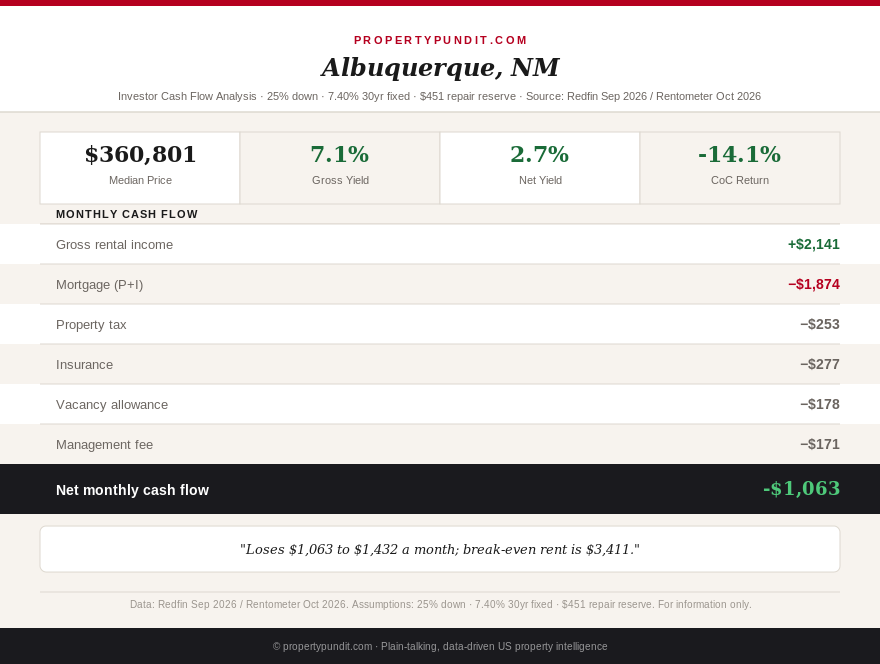
Buy a median-priced Albuquerque house as a rental today and you lose between $1,063 and $1,432 a month, depending on which rent you believe. In August the same market showed a $926 loss under a lighter cost method. New Mexico's rent-control ban and 3% assessment cap are real advantages, but neither one pays the mortgage.
The inputs are fresh. Redfin's September data puts the Albuquerque median sale price at $360,801, up 0.4% from a year ago, with 1,540 homes sold (down 5.5%), 35 days on market and a 98.8% sale-to-list ratio. Nearly 40% of homes (39.5%) had a price drop, 2 percentage points more than a year earlier (Redfin, September 2026). Rio Rancho's median is $389,804, up 3.7%, with 531 sales (up 13.3%).
This is the third New Mexico pass of the year (June and August came first). The method matches the recent state passes: 25% down, a 30-year fixed at 7.40% (Freddie Mac PMMS, October 15, 2026), 0.84% property tax, $277 a month insurance, 8% management, one month of vacancy a year and a 1.5% annual maintenance reserve.
Get this in your inbox every Friday.
One email. The number that matters and what it means for you.
Albuquerque and Rio Rancho cash flow at 7.40%
| Market and rent | Price | Rent | Full payment | Net cash flow | Coverage | Break-even rent | Break-even price |
|---|---|---|---|---|---|---|---|
| Albuquerque, carried rent | $360,801 | $1,700 | $2,403 | -$1,432 | 0.71 | $3,411 | $160,347 |
| Albuquerque, Rentometer 3BR | $360,801 | $2,141 | $2,403 | -$1,063 | 0.89 | $3,411 | $212,003 |
| Rio Rancho, carried rent | $389,804 | $1,390 | $2,574 | -$1,898 | 0.54 | $3,659 | $124,035 |
| Rio Rancho, Rentometer 3BR | $389,804 | $2,141 | $2,574 | -$1,270 | 0.83 | $3,659 | $212,003 |
"Full payment" is principal and interest plus tax and insurance. Coverage is gross rent divided by that payment; DSCR lenders typically want 1.0 or better. The $2,141 rent is Rentometer's 3-bedroom figure across all property types, dated October 21, 2026, and houses may rent for more or less. The $1,700 comes from the August pass, and Rio Rancho's $1,390 is carried from the same pass, so treat the rent columns as a range.
Even the kindest row, Albuquerque at $2,141, covers only 89% of the payment before a dollar of management, vacancy or repairs. A loan approval and a profitable rental are different tests, as I showed in the DSCR loan guide.
So what for you: if you want a New Mexico rental that pays for itself at 7.40%, neither city does it at a median price. The break-even price at the higher rent is $212,003, which is 41% below Albuquerque's median.
Why August's -$926 became -$1,063 to -$1,432
| Step | Change | Albuquerque net cash flow |
|---|---|---|
| August published result ($385,000, 6.67%, $1,700 rent) | - | -$926 |
| Today's cost method (management, vacancy, 1.5% reserve) | -$537 | -$1,463 |
| Rate rises to 7.40% | -$142 | -$1,605 |
| Price falls to $360,801 | +$173 | -$1,432 |
| Rent switches to $2,141 | +$369 | -$1,063 |
The biggest step is the method, not the market. Adding the repair reserve and a standard vacancy and management load costs $537 a month against August's lighter version. The rate rise costs $142, and the 6.3% lower price gives back $173. Nothing here suggests Albuquerque got worse; the earlier figure was too optimistic.
So what for you: when you compare any listing's rental pro forma to mine, check whether it includes a repair reserve and vacancy, because leaving them out flatters the result by $537 a month on this house, as the bridge above shows.
The rent question: $1,700 or $2,141
This is the largest source of doubt. Rentometer's Albuquerque 3-bedroom figure of $2,141 covers all property types, apartments included, and the house-specific figure sits behind a paywall. Zillow's Rental Manager page shows $1,695 for all bedroom counts and property types, but it was last updated August 28, 2025, so I treat it as stale. Zumper's $1,675 from the June pass is the lowest number I have.
Each $100 of monthly rent moves net cash flow by about $84 once management and vacancy come out. That means the full $441 gap between $1,700 and $2,141 is worth about $369 a month, which is how the table above moves from -$1,432 to -$1,063. Rent would have to reach $3,411 to break even, 59% above the higher figure.
So what for you: before you buy, pull three active house rent listings within two miles of the property and use the lowest one you'd accept, not the average.
Does price growth cover the carry?
| Market | Annual loss | Growth needed to cover it | Latest growth |
|---|---|---|---|
| Albuquerque at $2,141 | $12,754 | 3.53% | +0.4% |
| Albuquerque at $1,700 | $17,182 | 4.76% | +0.4% |
| Rio Rancho at $2,141 | $15,240 | 3.91% | +3.7% |
| Rio Rancho at $1,390 | $22,780 | 5.84% | +3.7% |
Growth needed is the annual loss divided by the purchase price. Albuquerque fails the test at both rents: it needs at least 3.53% and has delivered 0.4%. Rio Rancho comes closest, at 3.7% against a 3.91% requirement if you believe the higher rent, but its listings are slower (49 days on market) and 43.3% of homes had a price cut, up 7.4 points from a year ago. Prices can also move the other way: Redfin's own page text for Albuquerque quotes both +0.4% and 0.0% for the year.
So what for you: Albuquerque is not an appreciation play at this price, and Rio Rancho is a close call only if you trust a rent I couldn't verify for houses.
What the rent-control ban and tax cap really buy you
New Mexico bans local rent control under a 1991 state law (NMSA 47-8-30.1), and a 3% annual cap limits increases in a property's assessed value (New Mexico Taxation and Revenue Department). Long-term residential rentals are also exempt from gross receipts tax, which applies to short-term stays. Those rules reduce regulatory surprises, and they mean you can raise rent as fast as the market allows.
But rent has to rise a long way. From $2,141 to the $3,411 break-even is a 59% increase, which takes about 9.5 years at 5% a year, and your payment stays fixed while you wait. The assessment cap matters less than it sounds: a purchase generally resets the taxable value to the sale price, so don't count on inheriting the seller's lower bill. Insurance is the other open risk. The $277 a month is Insurify's statewide 2026 average carried from August, and insurance non-renewals tied to wildfire risk were a 2026 concern in my July research, so a real quote could run higher.
So what for you: treat the legal protections as a reason to hold for a decade, not as a reason to pay a median price today.
The market is giving buyers room
Albuquerque's 39.5% price-drop share and 5.5% fewer sales point to a slower market, and Rio Rancho's 43.3% price-drop share does too. That's the same loosening Redfin sees nationally, where September pending sales fell 4% and homes for sale reached their highest level since March 2020 (Redfin, October 12, 2026). In practice, you have room to ask for a price cut, though the break-even prices above show the gap is far larger than any realistic discount.
On a $360,801 house, a price cut to $342,000 (5.2% lower) cuts the monthly loss by about $134. Each quarter point on the rate is worth about $46 a month on a $270,601 loan.
What this means for you
Don't buy a median Albuquerque or Rio Rancho house as a cash-flow rental at 7.40%. The numbers lose between $1,063 and $1,898 a month, and neither market has the price growth to offset it. If New Mexico's laws appeal to you, wait for a price near $212,000 with a documented $2,141 rent, or put far more down and accept a longer payback.
If you still want in, use that negotiating room, run the rent from active house listings and get a landlord (DP-3) insurance quote before offering. Compare the result with markets where I've found smaller losses, such as the sub-$175,000 Omaha house at -$7 a month in my Nebraska pass.
What I couldn't verify
The 0.84% tax rate is Bernalillo County's homestead effective rate carried from the June pass, not a rental-specific bill, and I used it for Rio Rancho (Sandoval County) too. The $277 insurance figure is a statewide average, not a landlord quote. Rio Rancho's $1,390 rent is carried from August, and the $2,141 Rentometer figure includes all property types. Redfin's pages disagreed with themselves: Albuquerque's summary text says 0.0% year-over-year price growth against +0.4% in the table, and Rio Rancho's text says $386K and -0.65% against $389,804 and +3.7%. I used the table figures. How Bernalillo County applies the 3% cap to a rental purchase is unconfirmed.
Frequently asked questions
Is Albuquerque a good place to buy a rental property at 7.40% mortgage rates?
Not for cash flow. A median $360,801 house loses about $1,063 a month at a $2,141 rent and $1,432 a month at a $1,700 rent, after 25% down, 8% management, one month of vacancy and a 1.5% repair reserve (Redfin, September 2026, and PropertyPundit calculations).
What rent does an Albuquerque house need to break even?
About $3,411 a month on a $360,801 purchase with 25% down at 7.40%. That is 59% above Rentometer's $2,141 3-bedroom figure and double the $1,700 carried from August.
Why did Albuquerque's cash flow drop from -$926 to between -$1,063 and -$1,432?
Mostly the method. A fuller cost load (management, vacancy and a repair reserve) costs $537 a month, the rate rise to 7.40% costs $142, and a lower price returns $173. A higher $2,141 rent returns another $369.
Does New Mexico's rent-control ban make it a better state for landlords?
It removes one regulatory risk, because the state bans local rent control (NMSA 47-8-30.1), but it does not fix the numbers. Rent would have to rise about 59% to reach break-even in Albuquerque, which takes roughly 9.5 years at 5% a year.