 Property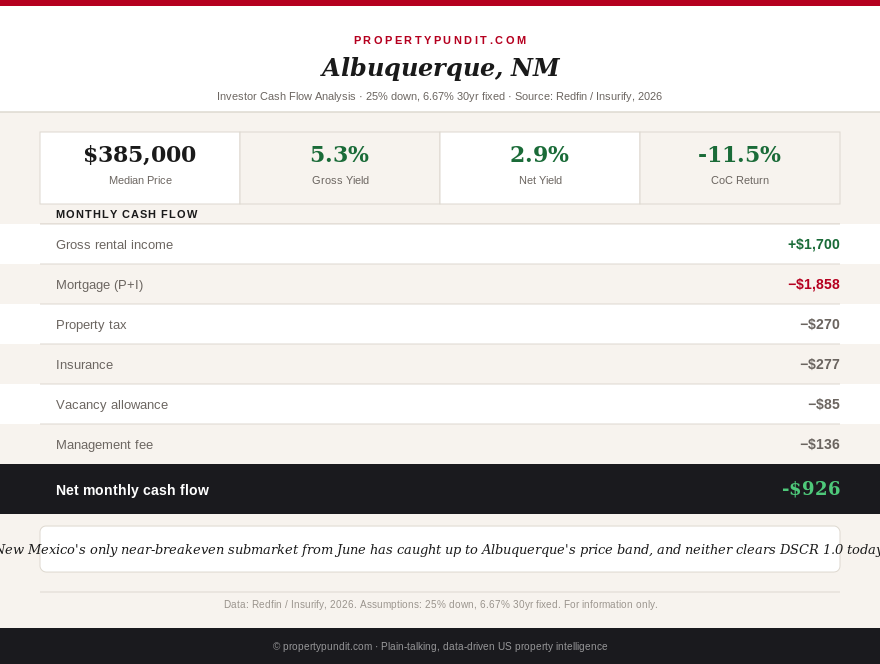
Back in June, New Mexico's numbers pointed to one working answer for investors: Rio Rancho, priced around $205,000 at the entry tier, was the only submarket in the state that came close to breaking even, with a DSCR of 1.11 and a monthly loss of just $58. Pulling fresh data this pass shows that math no longer exists. Rio Rancho's own city-wide median sale price has moved to roughly $370,000 to $377,000 (Redfin, 2026), squarely in Albuquerque's price range, and a corrected insurance figure erases most of what cushion remained anywhere in the state. New Mexico's rent control ban and its 3% assessment cap are still genuine structural advantages. Neither one offsets what price and insurance are doing to the monthly math today.
Albuquerque's price depends entirely on which source you trust
Redfin put Albuquerque's median sale price at $385,000 in July 2026, up 3.5% year over year, with 3.9 months of supply and homes sitting a median of 34 days on market across roughly 3,850 active listings. Zillow's Home Value Index, which smooths across the entire housing stock rather than just closed sales, shows $350,091 as of June 30, 2026, up a slower 1.1% year over year, nearly 10% below Redfin's figure. The gap exists because the two measure different things: Redfin's number reflects whatever mix of homes actually closed this month, while Zillow's index estimates the value of every home in the metro, sold or not. For an entry-level buyer or investor comparing your own target listing against "the market," check both. A home priced near $350,000 looks expensive against Zillow's index and roughly average against Redfin's.
Underneath both figures, Albuquerque's sub-$350,000 price band is where the competition is concentrated, with rate buydowns, New Mexico Mortgage Finance Authority assistance, and builder incentives all converging on the same pool of first-time buyers. So what that means for you: if you're underwriting a New Mexico deal off numbers from earlier this year, refresh the comparable sales before you make an offer, because a 10% swing between two legitimate sources is enough to turn a marginal DSCR into a failing one.
The insurance number we used in June was too low
New Mexico's average homeowners insurance premium now runs approximately $3,324 a year for $300,000 in dwelling coverage, well above the roughly $2,868 national average (Insurify, 2026), with an additional 11% increase projected before the end of 2026. That works out to about $277 a month, more than double the $125 monthly figure this site used in its first New Mexico pass in June. The gap matters because insurance is a fixed monthly cost that lenders count against DSCR the same way they count property tax, and understating it by this much can flip a marginal deal from breakeven to negative on paper alone.
The driver is wildfire retreat, not general inflation. New Mexico insurers refused to renew 6,200 home policies in 2025, the highest number on record and nearly triple the roughly 2,200 non-renewals seen in 2021, according to testimony from state Insurance Superintendent Alice Kane to the Legislative Finance Committee on July 21, 2026. Homeowners who lose standard coverage in high-risk areas can fall back on New Mexico's FAIR Plan, a last-resort option capped at $750,000 in coverage, but FAIR Plan premiums typically run higher than standard market rates. So what that means for you: get a real quote on the specific property before you underwrite it, especially anywhere near the wildland-urban interface outside Albuquerque and Santa Fe, because the statewide average may still understate your actual bill.
Full underwriting: neither Albuquerque nor Rio Rancho clears DSCR 1.0
At Albuquerque's $385,000 median, 25% down, and today's 6.67% Freddie Mac PMMS rate (August 13, 2026), the loan amount is $288,750 and principal and interest run about $1,858 a month. Add Bernalillo County's 0.84% effective property tax rate ($270 a month) and the corrected $277 monthly insurance figure, and PITI lands at $2,405. Rent for a comparable 3-bedroom single-family home runs an estimated $1,700 a month; after 8% management and 5% vacancy, effective rent is about $1,479. That's a monthly loss of $926 and a DSCR of 0.71.
Rio Rancho's own city-wide median now sits near $373,500. At the same terms, the loan is $280,125, principal and interest run about $1,803, property tax adds roughly $261, and insurance adds about $260 (slightly below Albuquerque given less wildland exposure in the immediate metro area). PITI comes to $2,324. Rent runs an estimated $1,390 a month; after management and vacancy, effective rent is about $1,209. That's a monthly loss of $1,115 and a DSCR of 0.60, worse than Albuquerque despite the lower price, because Rio Rancho's rent hasn't kept pace with what its own price band now demands.
| Market | Price | PITI | Rent (effective) | Cash flow | DSCR |
|---|---|---|---|---|---|
| Albuquerque | $385,000 | $2,405 | $1,479 | -$926 | 0.71 |
| Rio Rancho (city median) | $373,500 | $2,324 | $1,209 | -$1,115 | 0.60 |
So what that means for you: this pass corrects two things at once, a stale insurance figure and a price comparison that mixed Rio Rancho's cheapest listings with its city-wide median. Both corrections point the same direction. Neither Albuquerque nor Rio Rancho works as a median-price rental purchase at today's rate, and the earlier near-breakeven case rested on numbers that no longer describe either market.
Get this in your inbox every Friday.
One email. The number that matters and what it means for you.
The rent control ban and the 3% cap are real, just not a cash flow fix
New Mexico remains one of a small number of states with an outright statewide ban on local rent control, under the 1991 Rent Control Preemption Act (NMSA 47-8-30.1). Landlords can raise rents to market rate on any lease renewal in any New Mexico municipality, a genuine advantage over states like New York or Massachusetts, where local ordinances can cap how fast a unit's rent grows. New Mexico also caps annual increases in a property's taxable assessed value at 3%, regardless of how fast its market value climbs in a given year, which protects long-term owners from a tax spike after a hot appreciation cycle. Long-term residential rentals are also exempt from the state's gross receipts tax, unlike short-term rentals, which owe 5% to 9% combined state and local GRT.
These protections matter over a multi-year hold, not on day one. A 3% assessment cap does nothing for a property that's already cash flow negative from the day you close, and a rent control ban only helps once you're actually raising rent on an existing tenant, which takes time to compound into real dollars. So what that means for you: treat New Mexico's regulatory environment as a reason to hold longer once you're in a deal, not as a reason to accept a deal that loses money from the first mortgage payment.
Where a New Mexico deal could still work
Kirtland Air Force Base (roughly 25,000 military and civilian personnel) and Sandia National Laboratories (roughly 14,000 employees) anchor stable rental demand on Albuquerque's southeast side, and the University of New Mexico (roughly 15,000 employees) supports steady demand near campus. Intel's Rio Rancho manufacturing site (roughly 3,000 employees) does the same for that submarket. None of these employer anchors change the DSCR math at median price, but they matter for vacancy risk, which isn't captured in a DSCR snapshot.
The math points toward specific below-median listings, not the city median, as the only realistic path to a working New Mexico deal at today's rate. Foreclosure and estate-sale inventory priced meaningfully under $300,000 in either Albuquerque or Rio Rancho is worth underwriting individually; a home 15% to 20% under median, at the same rent levels modeled here, would move DSCR back toward the 0.85 to 0.95 range, still short of most lenders' 1.0 to 1.20 minimum but a materially different conversation than the median-price numbers above. For the underwriting mechanics DSCR lenders actually use, our DSCR loan investor guide walks through the qualification math, and our county-by-county SFR yield map is the companion piece for comparing New Mexico against states where the median price itself still clears the bar. New Mexico's median household income sits around $62,000 (Census ACS), well below the roughly $80,700 national figure, a reminder that the same price pressure squeezing investor math is squeezing local buyers too.
What this means for your next move
Frankly, if you pulled New Mexico's numbers in June and liked what Rio Rancho showed, run them again before you write an offer. Most investors who re-underwrite a deal a few months after their first pass find the price moved against them; fewer check whether their cost assumptions were too optimistic the first time, and in New Mexico's case, the insurance line was the bigger miss. This site's prior New Mexico coverage from June is worth revisiting alongside this update, since the structural story, a rent control ban and a 3% assessment cap, hasn't changed even though the price and insurance inputs have. Most investors who run this analysis honestly end up looking at specific distressed or below-median listings in New Mexico rather than the city medians, or shifting their New Mexico thesis from cash flow to a multi-year appreciation and equity play.