 Property
Your inspection report comes back clean: no active leaks, a roof with years left, a furnace that fires on the first try. You exhale, remove your contingencies and start picking paint colors. Three weeks after closing, a plumber's camera finds roots through the clay sewer pipe under your front yard, and the quote is $3,319, the national average for a sewer line replacement (Angi, updated August 3, 2026). On a $78,000 salary that's 51% of a full month's gross pay, due before you've unpacked the kitchen.
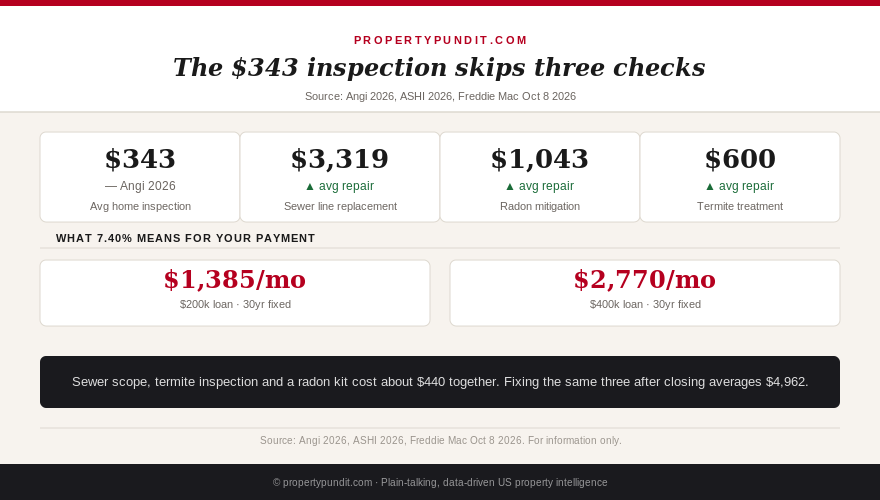
The report was accurate. Its scope simply stopped before the sewer line, the radon level and the termite check. A general inspection costs about $343 on average (Angi, 2026), and the standard most inspectors follow lists all three as things the inspector isn't required to examine. A clean report tells you the house passed the tests it ran. It says nothing about the tests nobody ordered.
This matters more than usual right now. The Freddie Mac 30-year rate reached 7.40% on October 8, 2026 (Freddie Mac), so every dollar of surprise repair competes with a mortgage payment that already strains the budget. Below: what the standard leaves out, what the three extra checks cost, and how to fit them inside your inspection window.
Get this in your inbox every Friday.
One email. The number that matters and what it means for you.
What the standard home inspection leaves out
The American Society of Home Inspectors publishes the Standard of Practice that many inspectors work from, and the 2026 version (approved January 8, 2026) is explicit about its limits. Inspectors aren't required to determine "the presence of wood destroying insects and organisms" (section 15.2.A.10). They aren't required to use "cameras or other equipment used to inspect the interior of a drain or sewer line" (section 16.2.A.9). And they aren't required to determine hazardous conditions such as radioactive substances (section 15.2.A.11), which is the closest category for radon, although the Standard doesn't name radon directly.
Some inspectors do more than the minimum and many sell these checks as add-ons. The point is that the minimum is what you get if you don't ask, and the report will not flag what it never looked at. Here is the gap in numbers.
| Check | Required of inspectors? | Add-on cost | Typical cost if found after closing |
|---|---|---|---|
| Sewer line camera scope | No (ASHI sec. 16.2.A.9) | $100 to $500 | $3,319 replacement average ($225 to $10,000) |
| Radon test | No (radioactive substances, sec. 15.2.A.11) | $15 to $60 DIY; $150 to $700 professional | $1,043 mitigation average ($805 to $1,326) |
| Termite inspection | No (wood-destroying insects, sec. 15.2.A.10) | $75 to $325; $100 average | About $600 treatment ($230 to $1,000); fumigation $1,500 to $8,000 |
What it means for you: read the "scope" page of your inspection agreement before you hire anyone, and treat every item the inspector isn't required to examine as a separate line you either pay to check or accept as a risk.
The sewer line: the biggest bill with the cheapest check
Angi puts the average sewer line replacement at $3,319, with jobs ranging from $225 to $10,000 depending on material, pipe length and access (Angi, updated August 3, 2026). The same page lists a video inspection at $100 to $500, and notes that most sewer projects require one anyway. So you're choosing between paying about $300 now, while the seller is still negotiating, or finding out later when the sewer is yours to fix.
Cheaper repairs exist. Cracked-pipe spot repair runs $600 to $1,050 and root removal $100 to $600 (Angi, 2026). A camera scope tells you which of those you're looking at. If the scope finds a collapsed section, you have a documented defect and a number to bring to the seller before you are committed.
What it means for you: when the house was built before about 1980 or has mature trees near the front yard, the scope is the add-on to buy first, because its downside is the largest and its price is the lowest.
Radon: a one-in-15 chance with a $15 test
The EPA estimates that nearly 1 in 15 U.S. homes has elevated radon, and says to fix a home at 4 picocuries per liter (pCi/L) or higher. The agency attributes about 21,000 lung cancer deaths a year to radon. The money side is mild: a mitigation system averages $1,043 and ranges from $805 to $1,326, a do-it-yourself test kit runs about $15 to $60, and a professional test $150 to $700 (Angi, updated September 28, 2026).
Run the arithmetic: a 1-in-15 chance of a $1,043 fix is an expected exposure of about $70, which is more than a $15 to $60 kit costs. The kit pays for itself on probability alone, before you count the health risk.
Timing is the catch. Short-term radon tests stay in the home for two days to 90 days depending on the device (EPA, Citizen's Guide to Radon), so a test ordered on day six of a seven-day window won't finish. Order it the day the offer is accepted.
What it means for you: if the result comes back at 4 pCi/L or higher, ask the seller to pay for a mitigation system or credit you the $805 to $1,326, since the repair is routine and the number is small next to the price of the house.
Termites: $100 to find them, $600 to $8,000 to treat them
Angi's September 2026 data puts the national average termite inspection at $100, with most homeowners paying $75 to $325. Treatment averages about $600 (range $230 to $1,000), and fumigating a large infestation costs $1,500 to $8,000. Angi's Atlanta page lists an average treatment cost of $486, with most homeowners paying $248 to $735. Damage is the larger unknown: one 2023 estimate from Bob Vila puts the national average termite damage repair at $1,800 (range $600 to $3,000), and that figure predates recent construction-cost increases.
Some lenders and sales contracts require a wood-destroying-insect report, so ask your agent whether yours does before you pay twice. If it doesn't, the $100 inspection is the cheapest check on this list.
What it means for you: an active infestation found before closing is a negotiating item; the same infestation found after closing is only your problem.
A worked example: $440 against $4,962
Take a buyer earning $78,000 a year, about $6,500 a month before tax. Price the three add-ons at the middle of their ranges:
| Line item | Low | Midpoint used | High |
|---|---|---|---|
| Sewer camera scope | $100 | $300 | $500 |
| Termite inspection | $75 | $100 | $325 |
| Radon DIY kit | $15 | $40 | $60 |
| Add-on total | $190 | $440 | $885 |
Now suppose none of the three was checked and every problem turned up after closing, each at its national average:
| If found after closing | Average repair |
|---|---|
| Sewer line replacement | $3,319 |
| Radon mitigation system | $1,043 |
| Termite treatment | $600 |
| Total | $4,962 |
The add-on package costs $440, about 9% of the $4,962 you would face if all three problems were hiding. Of course, most houses won't have all three. But $4,962 is 76% of that buyer's monthly gross pay, while $440 is under 7%. Pay the small, certain cost to avoid a large, uncertain one. And if all three come back clean, you spent $440 to learn the house is fine, which is cheap for a 30-year commitment.
Why you can ask right now
Waiving the inspection used to be common. In May 2026 only 17% of buyers waived their inspection contingency on a winning offer, down from 25% a year earlier (National Association of Realtors, Realtors Confidence Index). Sellers also offered concessions on 44.7% of August 2026 home sales, the highest share for that month since at least 2020, and about 21% of sellers cut their asking price in the four weeks before September 20 (Redfin, September and October 2026). In that market, a request for access to run a sewer scope and a radon test is ordinary, and a seller who refuses has told you something.
What it means for you: put the three add-ons into the offer as inspection items, with their deadlines, so you don't have to ask permission twice.
A simple plan for the next ten days
Order everything the same day your offer is accepted. Book the general inspection, the sewer scope and the termite inspection for the same visit window if you can, and place the radon device on day one. Ask the inspector or scope company for the raw video and the report in writing. If something turns up, ask for a repair or a credit using the averages above as your anchor: roughly $3,319 for a failed sewer line, $805 to $1,326 for radon, and $230 to $1,000 for termite treatment. If the seller won't give access, weigh that before you remove contingencies.
Frequently asked questions
Does a standard home inspection check the sewer line?
Usually not. The ASHI Standard of Practice does not require inspectors to use cameras to look inside a drain or sewer line. A separate scope costs $100 to $500, and a replacement averages $3,319 (Angi, August 2026). Book the scope for the same week as the inspection.
How much does radon mitigation cost?
A system averages $1,043 and ranges from $805 to $1,326 (Angi, September 2026). A DIY test kit costs about $15 to $60. The EPA says to fix a home at 4 pCi/L or higher, so test first and negotiate only if the result crosses that line.
Is a termite inspection worth $100?
Yes. Angi puts the 2026 national average at $100, against about $600 for treatment and $1,500 to $8,000 for fumigation. Buy the inspection, and ask your lender whether it already requires one.
Should I still get the regular inspection if I add these tests?
Yes. The general inspection covers the roof, structure, electrical, plumbing fixtures and mechanical systems, and the three add-ons cover what it skips. Together they cost roughly $780 at midpoint prices, which is $343 plus $440.
For the other half of the inspection fight, see our piece on why inspection waivers fell to 17% and the repair credit myth.