 Property
You're drafting an offer on a townhome you can actually afford on $78,000 a year, and someone, a friend, an agent, a forum thread you fell into at midnight, tells you to waive the inspection contingency or you'll lose the house. Your stomach drops a little. You picture yourself buying blind, discovering a cracked foundation or failing HVAC system after closing, with no way back out and no one to blame but yourself for skipping the one step everyone says protects you. That fear is doing a lot of work on advice that's already out of date.
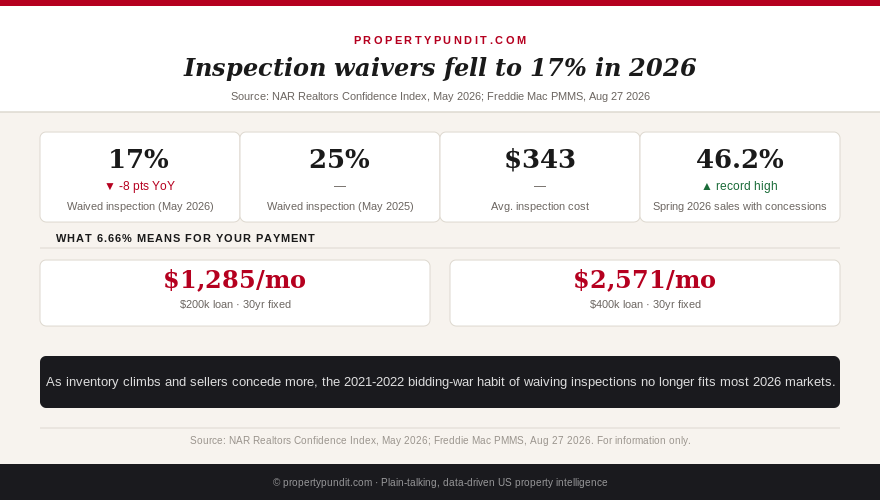
Only 17% of buyers waived their inspection contingency on a winning offer as of May 2026, down from 25% a year earlier, according to the National Association of Realtors' Realtors Confidence Index. That's not a small dip. It's the continuation of a steady decline, from 21% in September 2025 to 18% in December 2025 to 17% by May of this year. The "waive it or lose it" playbook came out of the 2021-2022 bidding wars, when inventory was scarce and sellers held every card. Most of today's market doesn't look like that anymore, and the advice hasn't caught up.
Get this in your inbox every Friday.
One email. The number that matters and what it means for you.
Where "waive it or lose it" actually came from
During the tightest stretch of the pandemic-era market, inventory was so thin and demand so intense that some buyers genuinely did lose houses over an inspection contingency, because a competing offer without one looked cleaner to a seller juggling a dozen bids in a weekend. That was a real, rational response to a real market condition. It also produced a piece of folk wisdom that spread far beyond the specific markets and specific weeks where it was true, and it stuck around the way advice does when it's tied to a strong memory of losing something you wanted.
The problem is that the market that produced that advice isn't the market you're buying in today. Active housing inventory climbed to roughly 1.5 million homes for the four weeks ending August 24, 2026, the highest level since May, and new listings rose 6% year over year over the same period (Redfin). Nationally, sellers outnumbered buyers by 47% as of Redfin's most recent count, and seller concessions hit a record 46.2% of spring 2026 sales, the highest share since Redfin started tracking the figure in 2019. None of that describes a seller's market where you need to hand over your due-diligence rights to compete.
So what for you: the version of the housing market that made waiving inspections a reasonable competitive tactic largely isn't the one you're shopping in, and treating 2021 advice as timeless is costing you protection you don't need to give up.
What the data says about your specific market right now
National averages hide a lot, so the honest caveat is that some tight micro-markets and specific price bands still see real competition. But the national direction is unambiguous. NAR's Realtors Confidence Index survey, which asks a national panel of real estate professionals what happened on their actual closed transactions, has shown the waiver share falling for most of 2026: 21% in September 2025, 18% in December 2025, and 17% in May 2026. Realtor.com separately reported that asking prices fell 2.5% year over year as of late August 2026, the steepest annual decline in its data since 2017, the eighth straight month of price declines. Sellers cutting their own asking price and offering concessions at a record rate are not sellers who can also demand you skip your inspection.
Put together, these numbers describe a market where the negotiating room has shifted toward you, even at $78,000 income in a competitive metro like Atlanta. That doesn't mean every offer you write should skip a rate buydown ask or an inspection credit request. It means the specific tactic of waiving your inspection contingency to win, which made sense when 25% of winning buyers were doing it, makes a lot less sense when the number has fallen to 17% and is still dropping.
So what for you: before you copy advice from a friend's 2021 home purchase, check whether your specific market still has the competitive pressure that made that advice correct, because national data says most buyers no longer need it.
What you actually give up when you waive
A typical home inspection costs $300 to $500, with a national average landing around $340 to $415 depending on the home's size and location, according to 2026 cost data from Angi and other inspection-cost trackers. That's a small number next to a $300,000-plus purchase, and it buys you two things a waived contingency doesn't: a licensed professional's assessment of the roof, foundation, HVAC, electrical, and plumbing systems, and a legal right to renegotiate or walk away if what they find is serious enough to matter.
Inspection findings are also one of the recognized categories of seller concession, alongside rate buydowns, closing-cost credits, home warranties, HOA prepayments, and escrow item coverage, and concessions of some kind showed up in 46.2% of spring 2026 sales. That means the inspection you'd be skipping isn't just protection against a bad surprise. In 2026's buyer-friendly conditions, it's frequently the document that gets you a credit at closing, whether that's for a water heater near the end of its life or a roof with five years left instead of fifteen. Waive the inspection and you don't just lose the safety net, you lose one of your clearest paths to negotiating the price down after you're already under contract.
So what for you: the $300 to $500 you'd save by skipping an inspection is small money against both the repair risk and the negotiating room you're giving up, and in a market with record concession rates, that negotiating room is worth more than it's cost you in most of 2026.
The one situation where waiving still makes sense
None of this means an inspection contingency is sacred in every circumstance. If you land in a genuine multiple-offer situation, a specific home in a specific pocket of demand where you're up against several other buyers, there's a version of waiving that keeps your protection intact: pay for a pre-offer inspection. You hire an inspector to walk the home before you write your offer, you learn exactly what you're buying, and then you submit without a contingency because you already did the diligence a contingency exists to guarantee. You take on the $300 to $500 cost regardless of whether your offer wins, which is the real trade-off, but you never buy a house blind.
That's a meaningfully different decision than waiving because you heard everyone does it. One is a calculated response to real, present competition on a specific property. The other is applying 2021 rules to a 2026 offer without checking whether the underlying market condition still exists.
So what for you: if you genuinely need to compete, a pre-offer inspection gets you the same information a contingency would, without weakening your offer, and it should be your first move before you consider waiving outright.
What to do with your next offer
The math points toward keeping your inspection contingency on your next offer unless your agent can show you real, current competition on that specific property, not a general sense that "it's still competitive out there." Ask what the last three comparable sales in that neighborhood looked like, how many offers they drew, and whether any of them waived inspection to win. If the answer is vague, the pressure that would justify giving up your protection probably isn't there.
Frankly, most buyers who run this check end up keeping their contingency and negotiating harder on other terms instead, whether that's your down payment structure, a faster close, or an appraisal gap agreement capped at a number you're comfortable with. Before you finalize your offer strategy, make sure your closing costs are budgeted separately from your inspection fee so you're not tempted to cut a corner to save a few hundred dollars, and double-check that your mortgage insurance assumptions are current if you're financing with less than 20% down. A $78,000 income doesn't leave room for a five-figure surprise repair bill, and in 2026, you're far less likely to need to accept that risk than the advice you've been hearing suggests.