 Property
A single-family rental at Wichita's $240,333 median price scores a debt-service coverage ratio (DSCR) of 0.72 at today's 7.28% mortgage rate. A duplex at the same price scores 1.01. Drop the duplex to $180,000 and it hits 1.25, the level DSCR lenders reward with their best pricing. You would still lose $150 a month on it. If you own rentals and you've wondered why lender websites say two doors clear the bar in cities where your own spreadsheet says one door can't, the answer is arithmetic, and it cuts both ways.
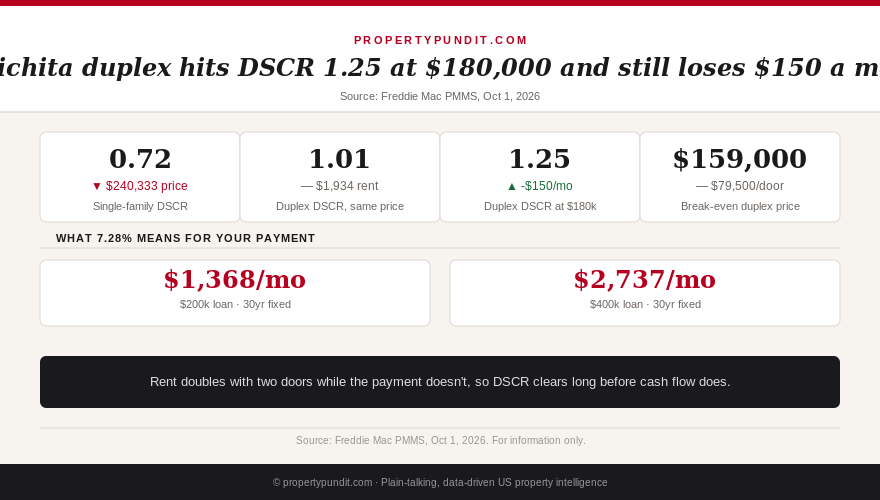
I've underwritten single-family houses in every state spotlight on this site. DSCR lender guides keep publishing 1.25-plus ratios for two-to-four-unit properties in the same markets where my single-family math fails. Both are correct, because they price different assets. This piece puts the two side by side for one city, with the full payment and the operating costs lenders ignore.
The short version: a duplex clears the lender's test because rent roughly doubles while the payment doesn't. It fails the owner's test for the same reason the single-family does, which is that a 7.28% loan against a 4% to 5% return costs more than the property earns.
Get this in your inbox every Friday.
One email. The number that matters and what it means for you.
How lenders calculate DSCR on a duplex
The formula is simple: gross rent divided by principal, interest, taxes, insurance, and any HOA dues (PITIA). Lenders use the lower of the appraised market rent or the lease in place, and they don't deduct management, vacancy, or repairs (Ridge Street Capital, 2026). A ratio of 1.25 or more gets the best pricing, while 1.00 to 1.09 is treated as break-even and carries a rate premium (LendFriend Mortgage, 2026). One to four units all qualify under residential DSCR programs; five or more moves to commercial lending (LendFriend, 2026).
Because the test ignores operating costs, it's a test of how much rent each dollar of mortgage buys. That makes the duplex's advantage structural. Two units earn two rents on a single lot, a single roof, and one tax bill. The payment grows with the price, but the rent grows with the door count.
So what: when you see "DSCR 1.25 on a duplex" in a lender's article, ask for the price per door and the rent per door. Those two numbers decide everything, and the articles almost never print them.
Wichita's single-family numbers: 0.72 and a $1,054 monthly loss
Wichita's median sale price is $240,333, up 4.3% from a year earlier (Stacker, 2026). A separate mid-year review puts it at $247,246, up 3.5%, with 2.3 months of supply and 29.8 median days on market (Stacker, 2026). I'm using the lower figure. Rentometer's three-bedroom house rent is $1,356 on average with a $1,345 median, dated January 2026, so treat it as a placeholder until you have a current comparable.
Property tax is the next input. Sedgwick County's effective rate is 1.40%, built from about 122 mills on a residential assessment of 11.5% (Property Tax Almanac, 2026), which adds $280 a month on this house. Insurance is the surprise: MoneyGeek puts Wichita at $4,484 a year, or $374 a month, the highest of any city it tracks in Kansas (MoneyGeek, 2026). Kansas ranked second nationally for hail events in 2024, with 495 of them (MoneyGeek, 2026).
With 25% down, a $180,250 loan at 7.28% costs $1,233 a month in principal and interest. The full payment is $1,888 against $1,356 of rent, a DSCR of 0.72. After management, vacancy, and a maintenance reserve, the house loses $1,054 a month. To reach a DSCR of 1.25 on that rent, the price would have to fall to about $112,857.
So what: no realistic price fixes this single-family at today's rate, and no lender will write a 0.72 loan at a normal rate. If Wichita is on your list, the question isn't whether to buy the house but whether to buy more doors per dollar.
The same $240,333 spent on a duplex
Duplex units are usually smaller, so I used Rentometer's $967 median for a two-bedroom house, twice over, for $1,934 of combined rent (Rentometer, January 2026). I also charged the duplex for what lender guides say it costs: roughly 0.125 to 0.375 percentage points more on the rate and about five points lower maximum loan-to-value than a comparable single-family (Mo the Broker and Lendmire guides, September 2026). That's 7.53% and 30% down in the table. The $450 insurance figure is my assumption (about 20% above the single-family quote), so get a real quote before relying on it.
| Monthly line item | Single-family (3BR house) | Duplex (two 2BR units) |
|---|---|---|
| Purchase price | $240,333 | $240,333 |
| Gross rent | $1,356 | $1,934 |
| Down payment / rate | 25% / 7.28% | 30% / 7.53% |
| Principal and interest | $1,233 | $1,180 |
| Property tax (1.40%) | $280 | $280 |
| Insurance | $374 | $450 |
| Total payment (PITIA) | $1,888 | $1,910 |
| Debt-service coverage | 0.72 | 1.01 |
| Management (8%) | $108 | $155 |
| Vacancy (one month a year) | $113 | $161 |
| Maintenance reserve (1.5% a year) | $300 | $300 |
| Net cash flow | -$1,054 | -$592 |
| Break-even rent | $2,615 | $2,642 |
| Rent as share of break-even | 52% | 73% |
The duplex's payment is $1,910, just $22 more than the house, even with the worse loan terms. The extra rent is $578 a month. That pushes DSCR from 0.72 to 1.01 and cuts the monthly loss from $1,054 to $592. Rent covers 73% of break-even instead of 52%.
Notice what didn't happen. A duplex at the same price as the house is still a losing deal at $592 a month. It passes a lender's minimum test and still fails yours.
So what: if you're comparing a duplex to a single-family at the same price, the duplex is the better asset. That doesn't make it a good one.
The price at which two doors clear DSCR 1.25
A duplex that costs the same as a median single-family house is a modest duplex. The interesting question is how far its price can rise before the ratio falls below 1.25. With $1,934 of rent, 7.53%, 30% down, 1.40% tax, and $450 of insurance, that price is about $180,593. The table runs the ladder.
| Duplex price | Price per door | Debt-service coverage | Net cash flow | Cap rate (before debt) |
|---|---|---|---|---|
| $240,333 | $120,167 | 1.01 | -$592 | 2.93% |
| $200,000 | $100,000 | 1.16 | -$297 | 4.11% |
| $180,000 | $90,000 | 1.25 | -$150 | 4.89% |
| $175,000 | $87,500 | 1.28 | -$114 | 5.11% |
| $159,000 | $79,500 | 1.37 | +$3 | 5.92% |
At $180,000 you're paying $90,000 per door and the DSCR is 1.25. The cap rate before debt (net operating income divided by price) is 4.89%, while the loan costs 7.53%. That gap is why the cash flow is negative: you borrow 70% of the price at a rate 2.64 points above what the property earns. Cash flow only reaches zero near $159,000, or $79,500 per door.
Here's the uncomfortable pattern. Each $20,000 off the price improves monthly cash flow by about $145, and the DSCR rises by roughly 0.08 to 0.09 along the way. The lender's number improves faster than yours does, because the lender never counts the $155 management fee, the $161 vacancy allowance, or the $225 reserve.
So what: if you're offered a Wichita duplex near $180,000, you can probably finance it on DSCR terms, and you will probably be subsidizing it from your other properties. Underwrite your offer to $159,000 or fewer if you want to break even, and treat anything above that as a bet on rent growth or appreciation.
Where the duplex wins for real: the vacancy buffer
Lender guides describe a built-in vacancy buffer on multi-unit properties, and it's real, even though DSCR doesn't count it. When a single-family tenant leaves, income drops to zero. When one duplex tenant leaves, you lose half. A three-month vacancy costs $4,068 on the single-family and $2,901 on the duplex (one $967 unit), and the duplex's mortgage is still being paid by the other side.
That doesn't show up in a DSCR or a cash-flow table, but it shows up in the reserves you need. Lenders typically ask for three to six months of PITIA in reserves on loans up to $1 million (LendFriend, 2026). A duplex lowers the odds that you'll draw on them.
So what: use the duplex's risk advantage to justify paying for it, not its DSCR. A property that doesn't go to zero income when one tenant leaves deserves a lower risk premium in your return target.
What this means for you
If you own one or two properties and you're shopping Wichita-type markets (price near $240,000, rents near $1,350 for a house), the arithmetic points in a clear direction. A single-family at today's median can't be financed on a good ratio and loses over $1,000 a month. A duplex at the same price can be financed but still loses about $592 a month. A duplex near $180,000 clears DSCR 1.25 and loses $150. Only around $159,000 does it earn a dollar.
Before you tour, compute your own ceiling: take combined rent, divide by 1.25 to get the maximum payment, and subtract tax and insurance to see how much is left for principal and interest. Then run the cash flow with management, vacancy, and 1.5% a year for repairs. If the listing price is above the second number, you're buying for appreciation. Wichita's 4.3% annual price gain is worth about $10,300 a year on a $240,333 asset, which is less than the single-family's $12,648 annual loss. That's a thin cushion, and appreciation isn't guaranteed.
If you want a property that works at today's rate, look at price per door, not price. Under $80,000 a door, in a market with proven rents, is where the duplex math starts to earn its keep.
Related reading: our Kansas third-pass spotlight shows what changed in Wichita's single-family numbers since July.
Common questions
What DSCR do I need on a duplex? Most lenders want 1.0 as a floor and reward 1.25 or higher with the best pricing; 2-4 unit loans often carry a modestly higher rate than single-family.
Does a DSCR of 1.25 mean positive cash flow? No. In the Wichita example, a duplex at 1.25 loses $150 a month once management, vacancy, and repairs are counted.
Why do duplexes pass DSCR when single-family homes fail? Rent scales with units while taxes and insurance scale with price, so a duplex buys more rent per dollar of payment.
Is a duplex safer than a single-family rental? It's less likely to hit zero income in a vacancy, because one unit can stay occupied, but it isn't automatically more profitable.