 Property
A rental house at Wichita's $240,333 median price loses about $1,054 a month at a 7.28% mortgage rate, with a debt-service coverage ratio (DSCR) of 0.72. In July, my second Kansas pass put Wichita's median at $224,000 with a DSCR of 1.01 and a $174 monthly loss. If you were thinking of Wichita as the Midwest's last place where the numbers work, this third pass is the one to read before you make an offer.
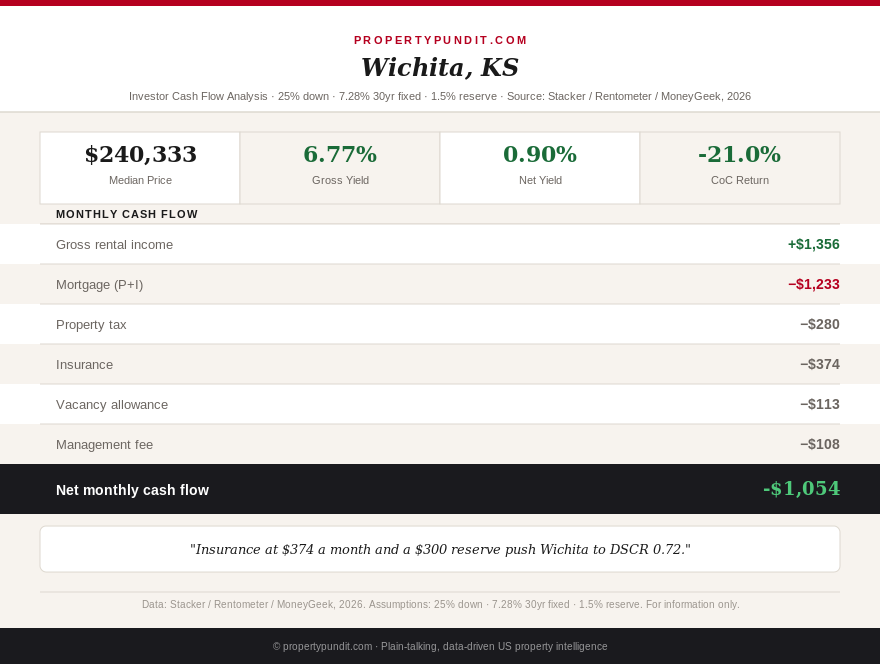
Three things moved since July. The mortgage benchmark rose to 7.28% (Freddie Mac, October 1, 2026), the highest reading since November 2023. I applied the 1.5% maintenance reserve that earlier Kansas passes didn't carry. And I re-sourced insurance and property tax, which turned out to be the biggest surprises.
I underwrote each case with 25% down, an 8% management fee, one month of vacancy a year, and that 1.5% reserve. Where inputs are weak, I say so.
Get this in your inbox every Friday.
One email. The number that matters and what it means for you.
Wichita has three median prices, and they disagree by $70,000
Stacker's 2026 Wichita summary shows a median sale price of $240,333, up 4.3% year over year. Its mid-year review lists $247,246, up 3.5%, on 782 homes sold, 2,581 active listings, 2.3 months of supply, and 29.8 median days on market (Stacker, 2026). SFR Analytics shows a median home price of $176,667 and a median rent of $1,350 as of July 1, 2026 (SFR Analytics). Different methods, different samples, and a $70,000 gap between the top and bottom figure.
I used $240,333 for the main case and $176,667 as an entry-level case, because a landlord shopping the cheaper end of Wichita will see something close to the second number. For context, Wichita's 2.3 months of supply is less than half the 4.9 months nationally (NAR, August 2026), and 24.4% of Wichita homes sold above list price, so buyers here don't have the bargaining power they have in Atlanta, where 72.8% of August sales carried a seller concession (Redfin, September 2026).
So what: when a listing site tells you "Wichita median," ask which one. At $240,333 you're in a market that's losing $1,054 a month; at $176,667 you're losing $578.
The full cash flow, median and entry-level
Rentometer's January 2026 figure for a three-bedroom house in Wichita is $1,356 on average with a $1,345 median. It's dated, so confirm it with a current comparable. SFR Analytics' $1,350 median rent is more recent, though I couldn't confirm its property mix.
| Monthly line item | Wichita median | Wichita entry-level |
|---|---|---|
| Purchase price | $240,333 | $176,667 |
| Rent (Rentometer / SFR Analytics) | $1,356 | $1,350 |
| Principal and interest (25% down, 7.28%) | $1,233 | $907 |
| Property tax (1.40%) | $280 | $206 |
| Insurance (MoneyGeek Wichita average) | $374 | $374 |
| Total payment (PITIA) | $1,888 | $1,487 |
| Management (8%) | $108 | $108 |
| Vacancy (one month a year) | $113 | $112 |
| Maintenance reserve (1.5% a year) | $300 | $221 |
| Net cash flow | -$1,054 | -$578 |
| Debt-service coverage | 0.72 | 0.91 |
| Break-even rent | $2,615 | $2,041 |
| Gross yield / net yield | 6.77% / 0.90% | 9.17% / 2.23% |
| Cash-on-cash return | -21.0% | -15.7% |
The entry-level case is closer to breaking even but still loses $578 a month, a cash-on-cash return of -15.7% on $44,167 of down payment. SFR Analytics advertises a 9.69% gross yield for Wichita, while the ratio of its own median rent to its own median price is 9.17%. A gross yield is also a poor guide to profit here: after tax, insurance, management, vacancy, and repairs, the net yield falls to 2.23%, which is well below the 7.28% cost of the loan.
So what: a 9% gross yield sounds like a cash-flow market. At 7.28%, it isn't. Run the net number before you fall for the gross one.
Insurance: $374 a month and a hail problem
MoneyGeek puts the average Kansas homeowners premium at $3,714 a year, 7% above the national average of $3,467 and the 12th highest in the country. Wichita runs $4,484 a year ($374 a month), the highest of its Kansas cities, against $3,158 in Olathe ($263 a month) and $3,970 in Salina. MoneyGeek attributes the premium to Kansas ranking second nationally for hail events in 2024 (495) and ninth for tornadoes (89), plus construction costs of $110 to $140 per square foot (MoneyGeek, 2026).
Earlier passes used $150 a month. That number was too low by $224. The honest caveat is that MoneyGeek's figure comes from a standard coverage profile, which can overstate the premium for a lower-value house. Table two shows what happens to the loss if you get quotes that come in cheaper.
| Change one input (median house) | Net cash flow | Monthly improvement | DSCR |
|---|---|---|---|
| Today's model | -$1,054 | n/a | 0.72 |
| Insurance at $150 (July pass figure) | -$830 | +$224 | 0.82 |
| Insurance at $200 | -$880 | +$174 | 0.79 |
| Rate at 6.55% (July pass) | -$966 | +$88 | 0.75 |
| Tax at 1.16% (June pass) | -$1,006 | +$48 | 0.74 |
| Rent at $1,550 (earlier estimate) | -$891 | +$163 | 0.82 |
| All four reversed, price $224,000 | -$417 | +$637 | 1.08 |
Even if you reverse every one of those four inputs, the loss would be $417 a month at a $224,000 price, versus the $174 published in July. The July figure also predates the maintenance reserve, which is $280 a month at that price. Insurance is the single largest driver at $224 a month, followed by rent at $163, rate at $88, and tax at $48.
So what: get three insurance quotes with the wind and hail deductible spelled out before you write an offer. A quote $175 a month under MoneyGeek's average is worth more than a quarter-point rate cut.
Property tax: 1.40%, not 1.16%
Sedgwick County's effective rate is 1.40%, which comes from a combined mill levy of about 122 and a residential assessment ratio of 11.5%. The county's typical bill is $2,590 on a $185,000 median home value (Property Tax Almanac, 2026). That's higher than the 1.16% figure from my first pass, and it adds $280 a month on the median house. Kansas reappraises annually, so assessments follow prices, and owners have 30 days from a notice to appeal.
I found no investor-specific surcharge in Kansas. The county-to-county gap is a millage difference, not a rental penalty. Kansas income tax runs 5.20% to 5.58% on two brackets, and the SB 269 phase-down toward a 4% flat rate hasn't been triggered (Tax Foundation, 2026).
So what: use 1.40% in Wichita and verify the actual mill levy on the parcel you're buying. A one-point error in the tax rate on a $240,333 house is $200 a month.
The rest of Kansas: I couldn't re-verify rents
The statewide median closed price is $359,900 across 9,304 closings, but that's a sample skewed toward Johnson County. Resideline's six-month data shows Overland Park at $499,000, Olathe at $460,000, Leawood at $765,000, and Topeka at $185,000 (Resideline, October 2026). Those are sale prices, not rents, and I didn't re-source rents for them.
I can tell you what a rent would have to be. At Olathe's $460,000 median, with a 1.0% tax rate (my assumption, within the range from earlier passes) and Olathe's $263 insurance, the payment is about $3,007 a month and the break-even rent is $4,281. At Overland Park's $499,000, the break-even rent is $4,617. Our July pass found a DSCR of 0.68 at $495,000. Wyandotte County (Kansas City, Kansas) showed a DSCR of 0.94 at $238,000 in July at a lower rate and without the reserve, so treat it as worse today.
So what: Johnson County is an appreciation play at best. Wichita's entry level and Topeka are the only places in Kansas I'd keep researching, and only with current rent comps in hand.
Does appreciation pay for the loss?
At 4.3% a year, a $240,333 house gains about $10,334 in value. The annual cash loss is $12,648. Net of the two, you're down $2,314 a year before counting the principal you pay down, and appreciation isn't guaranteed or liquid. On a $60,083 down payment, that's a thin cushion.
So what: Wichita is a market where the story works only if prices keep rising. If they stall, you're paying $1,054 a month to wait.
What this means for you
If you own other rentals and you're looking at Kansas, here are the decisions the numbers support. First, don't buy a Wichita single-family at the median for cash flow: it loses $1,054 a month and would need $2,615 of rent to break even, 93% above today's rent. Second, if you want to be in Wichita, look at the cheaper end and get actual insurance quotes first. Third, consider a duplex: in our companion piece, a Wichita duplex reaches DSCR 1.25 near $180,000 and breaks even near $159,000.
Lastly, treat any Kansas projection that uses a $150 insurance line as out of date. Premiums here have to be priced for hail.
Common questions
Is Wichita a good place to buy a rental in 2026? Not at the $240,333 median: it loses about $1,054 a month at 7.28%. The entry-level case near $176,667 still loses about $578.
How much is landlord insurance in Wichita? MoneyGeek puts Wichita homeowners insurance at $4,484 a year, the highest of any Kansas city it tracks, driven by hail.
What is the property tax rate in Wichita? Sedgwick County's effective rate is about 1.40%, from roughly 122 mills on an 11.5% residential assessment.
Does Kansas have a landlord-specific tax penalty? I found none. County differences come from mill levies, and income tax is 5.20% to 5.58%.