 Property
You're sitting on a 3.8% mortgage, and every headline this week quotes a different rate for the same loan: 7.03%, 7.30%, 7.58%. They're all chasing one number, the 10-year Treasury yield, which closed at 5.24% on September 28, just 2 basis points under its June 2007 peak of 5.26% (24/7 Wall St, September 29, 2026). If that yield keeps climbing, the rate you'll be quoted if you ever sell and move is heading toward 8%, and the payment math on a new loan is already ugly enough to rewrite your plans.
Freddie Mac's official weekly average stood at 7.03% on September 24, up from 6.95% the week before and 6.30% a year ago (Freddie Mac PMMS). Today's reading posts at noon Eastern, after this article was written, so treat 7.03% as the last confirmed official number. The live trackers say the next one will print higher, which is an inference from the gap, not a data point.
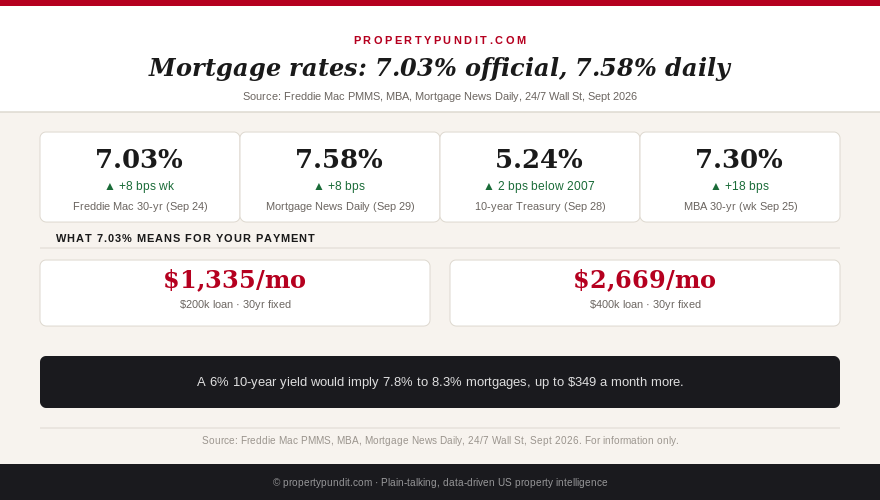
Where rates stand today: five readings, one direction
Here's every major reading from the past week, with the date and method, because the differences are the story. The Freddie Mac survey averages lender rates over several days and assumes a 20% down payment and strong credit. The daily trackers capture the market as it moves. When rates are rising fast, the trackers run ahead.
| Source | 30-year rate | Date | What it measures |
|---|---|---|---|
| Freddie Mac PMMS | 7.03% | Sept 24 | Weekly survey average, official benchmark |
| MBA weekly survey | 7.30% | Week ended Sept 25 | Contract rate on applications (+18 bps) |
| The Mortgage Reports | 7.343% | Sept 30 | Daily conventional quote |
| Mortgage News Daily | 7.58% | Sept 29 | Daily index, highest since Nov 1, 2023 |
| Mortgage Research Center (Fortune) | 7.506% | Oct 1 | 30-year refinance average |
The spread from the lowest reading to the highest is 55 basis points. On a $386,190 loan (a 10% down payment on the $429,100 national median, NAR, August 2026), that's $144 a month: $2,577 at 7.03% versus $2,721 at 7.58%. For why the surveys diverge, see our explainer on what the Freddie Mac number assumes. The practical rule: when you price a move, use the highest credible quote as your planning number, not the official average.
Why the 10-year Treasury is the number to watch
Mortgage rates track the 10-year yield much more closely than they track the federal funds rate. The Fed raised its target range 25 basis points to 3.75%-4.00% on September 16, its first hike since 2023, and mortgage rates barely moved that day because bond traders had already priced it in. The 10-year did the work in the weeks before.
Four pressures are pushing the yield up at once, according to 24/7 Wall St's September 29 analysis: expected Fed hikes, an energy shock tied to the war in Iran, ballooning federal deficits, and a historic AI investment build-out that is soaking up capital. Futures markets put the odds of another Fed hike on October 28 at 72.5% (CME FedWatch via Yahoo Finance, late September). None of those four pressures resolves quickly.
The gap between the mortgage rate and the 10-year gives you a rough conversion. Mortgage News Daily's 7.58% sits about 2.34 points above the 5.24% yield. Freddie Mac's lagging 7.03% sits about 1.79 points above it, but that survey hasn't caught up to the late-September move. So the honest spread is somewhere between those two numbers, and for planning I'd lean toward the wider one. What this means for you: stop watching the Fed's calendar for mortgage direction and watch the 10-year yield, which moves daily and tells you where the next survey will land.
Get this in your inbox every Friday.
One email. The number that matters and what it means for you.
The 8% math: what a 6% Treasury would do to a payment
Forecasts for the 10-year diverge widely. J.P. Morgan's Karen Ward expects yields to rise only slightly above 5%, while ING says they could reach 6% (24/7 Wall St, September 29). I'm not predicting 6%. I'm showing what each rate does to the same loan, so you can see what's at stake if the pessimists are right.
If the 10-year hit 6% and the spread stayed where it is, the 30-year mortgage lands between about 7.8% (using Freddie Mac's narrower spread) and about 8.3% (using Mortgage News Daily's wider one). That is an arithmetic scenario, not a forecast.
| Rate scenario | Principal and interest | Change vs 7.03% |
|---|---|---|
| 6.30% (PMMS, a year ago) | $2,390 | -$187 |
| 7.03% (PMMS, Sept 24) | $2,577 | n/a |
| 7.58% (Mortgage News Daily, Sept 29) | $2,721 | +$144 |
| 7.79% (6% Treasury, narrow spread) | $2,777 | +$200 |
| 8.34% (6% Treasury, wide spread) | $2,926 | +$349 |
On that $386,190 loan, the 8.3% scenario adds about $4,180 a year to the payment compared with today's official rate, and about $6,430 a year compared with last year's 6.30% ($536 a month). Taxes, insurance, and any mortgage insurance come on top of these figures. The decision this feeds is simple: if you're buying in the next few months, build your budget at 7.6% to 7.8% and treat anything lower as a bonus.
The demand data says buyers are already blinking
Higher rates are costing sellers and buyers at the same time. The Mortgage Bankers Association's purchase index fell 4.3% in the week ended September 25, to its lowest level since April 2025, and the refinance index dropped 8.7% (MBA via Bloomberg and Investing.com, September 2026). Realtor.com reports that 20.8% of September listings carried a price cut, a record for the month, while active inventory reached 1.161 million homes, up 5.4% from a year ago, and pending sales fell 4.1% (Realtor.com via Fox Business, September 30, 2026). The median list price slipped to $419,250, down 1.4% from last year.
Redfin's four-week data through September 6 shows the squeeze from the buyer's side: the typical monthly payment hit $2,641, its highest in 14 months, while the median sale price rose only 2.2% to $398,637 (Redfin, September 10, 2026). Prices aren't collapsing. They're stuck, because owners with low rates won't sell and buyers with high-rate quotes can't stretch. For you, that means sellers are more willing to deal than the price charts imply, and a rate buydown or closing-cost credit is easier to win than a big price cut.
What this means if you hold a 3.8% mortgage
This is the part most rate coverage skips. Suppose you owe $300,000 at 3.8%. Your principal and interest payment is $1,398. Sell that home and borrow the same $300,000 at today's 7.58% tracker rate, and the payment becomes $2,114, which is $716 a month more, or about $8,600 a year, for the same loan balance. At 8.34% the gap grows to $875 a month.
That gap explains why inventory stays tight even as listings rise: Realtor.com says active inventory is still 9.1% below pre-pandemic levels, the first time the gap has dipped under 10%. It also tells you what your low rate is worth. Giving it up costs you roughly $8,600 a year before you've bought a single square foot of upgrade. Unless you have a reason to move that outweighs about $700 a month, the math says stay put.
One exception matters. A home equity line of credit is variable, and it rises when the Fed raises. If you're carrying a HELOC balance, our September 30 breakdown of the Fed hike's HELOC cost shows about $10 more per month for every $50,000 owed for each quarter-point. If you carry one, it's the only part of your debt that reprices this fall.
What to watch this week, and what to do
Today brings the Freddie Mac reading at noon Eastern, jobless claims, and the ISM manufacturing index, with the September jobs report due Friday (The Mortgage Reports, September 30). A hot jobs number would raise the odds of an October 28 hike and push the 10-year higher. A weak one would pull yields down and give mortgage rates a chance to breathe. Watch the 10-year in particular: a close back below 5.0% would be the first real sign of relief, and a close above the 2007 peak would put an 8% scenario on the table.
The call, if you're a rate watcher sitting on a low rate: don't refinance a sub-4% mortgage, don't sell a home you love for a rate you hate, and if you're buying, shop three lenders on the same day and ask each for the rate and the cost of a buydown. The one move that can pay off immediately is negotiating seller credits while 20.8% of listings carry price cuts. Rates may fall later, and if they do you can refinance. A price you overpaid can't be refinanced.