 Property
In June, an investor pulling up Indianapolis comps saw a market with 21 days to pending, 1.8 months of supply, and a $245,000 SFR that cleared DSCR with a few dollars of positive cash flow left over. Run the same search today and the picture has changed underneath you: Indianapolis homes are now taking 49 days to sell, active listings are up 22.2% year over year, and the median has climbed to $260,000. Indiana didn't crash. It loosened, and the loosening arrived at the same time prices kept rising, a combination that just flipped the state's flagship investor market from thin-positive to outright negative.
A market that loosened fast
Indiana's statewide median sale price reached $280,055 in May 2026, up 3.7% year over year (Redfin). That's a continuation of the state's steady appreciation trend since earlier this year, when the March median stood at $273,400. But the supply side has moved in the opposite direction from where it sat in the spring: Indianapolis active listings hit 2,226 in January 2026, up 22.2% year over year, and days on market in the metro have stretched from roughly 21 days in March to around 49 days by mid-summer, with a broader 2026 daily average of 15,402 homes for sale statewide, 13% above 2025 (Redfin, IBRC, and local MLS data, 2026). Indiana is transitioning from a landlord's market to something closer to balanced, and that shift changes the math for anyone underwriting a deal off last year's assumptions.
So what for you: if your Indiana investment thesis is built on the tight, fast-moving market from earlier this year, that market no longer fully exists, and your offer price should reflect a buyer with more negotiating room than the comps suggest.
Get this in your inbox every Friday.
One email. The number that matters and what it means for you.
Indianapolis at $260k: the math that used to work
Run the current numbers on an Indianapolis SFR at the $260,000 median, 25% down, 6.55%: a $195,000 loan produces principal and interest of $1,239 a month. Add Marion County's roughly 1.0% effective investor property tax ($217 a month, since the homestead exemption doesn't apply to non-owner-occupied property) and insurance near $105, and PITI lands at $1,561. Against a typical 3-bedroom SFR rent of about $1,750 (RentCafe / Zillow Rental Manager, 2026), that's a DSCR of 1.12, which clears most lenders' 1.0 minimum on paper.
Cash flow tells a different story. Apply an 8% management fee and a one-month vacancy allowance, the standard underwriting haircut, and effective monthly income drops to roughly $1,476. Against the $1,561 PITI, that's a net cash flow of about negative $85 a month. This is the same pattern we've now confirmed in Idaho, Utah, and Colorado this year: a property can pass DSCR on paper while still losing money once real operating costs are applied. So what for you: DSCR alone is not a green light on an Indianapolis deal at the current median. Ask for the full trailing 12-month operating statement, not just the listing agent's pro forma rent estimate, before you write an offer.
Fort Wayne at $210k: the market that still works
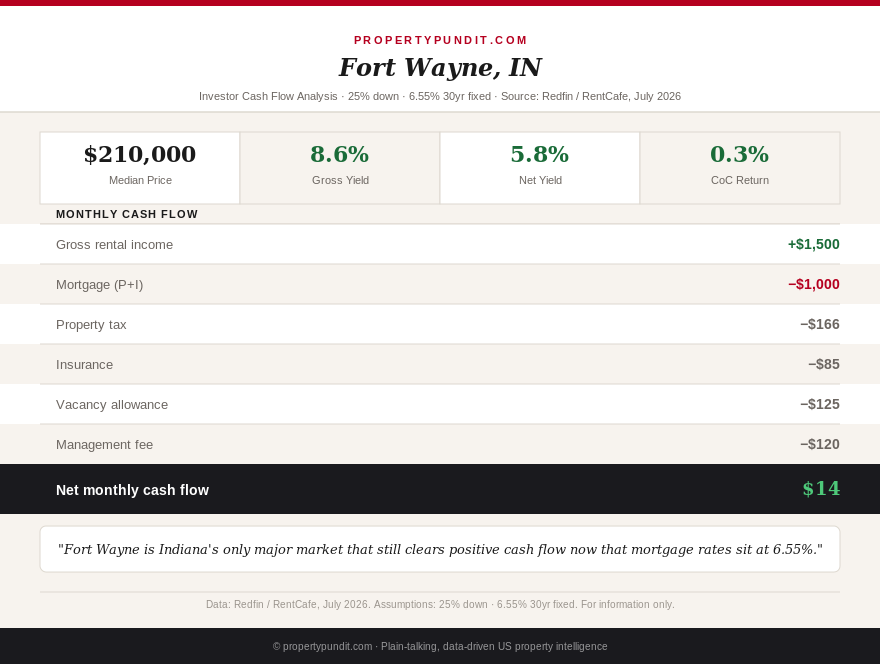
Fort Wayne tells the opposite story. At its current $210,000 median (Redfin, down a modest 0.71% year over year), a 25%-down purchase produces a $157,500 loan with principal and interest of $1,000 a month. Allen County's effective investor property tax runs closer to 0.95%, or $166 a month, and insurance comes in around $85, for a PITI of $1,251. Against a typical 3-bedroom SFR rent near $1,500 (Rent.com / RentCafe, 2026), that's a DSCR of 1.20, comfortably above the lender minimum.
After the same 8% management fee and one-month vacancy allowance, effective monthly income comes to roughly $1,265, against the $1,251 PITI, for a net cash flow of about positive $14 a month. That's thin, not the double-digit cap rates an out-of-state investor might hope for, but it's the only major Indiana metro currently clearing positive territory after real operating costs, not just DSCR. So what for you: if Indiana is on your shortlist this quarter, Fort Wayne's entry price and thinner-but-real margin currently make more sense than chasing Indianapolis at a price point the rent hasn't caught up to.
Fort Wayne's margin holds up in part because its rent base isn't dependent on a single employer. General Motors runs a large commercial truck assembly plant in the metro, Sweetwater Sound and Vera Bradley both anchor sizable local payrolls, and Parkview Health is one of the largest employers in northeast Indiana. That diversification matters for vacancy risk in a way a single-employer factory town doesn't: if any one of these employers cuts headcount, the local rental pool doesn't collapse with it. It's a quieter thesis than a defense base or a tech campus, but it's a durable one, and durability is what a $14-a-month margin needs most.
The tax picture: 2.95% income tax and a cap that actually helps
Indiana's flat 2.95% state income tax (reduced from 3.0% for 2026, per the Indiana Department of Revenue) applies equally to rental income, with an added county tax layered on top that ranges roughly 0.5% to 3.38% depending on where the property sits. There's no separate, higher rate carved out for landlords or capital gains, which keeps the tax math simpler than states like Michigan or Illinois, where investors face a materially different rate than owner-occupants.
The more distinctive protection is Indiana's property tax circuit breaker, a constitutional cap that limits non-owner-occupied residential property tax to 2% of assessed value, regardless of how high local millage rates climb. It's not a low tax rate in absolute terms, both Indianapolis and Fort Wayne investors are paying close to 1.0% effective today, but it's a hard ceiling that states without a circuit breaker, including neighbors like Illinois, simply don't offer. So what for you: the circuit breaker won't rescue a deal that doesn't cash-flow today, but it does put a knowable limit on how much worse your tax line can get if local rates rise, which is a real advantage when you're underwriting a hold period of five years or longer.
What this means for you this week
The math points toward treating Indiana as two different states right now, not one. Indianapolis at its current median has become an appreciation-and-tax-efficiency play rather than a cash-flow play, and if you're underwriting it as the latter, the numbers won't support the deal. Fort Wayne, and likely comparable entry-level submarkets within Indianapolis itself, like Lawrence and Warren Townships in the $185,000 to $210,000 range, remain the more defensible buy-and-hold plays at today's 6.55% rate (Freddie Mac PMMS, July 16, 2026).
Frankly, if you're comparing Indiana against other Midwest options this quarter, run the same DSCR-then-cash-flow test before assuming a state's reputation still matches its current numbers. Our Indianapolis vs Columbus comparison and the underwriting framework in our DSCR loan guide are useful starting points. Most investors who run a full county-level SFR yield check before committing end up choosing the lower-priced entry submarket over the flagship metro median, and Indiana in July 2026 is exactly that kind of market.
One more practical note before you underwrite anything here: our property management fee breakdown shows that the 8% figure used above is usually an understatement once leasing fees are amortized in, closer to 13% to 15% all-in. Run that fuller number against Fort Wayne's $14-a-month margin specifically, and self-management, or at minimum a hard negotiation on the management contract, stops being optional. At this thin a margin, the difference between an 8% and a 13% management fee is the difference between a property that cash-flows and one that doesn't.