 Property
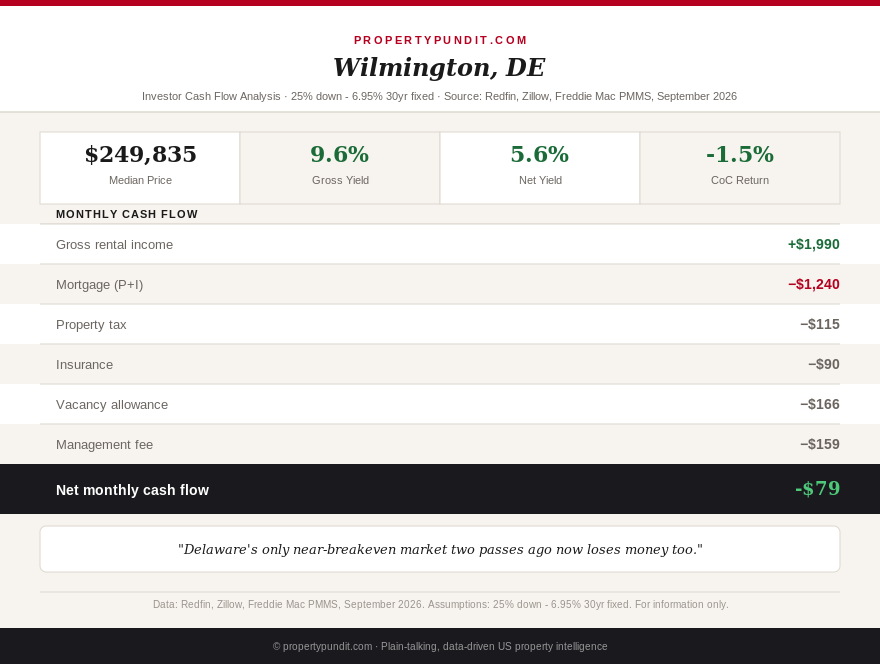
If Wilmington was the one Delaware market you'd already decided to underwrite, the one clean answer in an otherwise disappointing state, it's worth re-running the numbers before you go further. Negative $79 a month is what that same deal produces today once a current mortgage rate and a genuine maintenance reserve get applied. Back in July, this same city penciled out to positive $396 a month. Run the identical property through today's numbers and the state's best deal has quietly flipped into a loss, even though it's still, by a wide margin, the closest thing to a working investment Delaware has to offer.
What changed between passes
Two things moved since the July 15, 2026 second pass, and only one of them is about Delaware itself. The 30-year investor rate used in that pass was 6.49%; Freddie Mac's official PMMS now puts it at 6.95% for the week of September 17, 2026, a 46-basis-point jump that alone adds real cost to every loan in this analysis. The second change is a site-wide correction, not a Delaware-specific one: this pass adds a standard 1.5%-of-price annual maintenance reserve, a line item the July pass did not include at all, following the same correction this site has now applied across a dozen other states. On top of both of those, Wilmington's own price moved the most of any market modeled here: Redfin's August 2026 read put the city's median sale price at $249,835, up 13.6% year over year from a $215,000 read back in February, a swing large enough that it's worth treating with some caution given Wilmington's relatively thin transaction volume, rather than assuming it reflects a smooth, steady climb.
So what for you: if you're underwriting Wilmington off an older price or an older rate, you're not just off by a little; three separate inputs moved against the deal at once, and all three needed updating together to get an honest number.
Get this in your inbox every Friday.
One email. The number that matters and what it means for you.
Dover and the statewide median both got worse, too
Wilmington was the closest call, but it was not the only market to move. Dover's median sale price climbed to $312,593 as of July 2026 (Redfin), up 7.8% year over year from $289,827 in the prior pass, while its 3-bedroom rent moved up more modestly to $1,998 a month (Rentometer, September 2026). At 25% down and 6.95%, Dover's PITIA runs $2,175.92 a month against that rent, a DSCR of 0.92, a fail, and a real monthly loss of about $491 once management, vacancy, and the maintenance reserve are subtracted, worse than the roughly $40-a-month gap the July pass found. The statewide median, still inflated by Sussex County's beach-town prices, moved to $401,488 (Redfin, August 2026, up 3.2% year over year) and produces the weakest result of the three: a DSCR of just 0.70 and a monthly loss of roughly $1,145.
So what for you: Dover was never a clear pass, and it's not close to one now. Treat any Delaware pitch built around the statewide median as an appreciation story only, never a cash-flow one.
Delaware's tax rate is genuinely low, and it's not a no-income-tax state
Give Delaware credit where it's due: the state's effective property tax rate runs around 0.55%, among the lowest in the country (Tax Foundation, SmartAsset, 2026), and its three counties completed a court-ordered reassessment in 2024 and 2025 that moved assessed values off decades-stale numbers without producing the kind of runaway tax-bill increase you might expect from a 433% jump in New Castle County's average assessed value, because the county reset its rate to stay revenue-neutral in the process. The trap is a different one: Delaware charges no sales tax, and that fact gets stretched by marketing copy and quick online searches into "Delaware has no income tax," which is false. The state's graduated income tax tops out at 6.6% on taxable income above $60,000 (Delaware Division of Revenue, 2026), and it applies to rental income the same as any other income.
So what for you: run your actual Delaware income tax bill before comparing this state to a genuine no-income-tax market like Texas or Florida. The property tax pitch is real, but it's not the whole tax picture.
The apartment tax fight that doesn't (yet) touch a single-family rental
Delaware had a genuinely new property-tax story surface this year, and it's worth understanding precisely what it does and doesn't cover. New Castle County's reassessment let several school districts adopt a split tax rate that charges non-residential property, including apartment communities, up to 185% of the residential rate, a cap set by House Bill 462, which became law on August 7, 2026 without Governor Meyer's signature. The Appoquinimink School District saw apartment school-tax bills rise as much as 81%, and the average increase across affected New Castle County districts ran about 55%. Governor Meyer objected pointedly, saying "a home is a home, whether you own it or rent it," and called the classification "fundamentally flawed," pushing instead for a rival bill that would have capped the multiplier at 120% with $15 million in annual relief; that alternative did not pass.
The important scope note: this split rate targets apartment communities and other multifamily rental housing, not the single-family rentals that this analysis, and this site's spotlight series more broadly, actually models. A landlord buying a single-family house in Wilmington or Dover isn't currently subject to this multiplier. So what for you: if your Delaware plan involves a multifamily or apartment-style property in New Castle County specifically, this is a real, newly-enacted cost you need to underwrite. If you're buying a single-family rental like the ones modeled here, it doesn't apply to you yet, but it's worth watching given how directly the governor has criticized the policy.
The one place Delaware genuinely wins: insurance
Set the tax and rate story aside for a moment, because Delaware has a real, under-discussed advantage almost nobody mentions: homeowners insurance is cheap. The statewide average runs about $1,669 a year, or roughly $139 a month, 72% below the national average, and Wilmington and Dover both price in even lower, close to $970 a year (MoneyGeek, September 2026). That is a genuine structural edge over most of the other states in this series, where insurance has repeatedly turned out to be understated or outright missing from earlier passes.
So what for you: Delaware's insurance line is one input in this analysis you can trust without a second-guessing caveat, which isn't something this series gets to say about many states.
What this means for your next move
The math points toward a narrow, specific answer rather than a blanket yes or no on Delaware. Wilmington is still the market to underwrite first if you're set on this state, not because it clears a profit, but because negative $79 a month is a small enough gap that a slightly better rent comp, a rate a quarter point lower, or a smaller down payment could plausibly close it, the same way this site has flagged near-misses in other states. Dover and the statewide median are further out and should be treated as appreciation-only plays, not income plays, at today's rate. Most investors who run these exact numbers end up either passing on Delaware entirely or narrowing their search specifically to Wilmington's lower-priced inventory rather than shopping the state broadly.
For the underlying mechanics of how lenders qualify an investor loan, see our DSCR loan investor guide, and for how Delaware's yield compares to other counties nationally, the single-family rental yield county map is a useful cross-check. If you're weighing Delaware against a nearby Mid-Atlantic state, our New York spotlight found not a single New York market clearing a 1.0 DSCR either, and our most recent Connecticut spotlight found the same maintenance-reserve correction turning a near-breakeven city negative. Delaware's story fits the same pattern: this remains a difficult region for cash flow no matter which state you pick.