 Property
Freddie Mac's official 30-year rate jumped from 6.76% to 6.95% this week, the sharpest one-week move logged all year (Freddie Mac PMMS, September 17, 2026). If you've been sitting on a preapproval letter waiting for a calmer week to make an offer, this wasn't it. But the same week that pushed your rate quote higher also handed you something the headline number doesn't show: sellers are cutting prices and paying closing costs at levels the market hasn't seen in years, and the math on using that edge is better than most buyers realize.
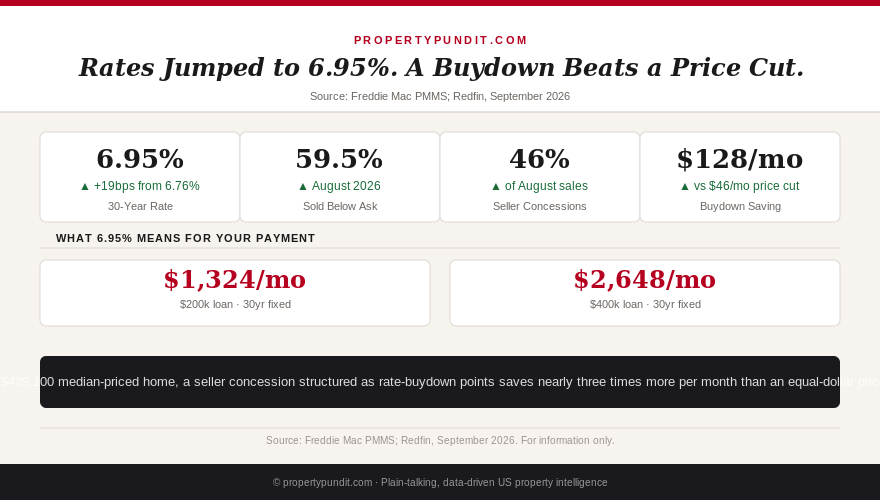
Here is the number that matters more than the headline rate: 59.5% of homes that sold in August went for less than their original asking price, and sellers offered some form of concession, whether a price cut, a closing-cost credit, or points toward a rate buydown, in roughly 46% of sales nationwide (Redfin, September 2026). That isn't a coincidence timed against this week's rate move. It's a market where supply has piled up faster than buyers can absorb it, and it means the seller sitting across the table from you needs this sale more than you need this specific house.
The question isn't whether you have negotiating power right now. The data says you do. The question is what you ask for, and most buyers are asking for the wrong thing.
Get this in your inbox every Friday.
One email. The number that matters and what it means for you.
This week's rate move, and why it happened now
Freddie Mac's weekly survey put the 30-year fixed rate at 6.95% as of September 17, 2026, up 19 basis points from 6.76% the week before, while the 15-year rate rose to 6.26% from 6.09% (Freddie Mac PMMS, September 2026). That move landed the day after the Federal Reserve voted 12-0 to raise its target rate a quarter point to 3.75%-4.00%, its first hike since 2023 (Federal Reserve, September 16, 2026). Mortgage rates don't move on the Fed's vote itself, they track the 10-year Treasury yield, which had already been climbing on inflation data before the meeting even happened, a mechanism we walked through in detail in our coverage of the week the hike actually landed.
What changed this week is the confirmation, not the surprise. Refinance applications fell 65% below year-ago levels for the week ending September 11 as the math stopped working for anyone who locked in the past two years (Mortgage Bankers Association, September 2026), and purchase activity has held up far better by comparison because buyers making a decision this month are pricing in today's rate, not chasing a lower one that hasn't shown up. For you, the takeaway isn't to panic at the headline number. It's to recognize that a rate this high, paired with this much seller flexibility, changes what you should be negotiating for, not whether you should buy at all.
Why sellers are under more pressure than you are
Active housing supply hit 4.9 months in August, up from 4.6 in July and the highest reading in more than a decade, with active listings climbing to 1.62 million homes, up 5.9% from a year earlier (NAR and Redfin data, August 2026). The median home sat on the market 50 days before selling in August, and existing home sales fell 2.0% to a seasonally adjusted annual rate of 3.98 million, even as the national median price kept climbing to $429,100, up 1.6% year over year and the 38th straight month of annual price gains (National Association of Realtors, September 2026 release).
That combination, prices still rising on paper while sales volume slides and inventory piles up, tells you exactly what kind of edge is actually available. Sellers aren't panic-cutting list prices across the board; the national median is still positive year over year. Instead, they're trading dollars for certainty through concessions rather than a public price reduction that would reset buyer expectations for every showing that follows. What's on the table right now is concession room, not a market crash, so it's worth using while it's here instead of waiting on a broader price drop the data doesn't currently support.
The math: a buydown beats an equal-dollar price cut
Take the national median price of $429,100 with 10% down, the standard owner-occupant math we use across this site, which puts the loan amount at $386,190. At last week's 6.76% rate, principal and interest run about $2,507 a month. At this week's 6.95%, that climbs to roughly $2,556, a $49 monthly increase from the rate move alone.
Now say the seller offers a concession worth about $7,724, roughly 2% of the loan amount and a realistic ask in a market where concessions already show up in 46% of sales. Structured as two discount points applied to a permanent rate buydown, and using a common lender rule of thumb of about 0.25 percentage points of rate reduction per point, that concession brings your rate down to around 6.45% and your payment to about $2,428 a month, a $128 saving that comfortably covers this week's rate jump more than twice over. Read our full breakdown of what closing costs actually include before you assume a "credit toward closing" and a rate buydown are the same request; they aren't, and the paperwork needs to say which one you mean.
Compare that to asking for the identical $7,724 as a straight price cut instead. Your loan shrinks to about $379,240, and your payment at this week's 6.95% rate comes down to roughly $2,510, a saving of just $46 a month. Same seller dollar, a worse outcome for you, because a price cut only lowers the amount you finance while a buydown lowers the rate applied to the whole loan. If you're also stretching to cover a 10% down payment, it's worth checking our look at the actual math behind the 20%-down myth, since the down payment size you choose changes how much loan amount is left for a buydown to work against, and your own quote will vary by credit profile the way we detailed in our credit score breakdown.
How to actually ask for it
The math points toward requesting the concession as seller-paid discount points rather than a price reduction whenever your rate is already above roughly 6.5%, which is exactly where the market sits today. In practice, that means three things. Ask your loan officer to run the buydown math against the exact dollar concession on the table before you counter, because the point-to-rate conversion varies by lender and loan program. Name the request specifically as points toward a permanent rate buydown in your offer, not a vague "credit toward closing costs," since a generic credit can get absorbed into fees instead of your rate. And keep your initial offer close to list price while asking for the concession in points, because sellers watching their days-on-market climb are typically more willing to accept that than a public price cut that resets the comps for every buyer who tours the house next.
What this means for you
Rates aren't falling this month, and the Fed just proved it by hiking instead of cutting. But a market with 4.9 months of supply and concessions on nearly half of all sales won't stay this buyer-friendly forever; competition returns the moment rates ease even slightly, and the room to negotiate you have today is the room you should use today. Most people who run this exact math end up structuring their ask as points toward a buydown rather than a lower price, because the same seller dollar does close to three times more for a monthly payment that way. If you're actively shopping, get your loan officer to price both scenarios this week, not after you're already under contract, since the concession conversation is easiest before you've signed anything.